It was written on the table at the front of the church I grew up in and chances are it was the same for you. I always thought the wording was strange — Why “this do” rather than “do this”? — but it is a part of my tradition.
But one thing we often forget is that communion or the Lord’s Supper is a complete construction. Originally a part of the Jewish tradition of the Passover meal, the bread and cup had specific roles to play in the meal. The Lord’s Supper that many evangelicals today practice is a far cry from that: It’s not a meal, the bread is as small a piece as you can get — sometimes it’s a wafer, the cup is also as small as you can get. There is no hope of eating too much or getting drunk — practices we are warned against in 1 Corinthians 11:20-22 but are in no danger of doing today. We commonly practice it once a month but the original passover was a once-a-year occurrence. So when Jesus commands us to do “this” until his return what is the “this” that he is referring to?
It got me thinking of how we shape memories and recollections in our lives. The Lord’s Supper was derived from the Jewish Passover. I wonder what other corporate memories other cultures have that are equivalent to Passover?
I guess what I am really asking is this: Is it possible that other cultures have ways of remembering Christ’s death until he comes in as powerful a way as communion? If so, what elements would be needed?
There would need to be some sense of inclusion in the collective memory of the people group in question. The passover was one of the big events in the history of the children of Israel. It was when God physically saved his people from slavery and oppression by preserving (or passing over) their houses and eliminating those of their oppressors. This lead to their Exodus from the land of Egypt back to the Promised Land. To be of Israel meant that one had experienced the Passover.
There would also need to be some symbol of salvation. This is closely connected with my previous point in that the experience of the Passover was an experience of salvation. Jesus use of the symbols of the Passover connects the Exodus event near the beginning of the Bible withthe salvation Jesus would enact later on.
It would also need to be include some hope for the future — “until he returns.” The Passover was more than just a historical event. It also pointed ahead to the Passover that would occur in the end when God returned to judge the living and the dead. What God had done in the past would be repeated for his people in the future. Once again, Jesus’ use of these symbols connects his salvation into the future salvation of the world.
It would also have to be as powerful symbolically as “bread” and “cup.” Both of these are powerful words in the Bible. Of course, they often simply refer to food or a drinking vessel. But they also have symbolic meanings. Bread is used so symbolise the abundant life in God’s Kingdom (Luke 14:15; John 6:31). Cup tends to refer to wrath and suffering in the Bible. Drinking of the cup means to accept the suffering associated with Jesus (Mark 10:38-39).
But some cultures value other things higher than bread or the cup. The various Philippine languages, for example, have hundreds of words normally translated as “rice” in English [palay, bigas, kanin, kakanin, tutong, etc.]. The opposite is true for the Tagalog word tinapay — there are probably hundreds of English equivalents [bread, cookies, cake, crackers, pizza, etc.].
Apart from foods, smells and sounds make me remember. They can be so powerful that when I smell or hear them I have no choice but to remember. When I was in university I only had to smell diesel smoke to be transported back to where I finished High School. When I broke up with my girlfriend (now my wife) for a couple of weeks the sound of the telephone was the most horrible thing I could hear. Too many memories that (I thought) I would never have again.
What kinds of things elicit memories for you? How can you utilise them to help you remember Jesus death until he returns?
A number of years ago, I wrote a couple of posts (here & here) in response to a discussion we had at our SEATS School of Missions regarding the quote from Rupertus Meldenius, “in essential matters, unity; in non-essential matters, liberty; in all other matters, charity.” The post went on to basically dissect the various meanings of “non-essential” after merely brushing along the surface of “essential.” I stated, “Other than certain foundational theological truths that we can’t mess with, we are surrounded by a vast amount of stuff that can be classified as personal preferences.”
Of course, the kind of stuff that was in my mind for this section was stuff like who Jesus is, who God is, the importance of the Bible, etc. Stuff that is really non-negotiable; stuff that Christians must agree on.
But what if those very theological foundations of my faith were not so much foundations as they were constructs of my culture and mind?
Enter Andrew Walls. I had the privilege of attending a couple of seminars by this great church historian from Scotland. To be honest, I had never heard of him until two days before the event, when I received an invitation to attend two days of lectures on Christianity and culture hosted by the Institute for Studies in Asian Church and Culture and Asian Theological Seminary. What I heard and experienced during those two days shook some of my fundamental theological understandings to the core!
According to Walls, the early Jerusalem Christians[1] were in fact Jews through and through. They worshipped in the temple, they offered sacrifices, and they followed Moses’ law to the letter. They even didn’t engage in missions to Gentiles! It wasn’t until persecution scattered those early followers of the Way that the message jumped from being something Jewish to being something also understood and accepted by Gentiles. It is here where my mind was blown. In Acts 15 we read the account of the first Council of Jerusalem, which was convened to discuss this new situation that had arisen – how do Gentiles fit into the whole scheme of things? The answer is surprising. The Jewish church leaders in Jerusalem basically said to the Gentiles, “You don’t have to follow Jewish customs.”
What struck me was that the Jerusalem followers of the Way still followed these Jewish customs. Their whole faith was built around Jesus fulfilling a specific set of prophecies, completing a complex legal systems, and being a part of the chosen people. The council in Jerusalem didn’t throw that out, they merely said that there are other valid ways of expressing the centrality of Christ. It was the first “Essentials vs Non-Essentials” debate and what is surprising is that the entire Jewish system is declared to be a non-essential! Note that this isn’t just a discussion of what kind of music to use in worship or what language to use when preaching – this is a complete overturning of the basic fundamental theological and social system of God’s people.
The Jews who followed the Way discovered that their Way was not the only way and that the Others’ Ways were sometimes polar opposites to what they knew and believed to be true in their hearts!
Of course the exciting thing is that God allows such diversity among his followers without being threatened.[2] How can we do the same thing without being threatened ourselves?
The key for Walls is the role of the Holy Spirit in the process. We often focus on the power aspect of the Holy Spirit. Could it be that the “counsellor” role of the Holy Spirit is counselling us on how to do church in relevant and understandable ways?
[1] In fact, according to Acts, followers of Jesus were not called Christians until a group formed and became known in Antioch. “The Way” was the term used to describe those who followed Jesus.
[2] A discussion of Walls assertion that the church has never ever been unified – and that’s ok – will have to wait for another time 🙂
Nalungkot ako noong nakarinig ako ng balita na meron mga pastor sa Pilipinas na nagtuturo sa mga simbahan nila na huwag magpabakuna. Ang ibang sinasabi ay medyo kakaiba, tulad ng ang bakuna ay mark of the beast o 666, demonic, o pagiging Zombie. Meron ding sinasabi na may kinalaman sa teolohiya, tulad ng “mas makapangyarihan ang Diyos kaysa sa bakuna,” at pinoprotektahan ng mga Kristianyo ng “dugo ni kristo.” Meron din akong nakarinig ng ganito mula sa mga pastor sa Canada. Hindi ko alam kung anu-ano ang mga dahilan nito pero mukhang kinakailangang magbuo ng teolohiya ng pagpapagaling sa pamamagitan ng gamot. Buti na lang na naunahan ako ng isang FB friend ko si Matt Stone. Pwede mong basahin ang kanyang blog post sa wikang Inglis dito. Karamihan sa mga sumusunod na puntos ay nagmula sa gawain ni Matt.
Siyempre, maraming halimbawa sa Bibliya ng pagpapagaling sa pamamagitan ng mga himala. Isa ito sa mga malaking gawain ni Jesus at ang kanyang mga alagad sa Bagong Tipan.
So paano ba ang theology of medical healing o teolohiya ng pagpapagaling sa pamamagitan ng gamot? Tama ba na hindi natin kailangang magpagamot dahil mas malakas ang ating Diyos o ang dugo ni Kristo? Siyempre maraming sinasabi ang Biblia patungkol sa supernatural healing pero meron ba’ng sinasabi ang Bibliya patungkol sa pagpapagaling sa pamamagitan ng gamot?
Meron.
Unang-una kailangan tingnan ang Santiago 5:14 “Mayroon bang may sakit sa inyo? Dapat niyang ipatawag ang mga namumuno sa iglesya para ipanalangin siya at pahiran ng langis sa pangalan ng Panginoon.” Nakikita natin sa mga talata nito na meron dalawang dapat gawin kapag may sakit tayo. Una, “ipatawag ang mga namumuno sa iglesya para ipanalangin siya” at ikalawa, magpagamot. Kasi ang ibig sabihin ng “pahiran ng langis” sa konteksto ng Bibliya ay magpagamot. Tingnan natin ang kuwento patungkol sa good Samaritan. Ano ba’ng ginawa nya sa taong binugbog ng mga magnanakaw? Naglagay sya ng langis sa kanyang mga sugat. Ibig sabihin, ok din magpagamot.
Pero hindi lang yun ang patungkol sa pagpapagaling sa pamamagitan ng gamot sa Bibliya. Maraming ibang mga talata at kuwento patungkol dito. Unang-una, lahat ng nilikha ng Diyos ay mabuti, kaya sa Bibliya may mga iba’t ibang halimbawa ng gamot, may mga doktor, at may mga sumpa kaugnay sa walang gamot.
Lahat ng nilikha ng Diyos ay mabuti. Alam naman natin ito dahil sa sinabi niya mismo sa Genesis 1:31. Kasama doon ang lahat ng mga potensyal na mga hinaharap na mga paggamit. Nilikha ng Diyos mula sa wala pero lahat ng likha natin ay mula sa mabuting nilikha ng Diyos. Ibig sabihin, kahit anong pinagmulan ng ating gamot — hayop, dahon, prutas, o bato — lahat ito ay mabuti. Ang tawag dito ay Doktrina ng Pangangalaga ng Diyos. Nakikita din natin ito sa 1 Timothy 4:4, “Lahat ng nilikha ng Dios ay mabuti, at dapat walang ituring na masama kung tinatanggap nang may pasasalamat.”
Mga sari-saring gamot sa Bibliya. May mga iba’t ibang uri ng gamot sa Bibliya, kasama ang alak, ang pulot-pukyutan, laway, at dinurog na igos.
Alak bilang gamot sa 1 Timoteo 5:23 kung saan sinabi ni Pablo kay Timoteo na “Dahil sa madalas na pananakit ng sikmura mo, uminom ka ng kaunting alak.”
Pulot-pukyutan bilang gamot sa Kawikaan 16:24 “Ang matatamis na salita ay parang pulot-pukyutan, nakakapagpasaya at nakakapagpasigla ng katawan.”
Laway ni Jesus bulang gamot sa Markos 8:22-26 kung saan “dinuraan [ni Jesus] ang mga mata ng bulag.”
Dinurog na igos bilang gamot sa 2 Hari 20:7 “Sinabi ni Isaias sa mga utusan ni Haring Hezekia na tapalan nila ang namamagang bukol nito ng dinurog na igos. Ginawa nga nila ito at gumaling siya.”
Mga Manggagamot sa Bibliya. May mga doctor din ang binanggit sa Bibliya. Unang-una si Lukas, ang may-akda ng Lukas at Gawa, ay pinaliwanag ni San Pablo bilang “Lucas, ang minamahal nating doktor” sa Col 4:14. Sinabi din mismo ni Jesus sa Markos 2:17 “Ang mga taong walang sakit ay hindi nangangailangan ng doktor, kundi ang mga may sakit.”
Mga sumpa kaugnay sa walang gamot. Moreover, there are many bible passages where lack of access to effective medicine is spoken of as a curse. Nakikita natin ito sa dalawang talata nito:
Jeremias 8:22 “Wala na bang gamot sa Gilead? Wala na bang manggagamot doon? Bakit hindi gumagaling ang sugat ng mga kababayan ko?”
Jeremias 46:11 “O mga taga-Egipto, kahit na pumunta pa kayo sa Gilead para maghanap ng panlunas na gamot, ang lahat ng gamot ay wala nang bisa at hindi na makapagpapagaling sa inyo.”
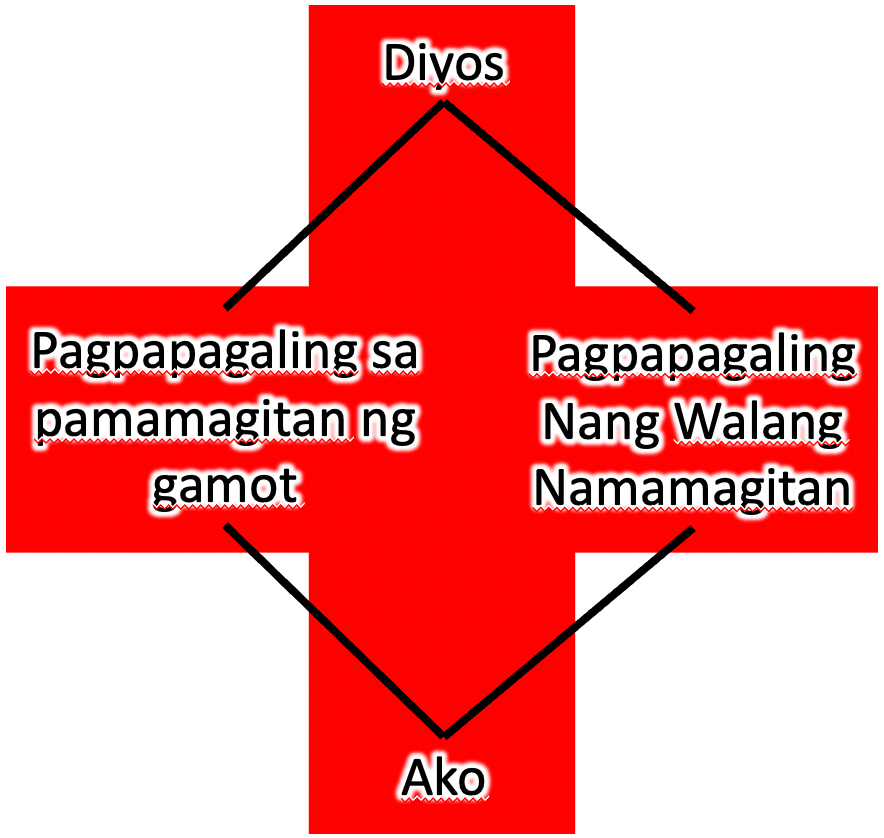
Ayon kay Stone, may dalawang maari paraan na ginagamit ang Diyos para sa ating kalusugan. Paminsan-minsan, nagpapagaling ng Panginoon ang mga tao sa pamamagitan ng gamot. Paminsan-minsan hindi siya gumamamit ng namamagitan — diretso galing sa kanya ang pagpapagaling (tingnan ang larawan sa ibaba). Dapat nating tanggapin ang tulong sa anumang paraan na pinili ng Diyos.
Ang isang magandang halimbawa dito ay ang kuwento ng pagpapagaling ni Naaman sa 2 Kings 5:1-14. Kung naalala nyo, si Naaman ay Heneral ng mga Kalaban ng Israel noong panahon ni Elisha. May malubhang sakit sa balat si Naaman. Meron siyang aliping dalaga mula sa Israel na nag payo sa kanyang amo na meron propeta sa Israel (si Elisha nga) na pwedeng magpagaling sa kanya. Para gawing maiksa ang kuwento, pumunta si Naaman kay Elisha at ang utos ni Elisha ay kinakailangan maligo si Naaman sa Ilog Jordan ng pitong beses para gumaling. Nakita natin na kahit may propeta ang Panginoon sa Israel, ginamit nya ang paligo sa ilog bilang proceso ng pagpapagaling sa sakit.
MGA IDINAGDAG 10 SET 2021:
Baka meron nagbabasa nito na nagsasabi ng ganito, “Dahil lahat ng gamot na binaggit sa Bibliya ay galing sa kalikasan, natural medicines lang ang dapat natin gamitin bilang Kristiyano. Iwasan natin ang pwedeng bilhin sa botika.” Alalahanin natin na ang mga gamot na nakalista sa itaas ay ang mga gamot na meron sila noong panahon nila. Hindi naman nila pinili na puro natural cures lamang — sa totoo lang wala naman silang mga pinagpilian. Ginamit nila kung anong meron sila. Wala naman sila botika noong panahon nila kaya wala silang option na gamitin yun.
Mahal ko ang gubat. Noong bata pa ako wala akong ibang pangarap kundi mamuhay sa gubat bilang isang ermitanyo! Nais kong magtayo ng sariling kong log cabin at “live off the land.” Nabasa ko ang lahat ng uri ng mga libro tungkol sa pamumuhay sa gubat. Nagtayo ako ng mga tent sa loob ng bakuran namin doon ako natutulog. Ginugol ko ang aking mga bakasyon noong High School sa pagsasagwan ng mga ilog sa Nilagang Saskatchewan, kapwa bilang bahagi ng Nemeiben Lake Canoe at Bible Camp at kasama ang aking pamilya. Sinagwan ko ang mga Ilog Churchill, Paull, Geikie (salungat sa agos), South Saskatchewan(nang mag-isa lang ako), at Foster. Pinatakbo ko (at lumangoy) ang mga lagaslasan at nagsagwan ng mga lawa. Sinaliksik ko ang mga programang pang-edukasyon na makasisiguro na nakatira ako sa gubat habang buhay ako. Nakakatuwa naman.
Ang aming kamakailang oras sa Canada ay muling binuhay ang aking pagmamahal sa gubat. Itong nakarran na taon nagkaroon ako ng pagkakataong gumawa ng pagsagwan at nagbalik na rin sa Ilog Churchill. Ngunit marahil ang pinakamalaking epekto sa aking mga pangarap ay ang palabas sa TV na Alone. Ang saligan na palabas ay iiwan ang 10 mga tao na nag-iisa sa gubat. Pinapayagan ang mga ito ng 10 mga bagay upang matulungan silang makaligtas. Ang taong tumatagal ng pinakamahabang panahon ay mananalo ng kalahating milyon dollar. Nagkaroon ng maraming mga dalubhasa sa paligsahan sa loob ng 8 seasons ng palabas at napagtanto sa akin ang isang bagay: Ginugol ko ang aking kabataan sa paggawa ng mga maling bagay (I had a misspent youth).
Una kong narinig ang katagang iyon ay sa aming paglalakbay sa Faith Academy Senior High School trip. Naglalaro kami ng Fuzbol, isang medyo nakakagulo na laro na tila nagsasangkot ng maraming pag-ikot ng mga tungkod na may mga kalalakihang plastik na nakakabit sa kanila. Anumang mga shot na nashoot namin ay tsamba lamang. Lahat maliban sa isang manlalaro. Si Sir Dan Larson ang aming guro sa photography at may kakayahan siyang kontrolin ang bola. Matapos ang isang kamangha-manghang shot kung saan maliksi niyang inilipat ang bola gamit ang isa sa kanyang mga tagapagtanggol at pagkatapos ay hinampas ito sa goal, sinabi ng aming advisor sa klase na si Sir Derek Foster, “Ah. Ginugol mo ang iyong kabataan sa paggawa ng mga maling bagay! (A misspent youth).”
Iyon ang nagpapatibay sa kahulugan ng term para sa akin: “Isang kasanayan na may kaduda-dudang halaga na nakamit ng isa dahil sa paggastos ng labis na oras dito kung kailan dapat silang gumugol ng oras sa ibang gawain.” Napagtanto ko habang pinapanood ang mga dalubhasa sa Alone na hindi ako gumugol ng oras upang paunlarin ang mga kasanayan na gagawing matagumpay sa akin sa palabas. Alam ko ang ilang mga bagay at may tamang pangarap ngunit ang aking mga kasanayan sa basic survival ay hindi pa binuo.
May napagtanto din akong iba. Kasalukuyan akong nabubuhay sa buhay ng aking mga pangarap. Mayroon akong isang kamangha-manghang soulmate at pamilya na ibinabahagi ko sa aking buhay. Ginagawa ko ang gusto kong gawin – nagtuturo ng teolohiya ng simbahan at kultura sa mga tao sa buong mundo. Nagtatrabaho ako sa isang mahusay na samahan. Nakatira ako sa isang mahusay na lungsod. Mayroon akong mahusay na mga kasamahan sa gawain. Wala talaga akong mga reklamo na sulit banggitin. So ano ba’ng nangyari?
Sa tingin ko may dalawang pangarap ako noong bata ako – dalawang pangarap na hindi magkatugma. Ang isa ay mabuhay mag-isa sa gubat at ang isa ay magiging isang misyonero. Marahil ang isa sa mga pangunahing kadahilanan kung bakit nais kong mabuhay mag-isa sa gubat ay ang aking pagkamahiyain. Ako ay takot-na-takot makipag-usap sa mga tao. Naaalala ko ang isang pag-uusap ko sa isang dalaga sa aming grupo ng kabataan – Ginugol ko ang oras sa pagtingin sa sahig na nagbibigay ng isang salitang mga sagot. Sinadya kong guluhin ang taunang mga talumpati na kailangan naming ibigay sa elementarya para lang hindi ko maipakita sa buong paaralan. Kakaiba na ito ngayon ang ginugugol ko sa aking oras sa paggawa.
Bilang mga kalalakihan madalas tayong masabihan na “sundin ang aming mga pangarap,” ngunit paano kung ang aming mga pangarap ay hindi tugma sa kung sino tayo? Nabanggit ko sa itaas na ginalugad ko ang mga programang pang-edukasyon na magpapahintulot sa akin na manirahan sa bush habang buhay ko. Ang hindi ko nabanggit ay hindi ako nakapasok sa mga programang iyon. Sa halip ay nagtapos ako sa isang degree sa araling relihiyon mula sa University of Saskatchewan, at isang degree sa seminary mula sa Canadian Baptist Seminary. Humanga pa rin sa akin na ang isang mahiyain, tahimik na tao ay pipili ng isang pampublikong papel na ginagampanan sa isang ministeryo at mga misyon para sa isang landas sa karera! So anong nangyari? Sa palagay ko ang pagkakaiba ay maaaring ipaliwanag sa pamamagitan ng isang pagtawag kumpara sa isang panaginip. Ngayon napagtanto kong maaaring nagse-set up ako ng isang maling dichotomy dito ngunit magtiis ka muna sa akin. Hindi ako masyadong malayo sa aking karanasan sa seminary nang inaasahang mangangaral ako ng isang sermon. Sa pagtingin ko sa unang sermon na iyon (mula sa Mga Taga Roma 7 pa!) hindi ko naalala ang anumang pakiramdam ng pagiging mahiyain o takot. Wala akong ibang paliwanag para doon kaysa sa binago ako ng Banal na Espiritu. Hindi na ako naghanap ng mga pagkakataon upang maiwasan ang mga tungkulin sa pagsasalita sa publiko o pamumuno.
Sa palagay ko sa ilang mga paraan naging totoo sa akin ang turo ng Roma 7 dahil sa wakas ay nagawa ko ang hindi ko nais na gawin! Nasasabi ko na masasabi ko kaysa sa maling paggastos ng aking kabataan ay ginugol ko muli ang aking kabataan sa pagbuo ng mga kasanayang kakailanganin ko upang matupad ang bagong pangarap na aking nabubuhay. At wala akong babaguhin para sa mundo!
Sa palagay ko dapat ko ring sabihin na ang aking buhay ay naging medyo tahimik kahit na nakatira ako sa isang exotic na lugar. Hindi ako nakaranas ng anumang trauma. Ang aking mga relasyon ay buo lahat. Ni hindi ko naisip na nakagawa ako ng maraming sakripisyo. Ngunit napagtanto ko na ang iba ay nasa ibang kakaibang sitwasyon kaysa sa akin at maaaring hindi maging masaya sa kung nasaan sila ngayon.
Ano ang iyong mga pangarap mo noong bata ka pa at paano ba ito’y tumugma sa ginagawa mo ngayon? Ok lang ba yun? Mayroon ka ba’ng mga bagong pangarap ngayon?
Paano mo maipapaliwanag ang mga pagkakaiba? Maaari mo bang makita ang katibayan na ang Banal na Espiritu ay naging isang pangunahing bahagi ng mga pagbabagong iyon? Sa anong paraan?
I love the bush. When I was younger I had no other dream than to live my life in the bush — as a hermit! I wanted to build my own log cabin and live off the land. I read all kinds of books about living in the bush. I built tents in the back yard and slept in them. I spent my High School summers canoeing in northern Saskatchewan, both as a part of Nemeiben Lake Canoe and Bible Camp and with my family. I paddled the Churchill, Paull, Geikie (upstream), South Saskatchewan (solo), and Foster Rivers. I ran (and swam) rapids and paddled lakes. I explored educational programs that would ensure that I lived in the bush for the rest of my life. It was fun.
Our recent time in Canada has rekindled my love for the bush. I have had a chance to do some paddling over the past year and even made a return trip to the Churchill River. But perhaps the greatest impact on my dreams of late has been the TV show Alone. Alone’s premise is to leave 10 people alone in the bush for as long as they can last. They are allowed 10 items to help them survive and the person who lasts the longest wins a cash prize. There have been a lot of highly skilled contestants over the 8 seasons the show has been on and it made me realise one thing. I have had a misspent youth.
I first heard that term on our Faith Academy Senior High School trip. We were playing Fuzbol, a rather perplexing game that seemed to involve a lot of spinning of rods with plastic men attached to them. Any goals scored by us seemed to be merely by chance. All except one player. Dan Larson was our photography teacher and he had the ability to actually control the ball. After one amazing shot where he deftly moved the ball with one of his defenders and then slammed it into the goal, our class advisor, Derek Foster, said, “Ah. A misspent youth!”
That cemented the definition of the term for me as “a skill of dubious value that one has gained because of spending too much time on it when they should have been spending time elsewhere.” I realised while watching the experts on Alone that I hadn’t taken the time to develop the skills that would make me successful on the show. I knew a few things and had the right dreams but my survival skills have not been developed.
I also realised another thing. I am currently living the life of my dreams. I have a wonderful soulmate and family that I share my life with. I am doing what I love doing — teaching theology of church and culture to people all over the world. I work for a great organisation. I live in a great city. I have great colleagues. I really have no complaints worth mentioning. So what happened?
I guess I really had two dreams when I was a kid — two rather incompatible dreams. One was to live alone in the bush while the other was to be a missionary. Perhaps one of the major reasons why I wanted to live alone in the bush was my shyness. I was petrified to talk to people. I remember one conversation I had with a young lady in our youth group — I spent the time looking at the floor giving one-word answers. I purposely messed up the yearly speeches we had to give in elementary school just so I wouldn’t have to present to the entire school. It’s odd that this is now what I spend my time doing.
As men we are often told to follow our dreams, but what if our dreams are incompatible with who we are? I mentioned above that I explored educational programs that would allow me to live in the bush for the rest of my life. What I didn’t mention is that I never entered those programs. Instead I ended up with a religious studies degree from University of Saskatchewan, and a seminary degree from Canadian Baptist Seminary. It still amazes me that a shy, quiet guy would choose such a public role a ministry & missions for a career path! So what happened? I guess the difference might be explained by a calling vs a dream. Now I realise I may be setting up a false dichotomy here but bear with me a little. I wasn’t very far into my seminary experience when I was expected to preach a sermon. As I look back on that first sermon (on Romans 7 of all things) I don’t recall any feelings of shyness or fear. I don’t have any other explanation for that than that the Holy Spirit changed me. I no longer looked for opportunities to avoid public speaking or leadership roles.
I guess in some ways Romans 7 became real to me in that I ended up doing what I didn’t want to do! I guess I could say that rather than mis-spending my youth I re-spent my youth developing the skills that I would need to fulfill the new dream I was living. And I wouldn’t change anything for the world!
I guess I should also say that my life has been pretty vanilla even though I live in an exotic place. I haven’t experienced any new trauma. My relationships are all intact. I don’t even think I have made a lot of sacrifices. But I do realise that others are in a much different situation than I am and may not be as happy with where they are right now.
What were your dreams growing up and how do they match what you are doing now? Is that ok? Do you have new dreams?
How can you explain the differences? Can you see evidence that the Holy Spirit has been a key part of those changes? In what ways?
“Not all appropriation is bad” may seem like an odd statement since in Part 1 of this topic I talked about all the reasons why appropriation is bad. In this part I intend to talk about one aspect of human culture that needs to be appropriated and if it isn’t appropriated then problems happen. I am talking of course about the good news of Jesus Christ.
Get this. The gospel is supposed to be appropriated. No one culture can claim ownership over it. No one group can say that they are the final authority on how the gospel should be understood and applied — such decisions need to happen in dialogue with everyone else. This is something very hard to do, granted, but also something that should be done. We know this because Jesus’ final command to his disciples — often called the Great Commission — is to spread this good news around the world.
Andrew Walls spent his life developing a framework of Transmission and Appropriation when it comes to the good news of Jesus Christ. What’s significant about Walls approach is that he sees not only the transmission side of things but also delves into the appropriation side as well. Appropriate is as intentional as transmission — eventually whatever is being transmitted is to subsequently be appropriated by the recipient.
Walls talks about two types of recipients of the good news: Proselytes and converts. Proselytes adopt some one else’s encounter with God as their own while Converts adapt their own culture to reflect a new encounter with God. It may seem as if this is a two-stage process starting from proselyte and moving towards conversion but that is an over simplification of how things work. In fact in every culture we see examples of both co-existing. For example the practice of baptism, while debated as to its mode, is a nearly universally accepted practice among Christians, in spite of the fact that it originated in the Jewish religion.
The fact that the gospel is to be transmitted also implies that it will also be appropriated. Thus, Appropriation and Transmission must occur together. What’s also interesting is that ultimately the process also happens in reverse to create a richer transmission culture: The appropriator becomes the transmitter and the transmitter becomes the appropriator — or at least it should 🙂 Cultural hybridity is not a bad thing. In reality there are very few cultures that exist that have no interaction with other cultures.
We have seen the dangers of what Bakhtin calls monologues — where only one person is allowed to speak. The results are staggering.
Church participation in Cultural Genocide. I have already written a lot about this topic particularly as it relates to the Canadian Indian Residential Schools System but suffice it to say the church’s failure to listen to the voices of the Other in their missions efforts has been nearly universal. The “Other” is “someone or something who is perceived, either consciously or not, as alien or different.” In this example, while missionaries may recruit some of those they are on mission to into their own ranks, their otherness is often maintained as seen by the second example.
Marginalisation of Other clergy. My great-great-great-great grandfather, Rev. James N. Settee, was the second person of First Nations ancestry to be ordained as a priest in the Church Missionary Society (Anglican Church of Canada). He devoted his entire life to spreading the gospel among first nations peoples in Manitoba and Saskatchewan but was also forced to spend much of his time combatting the inconsistencies and discriminations that he himself experienced on a daily basis to the point that it hindered his ability to do actual ministry. What’s interesting is that he clearly appropriated the gospel into his life’s work but found baggage that needed to be peeled away in order for it to work in his context.
Other examples. This can also been seen in the many Church splits and schisms that have marked church history as people took stands on where they thought the gospel should end — I suspect all done without acknowledging different contexts.
Rather than monologue, dialogues need to take place and it’s only through the use of dialogue that the appropriation of the good news of Jesus Christ can take place. We talked about Enriquez’ approach to what he calls indigenization from within, which is in effect a system of appropriation governed by insiders rather than outsiders and perhaps this is the best way for appropriation to take place — under the control of the Other!
Salin a Tagalog root word that means “translate” and also “pour” and talks about the process involved in making something one’s own in a different language or culture. Just as liquid is decanted from a pitcher into a glass, and thereby made useful, so also concepts can be decanted from one culture to another and more more understandable. But translation is more than simply making something more understandable — translation means that ownership is taken of the new word or phrase and making it one’s own. So how does someone make something one’s own? Here are a couple of examples from the Philippine context.
Sometimes this combination is more complex than merely combining indigenous and exogenous theories. Regardless of theoretical origins, other factors come into play that exert influence on human decisions, including sociopolitical purposes, religious institutional ends, and religious practitioners’ ends. The various actors, whether those in authority or those under oppression, are each able to exert their own will and influence outcomes. Wendt and Guazon each talk about the interaction of these three factors in the Philippines. Both describe situations where the original intent of the transmitters was re-purposed by the appropriators according to their own needs.
Wendt (1998) talks about fiesta, looking at both historical origins as a means of Spanish control that eventually was co-opted by Filipinos and reformulated into a real part of Filipino identity. Wendt says, “The functions originally intended to implement colonial rule, cultivate specific attitudes and stabilize the colonial system were counteracted to the same degree by the Filipinos’ incorporating the fiesta into their own ways of life and social structures.”
Guazon’s Crisis in the Formation of provisional members of a religious congregation in the Philippines is a study of the interactions between “formandi” and “formators” in the CICM, which is “Congregatio Immaculati Cordis Mariae, the institute’s Latin name. CICM is a Roman Catholic male religious missionary institute of Belgian origin.” The formandi are acolytes desiring admission to the order and the formators are those charged with overseeing the initiation process. One would assume that the process is quite straight forward since the acolytes are the ones seeking admission and will presumably submit. This is not the case, however, with tension occurring on multiple levels. In the end, Guazon concludes that the formandi … are “active participants” in the process and appropriate the requirements of their new social system “according to their own cultural matrix.”
Cultural Appropriation has made the news again. Nuseir Yassin runs the popular video log Nas Daily. He recently made the news (here, here, and here) when he offered a tattoo course by Whang-Od on his Nas Academy. Whang-Od is a traditional tattoo artist from the Philippine province of Kalinga who was honoured by the Philippine government with the Dangal na Haraya in 2018. The controversy started when Whang-Od’s grandniece called the course a scam. It turns out that Nuseir didn’t follow the proper procedures in making the deal with Whang-Od. According to Dr. Nestor Castro,
“Whang-od is not just an individual artist but she is also a member of the Butbut Tribe of Kalinga. Her skill on the art of traditional tattooing is derived from the indigenous knowledge of generations of Kalinga ancestors. Thus, this indigenous knowledge is collectively owned (although it may be individually practiced) by the Butbut. Thus, the consent of the members of the Butbut is necessary if this knowledge is to be shared to outsiders. Getting the permission of one individual is not enough.” [Click here to read the entire post].
Apart from this, the agreement also doesn’t conform to Philippine laws on the rights of indigenous peoples. In the end, Cultural appropriation of this type is inappropriate because it is the unacknowledged or inappropriate adoption of the customs, practices, ideas, etc. of one people or society by members of another and typically more dominant people or society. The issue is culture or people’s right to be the gatekeepers of their own cultural wealth, whether that means protecting that wealth from other’s exploitations, or benefitting themselves as the owners of that cultural wealth.
Virgilio G. Enriquez, whose Pagbabangong-Dangal: Indigenous Psychology and Cultural Empowerment is from the Philippine context, presents six phases of cultural domination to which “indigenous psychology and culture have been subjected” throughout the world. Included in the stages are:
1. Denial and Withdrawal, where the “colonizers outrightly reject the very existence of what they perceive as an inferior culture.” This inferiority includes language, sport, food, law, and religion. “As the dominant culture denies the existence and worth of the indigenous culture, it also attempts to replace it with its own.”
2. Desecration and Destruction, where the “oppressive culture attempts to destroy whatever vestiges are left” of the indigenous culture. “Clearly, as the dominant culture atemts to destroy element s of the supposedly inferior culture, it tries to institutionalize and strengthen its own.”
3. Denigration and Marginalization, where the indigenous is labeled, giving the impression that it is inferior or damaged. This includes terms like Juan Tamad, quack doctor, ningas kugon, Filipino time, and talangka mentality as well as inaccurate portrayals of Filipinos in artwork depicting historical events, each of which is a negative stereotype of what it means to be Filipino.
4. Redefinition and Token Utilization, where the indigenous is “redefined and recast into the colonial mold.” Thus all indigenous meaning attached to the element is lost and it is not only completely redefined in a new context but also claimed by that new context as one of its own. Enriquez uses the Manila Galleon as an example. Here we have Filipino ingenuity in shipbuilding being redefined and claimed by the Spanish as one of their own. Enriquez also includes a discussion of what appears to be the token usage of “indigenous psychological texts” by Western-trained practitioners. It seems that they are being used not because of their value as psychological tools but because they merely make the client more at ease in an unfamiliar setting.
5. Transformation and Mainstreaming, appears to be similar to Stage 4 only intensified. Here Enriquez focuses on the word hiyang, that at one time was considered nonsensical but is now seen as highlighting “personal differences” in therapeutic settings. Enriquez applies this to what happens in the doctor’s office, the kinds of food we eat, and folk-understandings of colors, shapes, textures, and sounds. “Once the prejudgment that the indigenous concept is merely superstitious or even useless has been proven wrong, the concept is reluctantly used but redefined according to the colonial mindset.”
6. Commercialization and Commodification, is where the real legitimacy of the indigenous is recognized by the colonizer. This can lead to one of two options, according to Enriquez. The first is “transforming and mainstreaming,” where “complete recognition and respect” is given by the colonizer to the indigenous and the two are mutually beneficial. The second option is where the indigenous culture’s knowledge and heritage are “exploited and commercialized.” Enriquez says that option #1 is rarely taken. He goes on to discuss the exploitation of indigenous genetics, both plant and human.
Enriquez proposes a counter-framework he calls “Decolonization, Counterdomination, and Empowerment” in order to guide in the recovery of what has been lost through colonialism. His model involves blending “both the modern and traditional cultural systems.” Key to his approach is what he calls indigenization from within, a traditional values-based approach that sees the indigenous as the main actor rather than the outsider. This internal orientation is essential to beginning decolonization because it puts the indigenous firmly in the driver’s seat. Enriquez identifies four aspects to indigenization from within, namely the “identification of key concepts from the indigenous culture,” the “semantic and lexical elaboration of these concepts,” the systematization and articulation of a theoretical framework, and applying and using this framework in the field. This process combines ideas and practices that are not only appropriate for the culture but also valid scientifically. So while one may conduct an interview in order to gather data, one is also free to conduct that interview in a culturally appropriate and relevant way.
Thus, by most accounts, appropriation is something that is bad but can be remedied. In our next post we will talk about a situation where appropriation is not only good, but is also the right thing to do.
Part 1 of this post proved very popular on Facebook. If you haven’t read it yet, head on over to get caught up. Lots of good questions and discussion. In light of that I thought it might be a good idea to flesh out some of the ideas in that post and try to answer any questions that arose.
What should be obvious from part 1 is that evil is a complex subject. For sake of clarity I am using evil as a catch all for everything bad that is in the world. I base this on the statement God repeatedly makes in Genesis after creating stuff: “Everything is very good.” For me that means that if something is bad then it isn’t a part of the original creation. Jumping off on this, I think that our theologising is misguided when we start from the concept of original sin since Adam and Eve were created with original righteousness. So my conceptualisation of evil includes death, sin, suffering, sickness, injustice, rebellion, and self-righteousness/self-trust and anything that causes these things.
I actually expected most of the comments to be about structural evil since that is a huge topic in the church today. However, as it turned out, most comments related to personal evil and natural evil.
Any discussion of evil has to start with Genesis 3 where we see the story of Adam and Eve’s sin in the garden of Eden. It’s interesting to look at the three types of sin that are talked about in this passage.
Personal Evil. We begin with the curses that are placed upon Adam, Eve, and the serpent for their personal sins. It is important to point out however, that even though Adam, Eve, and the serpent sinned personally, the bible treats their personal sin differently that our personal sin because their personal sins had an effect on everyone else.
As Saul Samante asks, “Is it safe to conjecture that these three evils are not really separate entities but deeply connected with each other? Let me put it this way: Personal evil (Adamic sin), gave rise to cosmic and systemic evils. Prior to the fall, everything was perfect and harmonious. After the fall, cosmic harmony disintegrated and human structures or systems became oppressive.”
Romans says that death entered through Adam’s sin. This is significant for the rest of our conversation because a large part of our understanding of natural evil is connected to death. We will expand on this below.
Structural Evil. We also see Adam’s sin as it affects his family namely Eve and their unborn children. So here we see that Adam’s personal sin has an effect upon the structures of the day, in this case family but of course eventually expand on to become greater structures in society. As Mike Swalm points out,
“Your examples of systemic evil, for instance, could they stem from some of the systemic curse language (your desire will be for your husband and he will rule over you/enmity between woman and serpent etc)?”
Mike is on the right track. The language used in these two phrases is significant in that we see linguistic parallels between this passage and the account of Cain’s sin a few chapters later. Take a look:
In Genesis 3:16 God says to Eve, “Your desire will be for your husband, and he will rule over you.”
In Genesis 4:6, God says to Cain, “But if you do not do what is right, sin is crouching at your door; it desires to have you, but you must rule over it.”
These simple words set the stage for the battle of the sexes. They set up a struggle of evil desires that each party will have as a result of sin. The woman will desire to control her husband in the same way that Cain’s sin desired to rule over him. On the other hand, the husband response is to rule over his wife.
Of course God had already told us what the relationships should be: a “helper who is right for him,”taken not from his head nor from his feet but from his side. It is a statement of equality, of companionship, of working together, of partnership.
Natural Evil. We also see in the in the curse on Adam that his curse will impact the ground or the environment around him and this is a curse as it exists upon the natural world. Whereas prior to this the ground would give up its riches willingly to him, after the sin he would have to work for these riches with the sweat of his brow and his work would be less than productive.
Lex Ely Aspiras asks, “In natural evil, what makes natural phenomena evil? It is easy to understand that when people suffer because of typhoon Ondoy, this indeed is evil. Somewhere in the world, a storm is raging without affecting any human being, is this also evil? An earth-size storm is raging in Jupiter for centuries, is that evil? Sunspots adversely affect life on earth, are sunspots evil? Beyond earth’s atmosphere up to the edge of the observable universe, everything appears anathema to life as we know it, is this “everything” evil?”
We saw above that Romans says that death entered through Adam’s sin. This is significant because a large part of our understanding of natural evil is connected to death. It seems that prior to Adam’s sin, there was no death. That means that because death is a direct result of sin that things that cause death are also a part of the evil that pervaded the universe after Adam. Following this along further, events that seem normal in today’s world — typhoons, earthquakes, floods, pandemics — may have existed in the past but they certainly didn’t cause death.
One question we need to ask is, “What is the cause of these weather patterns?” Certainly they are natural but are there also other causes for them? The Bible pretty explicitly says that some weather patterns such as storms, pandemics, and famines can be caused by sin. I have written about that here.
There is actually some evidence that weather patterns prior to the flood were different that the weather patterns we have now. Genesis 2:5-6 says there wasn’t any rain but that a mist or underground water watered the earth. This seems to imply that the rains that came before the flood were something unique and unknown during those days. All that to say that storms may not have existed prior to Adam’s sin.
Where do the Spiritual Powers fit into all of this? Another aspect of evil emerged from the online discussion, particularly by Rei Lemuel Crizaldo and Rene del Barrio. “What about,” some asked, “The evil associated with spiritual powers?” We do see within the story the reality of spiritual powers because the serpent, who we later discover is the Satan, is in fact a spiritual power. Because of the curse we see that his power is limited through this encounter because he can no longer walk upright but must crawl on the ground dragging his belly. The question remains as to where these spiritual powers fit into today’s world.
Ultimately the question associated with this is, “Is Satan responsible for causing some of the evil in the world, too?” Many stories of people’s encounters with spiritual evil exist. I have heard stories of people being freed from spiritual oppressions that have caused mental illness and even death. The Bible also has countless examples of Jesus freeing people from unclean spirits. It cannot be denied that spiritual powers exist and are active in the world.
Jesus, in the direct context of a discussion of whose power he is using — Satan’s or God’s — says that he needs to “tie up the strong man.” The strong man in this case is the devil.
The Book of Revelation speaks of the end of all kinds of evil, including the end of rebellious spiritual powers — Satan ends up cast into the bottomless pit and the lake of fire. Evil is eventually eliminated from creation and we get a glimpse of what life will be like without any evil.
So it seems that if we give permission or opportunity for these powers to exert themselves then they will. And it appears that if we do not give permission or opportunity then these powers cannot act.
Today there are lots of phrases designed to help men be men, ranging from the rather tame, “Man up!” to the more crass “Grow a pair!” In the Philippines we say, “Magpakalalake ka!“
Did you know that this term is used in the Bible? Try and guess where. You may be surprised. It isn’t used as a command for Jesus’ followers to emulate. It’s not used to stir God’s people to serve Him in a more faithful way. In fact it is used by a group of people who are so inspired that they defeat God’s people and capture their most important religious artifact.
The story is told in 1 Samuel 4. The scene opens on a battle between Israel and the Philistines where Israel ends up losing. As a way to ensure that they win the next battle, they quickly run home to get the Ark of the Covenant. When the Ark arrives the men of Israel “shouted so loudly that the earth rang with echoes.” This causes the Philistines to be afraid and they say,
“A god has come into ⌞their⌟ camp.” They also said, “Oh no! Nothing like this has ever happened before. We’re in trouble now! Who can save us from the power of these mighty gods? These are the gods who struck the Egyptians with every kind of plague in the desert. Be strong, Philistines, and act like men, or else you will serve the Hebrews as they served you. Act like men and fight.”
What was the result? “The Philistines fought and defeated Israel!” I don’t know about you but this is very surprising to me. This story seems to be saying that if men are men that they can do the following:
They can defeat ancient Israel, God’s chosen people.
They can chase everyone back to their own home.
They can kill 30,000 enemy soldiers.
They can kill the priests that God has annointed and cause the death of their father, the nation’s leader.
They can capture the Ark of the Covenant and take it home as the spoils of war.
They can keep themselves from being slaves of their enemy.
They can defeat the God of Israel!
This raises a lot of questions, doesn’t it? One of the key aspects to interpreting the Bible is “if you have a question, keep on reading.” If we keep on reading we will find out more.
When we keep on reading, we find out that the battle was in fact a part of God’s judgement against the evil things that Israel had done over the years. Perhaps the best sum up that we have of how Israel was acting during that time is in Judges that reads, “In those days Israel didn’t have a king. Everyone did whatever he considered right” (God’s Word). Even their priests are described in 1 Samuel 2:12 as “good for nothing,” which is pretty bad, they are also said to have “no faith in the Lord.” God saw what they were doing and pledged to fix things. He gave a sign to Eli, the High Priest, that this would all happen. “What is going to happen to your two sons, Hophni and Phinehas, will be a sign to you: Both of them will die on the same day” (1 Samuel 2:34; see also 1 Samuel 3:13).
In 1 Samuel 5 we read that the Philistines placed the Ark in their own god, Dagon’s temple. This resulted in Dagon’s humiliation. In addition to that “The Lord dealt harshly with the people of Ashdod. He destroyed them by striking the people in the vicinity of Ashdod with tumors.” In an effort to appease the LORD, the people shuffled the Ark around from city to city. Finally they had enough and sent the Ark back to Israel. 1 Samuel 6 tells the story of the Ark’s return to Israel. So in the end, manning up didn’t really work out all that great for them.
There are other accounts in the Bible of how when people banded together, they were able to do the impossible. Genesis talks about the tower that people started building in what was to become Babylon (a name that eventually stands for humans grouping together against God). God, when he saw that they were going to be very successful, ensured that they wouldn’t be able to finish it. He said, “Now nothing they plan to do will be too difficult for them.” He confused their communication systems because he knew that his plans for them were much greater than their own. It wasn’t until Acts 2, when the Holy Spirit removed the language barriers, that God’s purposes are fully revealed. Rather than building a tower to reach the heavens (ie. their own kingdom), God wanted them to build his kingdom, which in the end is a much better kingdom. We know this because Babylon eventually stands for humans grouping together against God and we see it’s animal-like nature every day. I have written about that here and here.
So what does trusting God as men look like?
The enmity between Israel and Philistia continued for generations. One of the most famous encounters we know as the story of David and Goliath, where Israel emerges as the victor. What is interesting about the story of David and Goliath is that Goliath is the epitome of the man’s man — big, strong, famous, and arrogant. David, on the other hand, is just a kid. Even King Saul says in 2 Samuel 17:33, “You can’t fight this Philistine. You’re just a boy, but he’s been a warrior since he was your age.”
Paul’s claims to fame that reads almost like a manly bucket list of fame and adventure in 2 Corinthians 11:21-28:
Hebrew? Check.
Israelite? Check.
Abraham’s descendant? Check.
Christ’s servant? Check.
Worked hard. Check.
Been in prison because of Jesus? Check.
Been beaten? Check.
Faced death? Check.
Beaten with 39 lashes. Check x 5.
Beaten with clubs. Check x 3.
Almost stoned to death. Check.
Shipwrecked. Check x 3.
Drifted on the sea for a night and a day. Check.
Faced dangers from raging rivers, from robbers, from my own people, and from other people. Check.
Faced dangers in the city, in the open country, on the sea, and from believers who turned out to be false friends. Check.
Gone without sleep, been hungry and thirsty. Check.
Gone without proper clothes during cold weather. Check.
Daily pressure of my anxiety about all the churches. Check.
What’s interesting is that Paul doesn’t give us this list to show us that he grew a pair or manned up. Rather he says something rather odd and seemingly unmanly. He says “If I must brag, I will brag about the things that show how weak I am.” Paul then goes on in 2 Corinthians 12:7-10 to say, “Satan’s messenger, torments me to keep me from being conceited. I begged the Lord three times to take it away from me. But he told me: ‘My kindness is all you need. My power is strongest when you are weak.’ So I will brag even more about my weaknesses in order that Christ’s power will live in me. Therefore, I accept weakness, mistreatment, hardship, persecution, and difficulties suffered for Christ. It’s clear that when I’m weak, I’m strong.”
Paul’s appeal for healing and Jesus answer can help us find answers on how best to be men. Jesus’ “No!” may seem unfair at first until we look closer. We need to remember how Jesus expresses his own masculinity. First of all, Paul’s appeal for healing and Jesus’ answer can help us find answers on how best to be men. Jesus’ “No!” may seem unfair at first until we look closer. We need to remember how Jesus expresses his own masculinity.
First of all, Jesus himself was a man who gained victory through his weakness. His cry of anguish in the garden of “take this cup ⌞of suffering⌟ away from me” is also answered by his “However, your will must be done, not mine.” He knew that he could achieve victory for himself in his own power but that the victory God wanted through him was achievable only through God’s power because it was so much bigger than just for him.
Secondly, Jesus’ answer to Paul is that he will provide the strength for Paul’s struggle, because Jesus’ dream for Paul is far bigger than Paul can accomplish.
So what should we do instead? It’s clear that the call to “be a man” is powerful enough to cause us to do impossible things. We can defeat the enemy. We can build a tower that reaches to the heavens. It’s also clear that the impossible things we can accomplish are not necessarily good in the end nor are they necessarily what God wants us to accomplish. To truly be men we need to join God on his mission and await his power so that we can help him accomplish it!
“When I began to speak, the Holy Spirit came to these people. This was the same thing that happened to us in the beginning. I remembered that the Lord had said, ‘John baptized with water, but you will be baptized by the Holy Spirit.’ When they believed, God gave them the same gift that he gave us when we believed in the Lord Jesus Christ. So who was I to interfere with God?” When the others heard this, they had no further objections. They praised God by saying, “Then God has also led people who are not Jewish to turn to him so that they can change the way they think and act and have eternal life.” Acts 11:15-18 GW
In Acts 10–11 some incredibly significant changes happen in the early church. Here we read that the good news of Jesus Christ is expanded to include proselytes to Judaism and non-Jewish peoples.
In Acts 11 some people complain about Peter’s encounter with Cornelius saying, “You went to visit men who were uncircumcised, and you even ate with them.” Peter then goes into a lengthy explanation of what had happened, repeating every detail of the events of Acts 10. He says, “When I began to speak, the Holy Spirit came to these people. This was the same thing that happened to us in the beginning. I remembered that the Lord had said, ‘John baptized with water, but you will be baptized by the Holy Spirit.’ When they believed, God gave them the same gift that he gave us when we believed in the Lord Jesus Christ. So who was I to interfere with God?”
Once the complainers heard this “they had no further objections. They praised God by saying, ‘Then God has also led people who are not Jewish to turn to him so that they can change the way they think and act and have eternal life.'”
The argument seems to be based on shared experiences. Jesus promised that they would be baptised with the Holy Spirit and so if anyone else shares in that baptism then that is a good thing.
It got me thinking about issues that we face today. Issues where we know that we are right, not simply because of our opinions but because the Bible tells us that we are right. Is it like that for us today, too? Is this a model of how to make determinations in these issues? Are there things we are absolutely convinced about that the HS may have a different opinion on? How would the HS make that known to us?
In Acts 10-11 we see two ways that these kinds of changes happen:
1. Sometimes God intervenes directly and tells people where they need to change. God directly tells both Cornelius and Peter that change is coming.
2. Sometimes people act on their own and God blesses their actions. One could argue that the people from Cyrene who first shared the good news with the Greeks of Antioch were simply following Peter’s example. But we also read that there was another discussion held in Jerusalem about the issue that resulted in the statement of Acts 15 regarding how non-Jewish followers of Christ needed to act.
Andrew Walls, in The Gospel as the Prisoner and Liberator of Culture, says of theology, “It is therefore important, when thinking of African theology, to remember that it will act on an African agenda. It is useless for us to determine what we think an African theology ought to be doing: it will concern itself with questions that worry Africans, and will leave blandly alone all sorts of questions which we think absolutely vital. We all do the same. How many Christians belonging to churches which accept the Chalcedonian Definition of the Faith could explain with any conviction to an intelligent non-Christian why it is important not to be a Nestorian or a Monophysite? Yet once men not only excommunicated each other, they shed their own and others’ blood to get the right answer on that question. The things which we think are vital points of principle will seem as far away and negligible to African theologians as those theological prize fights among the Egyptian monks now seem to us. Conversely the things that concern African theologians may seem to us at best peripheral.”
What Walls is saying is that theology is developed around questions that are important for people in societies and because there are a variety of societies in the world, sometimes the issues in one society are unintelligible to the people of another society.
For example, clearly the NT people saw no problem with the prominent role that women played in the spread of the good news of Jesus Christ. From the women who supported Jesus and the 12 financially, to the women who first announced the resurrection, to Saphira who, with her husband Ananias, taught Apollos the ways of the gospel, to Junias who was numbered among the apostles, there were many women who were involved in ministry at the highest levels! If this is indeed the case, why do many have such big issues with it today?
Justice is also a key biblical issue. When Ezekiel says, ”Put a mark on the foreheads of those who sigh and groan about all the disgusting things that are being done in the city” (9:4) he is telling us that it’s a sign of connection to God to complain about injustice. If justice is so important to God, why is social criticism that is a part of movements such as Critical Race Theory, Black Lives Matter, and #metoo often rejected by the church?
When writing this post I had a lot of issues in my mind that I think others get wrong. But the real question I need to ask myself is where am I getting it wrong? Where do I need to hear the voice of God and change my deeply held convictions and move into conformity with his will?