The following is the text of a talk I gave at the 2026 Biennial Conference for the Baptist Conference of the Philippines, 30 July 2026. There is a video version. A PDF version can be found at the end of this article.
1. Introduction
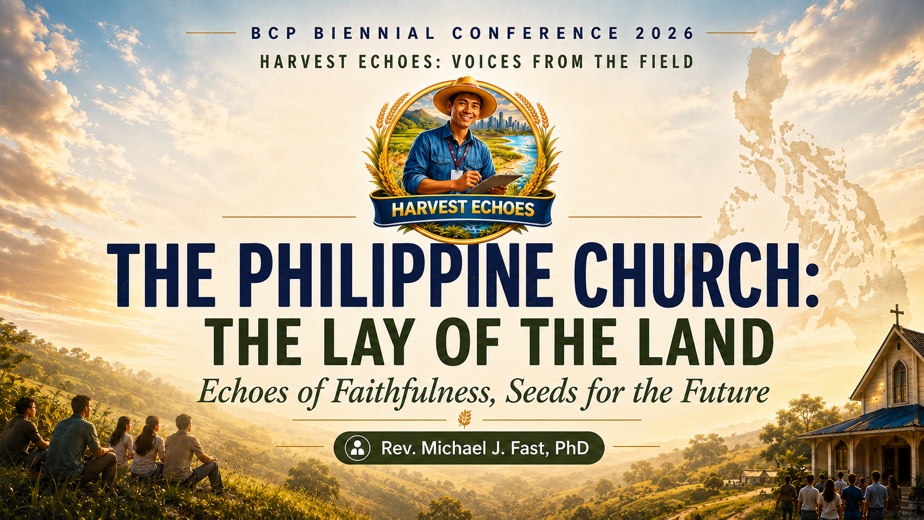
Good morning. My name is Dr. Michael Fast, and I’ve been asked to give the opening presentation for our sessions over the next two days: The State of the Philippine Church: The Lay of the Land – Echoes of Faithfulness, Seeds for the Future.
This morning I’d like us to zoom in together. We’ll begin with the Philippines as a whole. Then we’ll focus on evangelicals. Finally, we’ll look at our own family – the Baptist Conference of the Philippines.
2. Religion in the Philippines
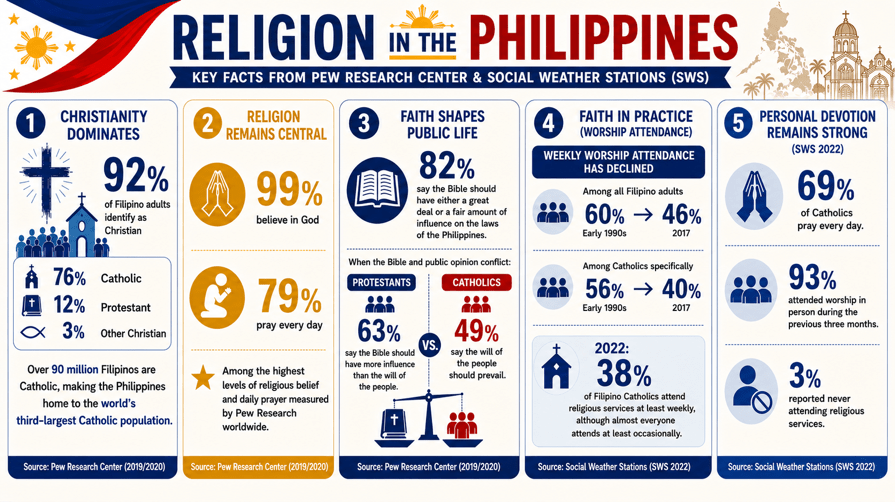
I’d like to begin by looking at religion in the Philippines. The following statistics are drawn primarily from the Pew Research Center and Social Weather Stations.
Christianity continues to dominate religious life in the Philippines. Approximately 92% of Filipino adults identify as Christian, including Roman Catholics, Protestants, and members of other Christian traditions.
The Philippines is also home to the third-largest Roman Catholic population in the world, so it is no surprise that religion remains central to Filipino society.
According to Pew Research, 99% of Filipinos believe in God, and 79% pray every day. These are among the highest levels of religious belief and daily prayer measured anywhere in the world.
Faith also shapes public life. Eighty-two percent of Filipinos say that the Bible should have either a great deal or a fair amount of influence on the laws of the Philippines.
When biblical teaching and public opinion come into conflict, 63% of Protestants say that the Bible should have greater influence than the will of the people, while 49% of Roman Catholics say that the will of the people should prevail.
In practice, however, weekly worship attendance has declined over the past several decades. During the early 1990s, approximately 60% of Filipino adults attended weekly worship services. By 2017, that figure had declined to 46%. Among Roman Catholics, weekly attendance fell from 56% to approximately 40% over the same period.
Even so, personal devotion remains remarkably strong. Approximately 69% of Catholics pray every day, 93% reported attending an in-person worship service during the previous three months, and only 3% said they never attend religious services at all.
These statistics provide a broad picture of Christianity in the Philippines. At this point, I am not addressing other religious communities, such as Islam or Indigenous religions. Instead, I’d like us to narrow our focus.
3. Evangelicals in the Philippines
So, what about evangelicals?
Some of you may already be thinking,” Yes – but we’re not Roman Catholics. We’re evangelicals!”
That’s true. So, what does the state of the evangelical church in the Philippines look like?
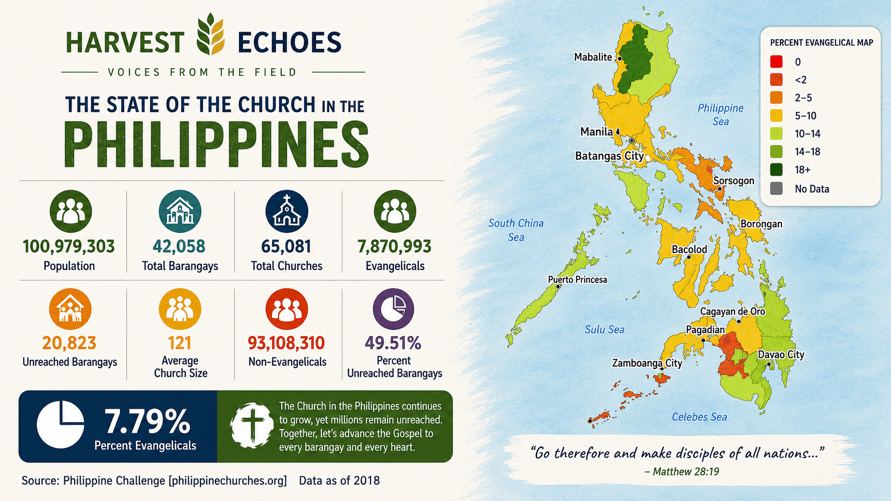
According to Philippine Challenge (2018), the Philippines had a population of approximately 101 million people. Today, that figure is closer to 120 million.
The country has roughly 42,000 barangays. Just under half of them remain unreached, meaning there is no evangelical church present in those communities.
At that time there were approximately 65,000 evangelical churches, serving about 7.8 million evangelicals – roughly 7.8% of the population.
The average evangelical church had approximately 121 members.
We’ll return to that figure in a few moments.
So, we’ve moved from looking at the Philippine population as a whole to evangelicals. Now let’s narrow the focus even further.
4. How Large is the Baptist Conference of the Philippines?
What about the Baptist Conference of the Philippines (BCP)?
Here we find some interesting statistics.
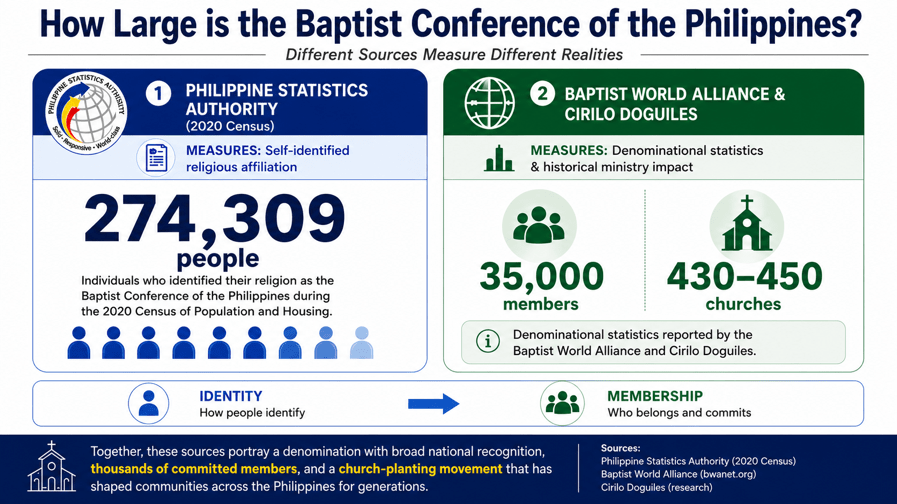
According to the Philippine Statistics Authority (PSA), approximately 274,000 people identify themselves as members of the Baptist Conference of the Philippines.
These are self-identification statistics. In other words, when census workers ask,” What is your religion?” these individuals respond,” Baptist Conference of the Philippines.”
These figures differ somewhat from the membership statistics available through denominational sources.
The membership figures reported by the Baptist World Alliance and cited on Converge materials reflect data collected during the tenure of General Secretary Boy Alfafara. Those reports indicate approximately 35,000 members worshipping in 430 to 450 churches.
I’m not certain where those numbers stand today. Perhaps, as a result of this Biennial, we’ll have an even clearer statistical picture.
These two sources are measuring different things.
One measures identity – how people identify themselves.
The other measures church membership.
Taken together, however, they portray a denomination with broad national recognition, thousands of committed members, and a church-planting movement that has faithfully served communities across the Philippines for generations.
5. The State of the Local PHP Church
So, what about the local church?
We’ve moved from looking at the Philippines as a whole, to evangelicals, to the Baptist Conference of the Philippines. Now let’s consider our local churches.
When we think about churches, we often focus on numbers. We ask questions like: How many? How much? How large?
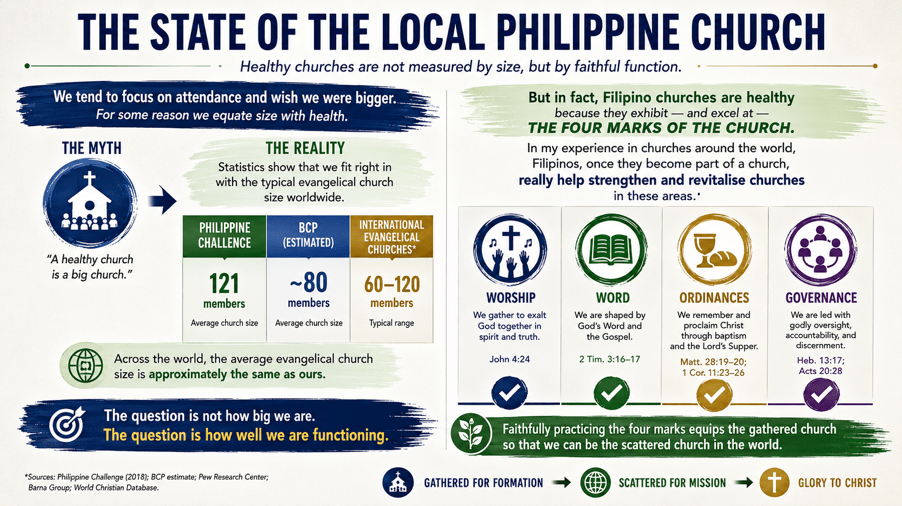
Sometimes we even assume that a healthy church is a large church, and a large church is a healthy church.
But the evidence suggests otherwise.
According to Philippine Challenge, the average evangelical church in the Philippines has approximately 121 members. Internationally, the average evangelical church often falls somewhere between 60 and 120 weekly attenders, depending on the country and denomination.
If our estimate of about 80 members per BCP church is reasonably accurate, then we are well within the range of what is typical for evangelical churches around the world.
In other words, our churches are not unusually small.
More importantly, church health cannot be measured by attendance alone.
Healthy churches are measured by something much deeper than size.
That brings us to an important transition.
Rather than continuing to focus on statistics, I’d like us to turn our attention to stories. Our Biennial theme, after all, is Harvest Echoes: Voices from the Field. So, what do these stories tell us about the health of the Philippine church?
I would suggest that they tell us something very encouraging: Filipino churches are healthy churches.
Why do I say that? Because, in my experience serving and visiting churches around the world, Filipino believers consistently strengthen and revitalize churches by faithfully practicing what I call the Four Marks of the Church.
First, Worship. We gather together to exalt God in spirit and in truth (John 4:24).
Second, the Word. We are shaped by God’s Word and by the gospel (2 Timothy 3:16–17).
Third, the Ordinances. Through baptism and the Lord’s Supper, we remember and proclaim the saving work of Christ (Matthew 28:19–20; 1 Corinthians 11:23–26).
Finally, Governance. The church is led through godly oversight, accountability, and spiritual discernment (Hebrews 13:17; Acts 20:28).
These four marks help form healthy churches. They prepare and equip the church so that we can then be scattered into the world as God’s people.
We’ll return to that idea later.
As we listen to the stories shared throughout this Biennial, I believe we’ll hear repeated evidence of churches faithfully living out these four marks.
Now, I know some of you may already be thinking, “But what about our weaknesses? What about the challenges we face?” Those are important questions. We’ll acknowledge them in due course. But before we talk about what we still lack, I think it’s important that we first recognize who God has already made us to be.
6. Transmission & Appropriation Framework
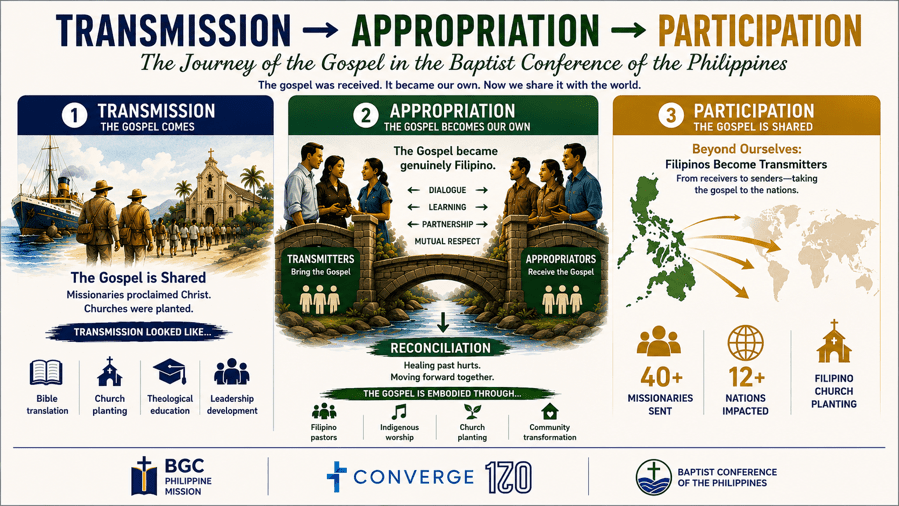
As we reflect on the stories we’ll hear throughout this Biennial, it’s helpful to step back and consider the larger story of the Baptist Conference of the Philippines.
When we look at the history of Christian mission—not only in the Philippines, but around the world—we often see a similar pattern unfolding.
I describe that pattern in three movements: Transmission. Appropriation. Participation.
Together, these describe the journey of the gospel within the Baptist Conference of the Philippines.
First, the gospel is received.
Then, the gospel becomes our own.
Finally, the gospel is shared with the world.
The first movement is Transmission.
This is the season in which the gospel is proclaimed by missionaries. Churches are planted. Scripture is taught. Leaders are trained. Bible translation, theological education, leadership development, and church planting all become part of establishing the church.
We’re honoured that Ma’am Joyce is with us today. She represents many missionaries who faithfully served the church in the Philippines over many decades. Their work laid important foundations upon which we continue to build today.
The second movement is Appropriation.
In many ways, this begins almost immediately. As Filipinos hear the gospel, they naturally begin asking, “How does this become our story?”
The question is no longer simply, “What have we received?” but “How do we faithfully embody the gospel within our own culture and communities?”
Years ago, while teaching in Vietnam, I asked a group of students how people in their country perceived Jesus. One student replied, “Jesus is a foreigner.”
I’ve often reflected on that conversation. I don’t believe most Filipinos think of Jesus as a foreigner. Rather, Filipino believers recognize that Christ identifies with them, speaks into their lives, and calls them within their own culture.
Appropriation is never a one-sided process. It involves dialogue between missionaries and Filipino believers. It involves learning from one another. It requires mutual respect.
At times, it also involves misunderstanding and tension. That is a normal part of every missionary movement. Yet through God’s grace, those tensions can give way to reconciliation, healing, and deeper partnership. The gospel becomes embodied through Filipino pastors, Indigenous expressions of worship, church planting, community transformation, and ongoing theological education.
The third movement is Participation.
Now the gospel is not merely received. It is shared. Filipinos become not only recipients of mission but participants in God’s global mission. Those who once received the gospel now become those who send others.
According to the Baptist World Alliance, the Baptist Conference of the Philippines has commissioned more than forty missionaries serving in various parts of the world. While I may not know every country where they serve, we know of ministry taking place in places such as Thailand, Cambodia, Japan, Canada, and the United States, along with many other contexts. Filipinos are planting churches internationally, serving immigrant communities, and participating in God’s mission far beyond the Philippines.
This Biennial also marks an important milestone. It is our first Biennial in this new era of participation. At our previous Biennial, Dr. Jenkins, representing Converge, formally recognized the Baptist Conference of the Philippines as a sister organization – an equal ministry partner, serving together in God’s global mission.
That recognition symbolizes something much larger. It reminds us that the Baptist Conference of the Philippines has matured from being primarily a mission field into becoming a missionary movement.
That is something worth celebrating.
7. Stories of Transmission by Early Missionaries
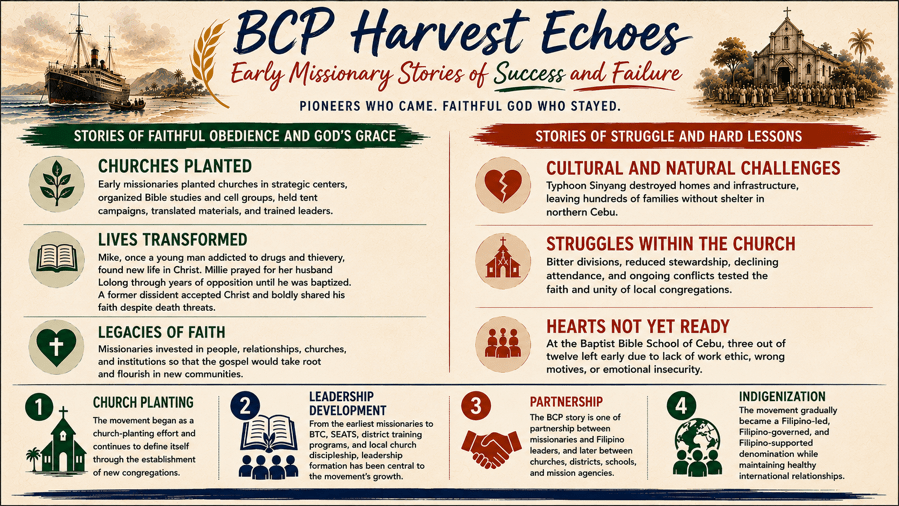
So, what does this look like in practice?
One way to answer that question is to look back at the stories of those who came before us.
As I worked through the missionary prayer letters preserved in the BTC Archives, I was struck by how familiar many of those stories felt. Some of the missionaries represented there are connected with families who are with us today—the Esplands, the Chalmers, the Osbrons, the Nelsons, and many others. Their names remind us that the story of the Baptist Conference of the Philippines has always been a shared story.
Those prayer letters tell stories of churches being planted, lives being transformed, and communities encountering the hope of the gospel.
Those are wonderful stories. They’re also our stories. Over the next two days, we’ll hear many similar testimonies from churches across the Philippines.
But those missionary letters tell another story as well. They speak honestly about struggle. They describe cultural misunderstandings, natural disasters, disappointments in ministry, conflict within churches, and seasons when hearts were not yet ready for what God was doing.
Those are our stories too.
Every generation of God’s people experiences both joy and difficulty. Yet despite those challenges, the missionaries left an extraordinary legacy. They helped establish churches. They invested in leadership development. They modelled partnership. And perhaps most importantly, they helped nurture a movement that became increasingly Filipino-led, Filipino-governed, and Filipino-supported, while continuing to enjoy healthy international partnerships.
That is a remarkable testimony to God’s faithfulness.
8. Appropriation In the Baptist Conference of the Philippines
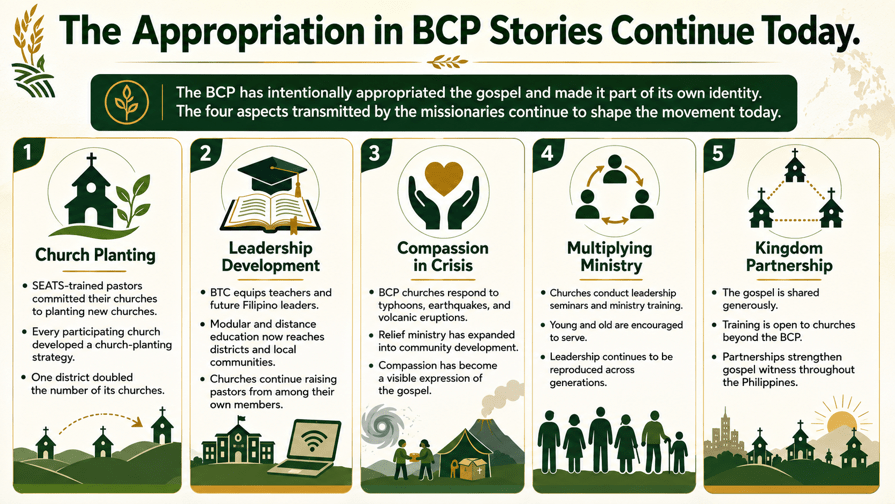
Our work of appropriation did not end with the first generation. It continues today. The gospel continues to take deeper root as Filipino churches faithfully live out their calling within their own communities.
I see at least five enduring expressions of that legacy.
Church planting continues to be one of the defining strengths of the Baptist Conference of the Philippines. SEATS, where I serve as Academic Dean, has partnered with districts and local churches for many years. Through these partnerships, participating churches have developed intentional church-planting strategies. In that one sub-district alone, the number of churches doubled as a result of that initiative. That is only one example among many. Throughout the Baptist Conference of the Philippines, God continues to raise up new churches.
Leadership development also remains central. Baptist Theological College continues preparing pastors, teachers, and Christian leaders for ministry across the Philippines. BTC extends theological education through modular and distance-learning programs, making training accessible to pastors serving throughout the country. Local churches continue identifying and developing leaders from among their own members.
Together, these ministries demonstrate that leadership development remains one of the great strengths of our movement.
The gospel is also demonstrated through compassionate ministry during crises. BCP churches faithfully respond to typhoons, earthquakes, volcanic eruptions, and other crises. Relief ministries have increasingly developed into long-term community ministries, showing that compassion is not merely an emergency response but an ongoing expression of the love of Christ.
Leadership multiplication continues at every level. Many pastors are trained within their local churches, while seminars, mentoring relationships, and ministry training continue to equip believers for service. Older and younger generations serve together, ensuring that leadership is reproduced from one generation to the next.
Finally, our movement continues to value partnership. Di naman tayo madamot sa ating faith. Training opportunities are often shared with churches beyond the Baptist Conference of the Philippines. Relationships across denominations strengthen the witness of the gospel throughout the nation. The gospel is never diminished by partnership. It is multiplied.
9. Filipinos by Nature: Redefining what it means to be Religious, Relation, Restorative, and Present.
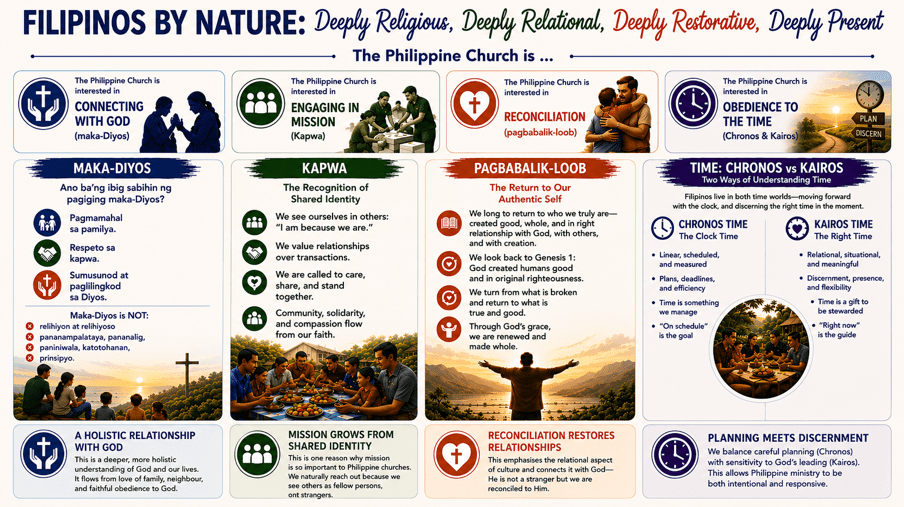
As we think about the future, I believe God has uniquely prepared Filipino believers for ministry. The gospel has not simply been translated into Filipino culture. It has been deeply appropriated. I see this reflected in four cultural strengths that continue to shape the health of the Philippine church.
First, maka-Diyos. Filipinos have a deep desire to live in right relationship with God. Maka-Diyos is much richer than simply being religious. It is more than attending church. More than believing certain doctrines. More than following moral principles. It reflects a holistic orientation toward God that is expressed through loving one’s family, caring for one’s neighbour, and faithfully serving the Lord.
Second, kapwa. Mission grows naturally from a shared identity. Kapwa reminds us that we are not isolated individuals. We belong to one another. Relationships matter more than transactions. We are called to care, to share, and to stand together. Because of this, compassion and mission often flow naturally within Filipino communities.
Third, pagbabalik-loob. A return to our authentic self. The gospel restores what sin has broken. Filipino culture places great value on restoring relationships, and this resonates deeply with the biblical story. Genesis reminds us that humanity was created in God’s image, living in harmony with God, one another, and creation. Through Christ, God begins restoring that wholeness. The church becomes a community where reconciliation is not merely preached – it is practiced.
Finally, kairos. We often joke about “Filipino time.” Yet beneath those jokes lies a deeper cultural insight. Filipinos often live with an awareness that not every important moment can be scheduled. Alongside Chronos – clock time – we also recognize Kairos – God’s appointed time or ang takdang panahon. Chronos teaches planning, organization, and stewardship. Kairos teaches discernment, presence, and responsiveness to the Holy Spirit. Healthy ministry requires both. Planning without discernment becomes mechanical. Discernment without planning becomes ineffective. The healthiest churches learn to hold both together.
How does each of these redefine church?
Maka-Diyos defines how to have a Holistic relationship with God. This is a deeper, more holistic understanding of God and our lives. It flows from love of family, neighbour, and faithful obedience to God.
Kapwa defines how mission grows from shared identity. This is one reason why mission is so important to Philippine churches. We naturally reach out because we see others as fellow persons, not strangers.
Pagbabalik-loob defines reconciliation restores relationships. This emphasizes the relational aspect of culture and connects it with God—He is not a stranger, but we are reconciled to Him.
Chronos and Kairos times define how planning meets discernment. We balance careful planning (Chronos) with sensitivity to God’s leading (Kairos). This allows Philippine ministry to be both intentional and responsive.
So where do we go from here?
10. The Way Forward
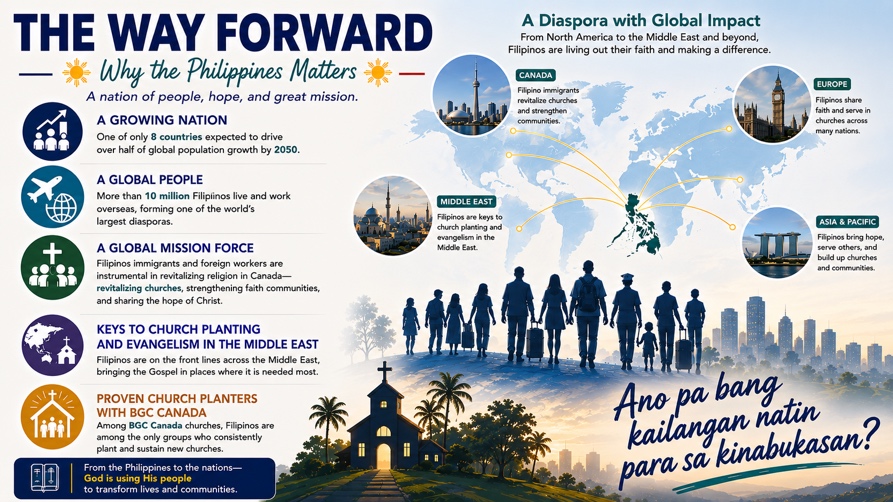
Why does the Philippine church matter—not only to the Philippines, but to the world? I believe there are several reasons.
First, the Philippines is a growing nation. By the middle of this century, the Philippines is expected to be one of the countries contributing most significantly to global population growth.
Second, Filipinos are a global people. More than 10 million Filipinos live and work outside the Philippines, forming one of the largest diaspora communities in the world. That means the Philippine church is already present in nearly every region of the globe.
Third, Filipinos are becoming a global missionary force. Whether serving as pastors, professionals, overseas workers, or students, Filipino believers are faithfully bearing witness to Christ wherever God has placed them. We’ve seen this throughout the Middle East, across Asia, in Europe, in North America, and in many other parts of the world.
In Canada, for example, Filipino believers have played a significant role in revitalizing existing churches and planting new ones. As Pastor June Torres has observed, among BGC Canada churches, Filipino congregations are among those most consistently planting and sustaining new churches. Those are remarkable gifts that God has entrusted to us.
The question is: Ano ba pang pangangailangan natin para sa kinabukasan? [What do we need for the future?]
11. Functional Church Scorecard
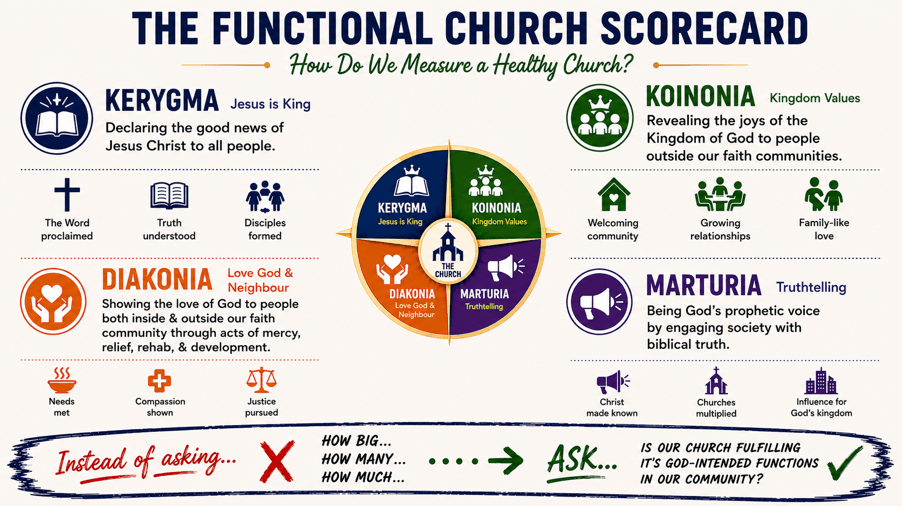
We need to begin by looking Beyond the Four Walls of the church. Perhaps one of the greatest opportunities before us is to remember that the church exists for more than what happens on Sunday morning. Sunday worship is essential. But worship also prepares us to be sent into the world.
Rather than asking only, “How large is our church?” or “How many people attended?” perhaps we should also ask, “Is our church faithfully fulfilling God’s purposes in our community?” That question changes everything.
A healthy church is not simply one that gathers well. It is a church that is faithfully scattered.
We are called to proclaim the good news of Jesus Christ. We are called to reveal the joys of God’s Kingdom. We are called to demonstrate God’s love through mercy, relief, rehabilitation, community development, and compassionate service. And we are called to speak prophetically into society with biblical truth, humility, and courage. Those are the functions of a church living faithfully in God’s mission.
12. Reflections for this Week
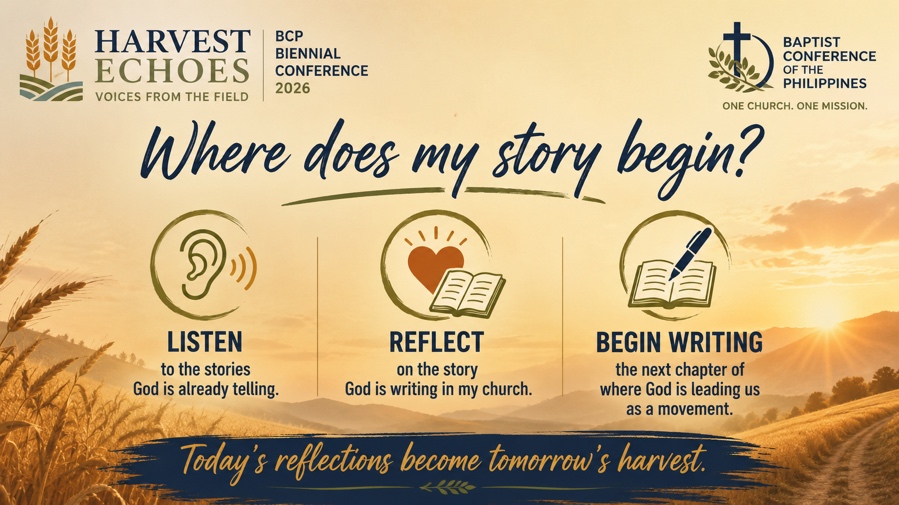
That brings us to a very personal question: “Where does my story begin?”
Throughout these next two days, you’ll hear many stories – stories of faithfulness, sacrifice, perseverance, and hope. Listen carefully. Listen for what God has done. Listen for what God is doing. And perhaps most importantly, listen for what God may be saying to you.
As you listen, reflect on the story God is writing in your own church. Where have you seen His faithfulness? Where is He calling you to grow? What new chapter might He be inviting you to write?
Because today’s reflections become tomorrow’s harvest. The stories we celebrate during this Biennial are not the conclusion of God’s work. They are an invitation to participate in what He is doing next. May God give us ears to hear, hearts to respond, and the courage to write the next chapter of the Baptist Conference of the Philippines together.
Thank you.
Good morning. Magandang umaga, and may God bless us all.
13. References
Bakhtin, M. M. (1981). The dialogical imagination (M. Holquist, Ed.; C. Emerson & M. Holquist, Trans.). University of Texas Press.
Bakhtin, M. M. (1984). Problems of Dostoevsky’s poetics (C. Emerson, Ed. & Trans.). University of Minnesota Press.
Bakhtin, M. M. (1986). Speech genres and other late essays (V. W. McGee, Trans.). University of Texas Press.
Baptist World Alliance. (n.d.). Baptist Conference of the Philippines, Inc. Retrieved June 24, 2026, from https://baptistworld.org/member/baptist-conference-of-the-philippines-inc/
Chalmers, G. W. (1969, November 22). Tell it like it is… [Missionary prayer letter from Cataingan, Masbate, Philippines]. Board of Foreign Missions, Baptist General Conference.
Chalmers, G. W. (1985, July). Turning from Fear [Missionary prayer letter from Calbayog City, Western Samar, Philippines]. World Missions, Baptist General Conference.
de Mesa, J. M. (1988). Re-thinking the faith with indigenous categories. Inter-Religio, 13(Summer), 18-29.
de Mesa, J. M. (2003). Why theology is never far from home. De La Salle University Press.
de Mesa, J. M. (2004). Mga aral sa daan: Dulog at paraang kultural sa kristolohiya. De La Salle University Press.
Espland, H. W. (n.d., May 22). Day of Rejoicing [Missionary prayer letter from Tagbilaran, Bohol, Philippines]. World Missions, Baptist General Conference.
Espland, H. W. (1982, July 10). Dear Prayer Partners [Missionary prayer letter from Tagbilaran, Bohol, Philippines]. World Missions, Baptist General Conference.
Evans, J., & Lesage, K. (2026, June 30). 5 facts about religion in the Philippines. Spring 2024 Global Attitudes Survey, PEW Research Center. Retrieved July 24, 2026, from https://www.pewresearch.org/short-reads/2026/06/30/5-facts-about-religion-in-the-philippines/
Pew Research Center (2011). Global Christianity: A report on the size and distribution of the World’s Christian Population. https://www.pewresearch.org/wp-content/uploads/sites/20/2011/12/Christianity-fullreport-web.pdf
Maggay, M. P. (2013). A religion of guilt encounters a religion of power: Missiological implications and consequences. In M. P. Maggay (Ed.), The gospel in culture: Contextualization through Asian eyes. OMF Literature Inc.
Marshall, A. (2014). Bayanihan and belonging: Filipinos in Manitoba. Manitoba History, 76, 2-12.
Marshall, A. (2015). Stories of bayanihan and belonging: Filipinos in Manitoba, Part 2. Manitoba History, 77, 2-12.
Nelson, R. K. (1968, December 9). Typhoon Sinyang correspondence [Missionary prayer letter from San Remigio, Cebu, Philippines]. Board of Foreign Missions, Baptist General Conference.
Osbron, J. (1981, December 28). Dear friends: The taming of Mike Escalante [Missionary prayer letter from Bacolod City, Negros Occidental, Philippines]. World Missions, Baptist General Conference.
Philippine Statistics Authority. (2020). Household Population by Religious Affiliation, Region, Province, and Highly Urbanized City: Philippines, 2020. 2020 Census of Population and Housing.
van Engen, C. (1991). God’s missionary people: Rethinking the purpose of the local church. Baker Academic.
Varberg, R. (2009). Why didn’t you come sooner? Stories from My Life as a Missionary in the Philippines. William Carey Library.
Vencer, A. B. (2004). Towards a functional church in society. DNA Discipling a Whole Nation, n.p.
Vencer, A., Punzalan, C. V. P. III, & Fast, M. J. (Eds.). (2020). The functional church (Faculty Working Paper, Discipling a Whole Nation). South East Asian Theological Schools, Inc.
Walls, A. F. (2002). The cross-cultural process in Christian history: Studies in the transmission and appropriation of faith. Orbis Books.
Zurlo, G. A. (2026). How many evangelicals in the world? A new assessment from the World Christian Database. Review of Religious Research. Advance online publication. https://doi.org/10.1177/0034673X261447046