Something is definitely going on. It’s not something I ate. I had a normal breakfast this morning. Had my coffee, did whatever I need to do. But yet still, my stomach is making itself known.
It’s interesting how our brain is connected to our stomach, isn’t it? Not so much to tell us when we’re hungry, but…
I suspect it’s stress. Pressures from work. Lists of things to do. Reports to fill out at the beginning of the year — even though we’re already in the end of the first quarter.
It’s been busy. Lots of guests. It’s been wonderful. Lots of guests. But not a lot of time to do the administrative work that I need to do.
So today,
Tight. Stiff. Churning? Not so much.
But …
Maybe it’s more than that.
Maybe it’s my upcoming doctor’s visit. Not too serious. I don’t think. A ‘plumbing’ issue — But not, seemingly, something a plumber can fix or I’d go see a plumber. Probably cost the same. I don’t live in a universal healthcare country so it’s pay as you go.
Don’t think a plumber could help me.
But a urologist definitely can.
Nervous? Perhaps. Wondering? Perhaps.
My mind doesn’t seem too distressed, although in the back of it is my high school classmate, Isaac, who’s spent the last month in the hospital, dealing with a serious health issue.
I just turned 59. And apparently with that age comes a whole host of things that never seemed to bother me before.
I saw kids running in the street today … Carrying heavy stuff. Going along as if there’s no tomorrow. Energy. Exuberance. Joy.
None of the worries of the life ahead have reached them, yet.
Me …
I don’t run down the street carrying my garbage. I carry it carefully, so the bag doesn’t break, hoping that by the time I get to the end of my street, I’m not huffing and puffing too much.
It’s interesting how ‘athletics’ happen in our life. They happen when we’re younger. I was a track star after all. The fastest in any of the schools that I attended. Haven’t done that for a while. Turns out those schools were High Schools!
But yet it seems that athletics needs to reenter my life.
I need to return to a love of … running … ? jogging … ? walking … ? pedalling … ?
Something.
Because without that, I won’t be prepared to enter the next phase of my life.
And maybe with that, will come an ease to the tightness … the stiffness … the churning.
Is my stomach letting me know things need to change?
My stomach talks to me a lot. In fact that’s one of the ways I know if I’m making the right or wrong decision.
My stomach’s never wrong. It talks to me all the time. ‘You don’t want to go tree planting? Well, I think that you need to!’ ‘You don’t know if you love her or not? Well I think that you do!’ ‘You don’t want to be vulnerable worshipping with strangers? Well I think that you need to!’ Always talking. Always right.
How does my stomach know when my brain doesn’t?
So, what if my stomach isn’t telling me about my stress level or my upcoming checkup? What if it’s trying to help me make a decision? What is it? I wonder.
Stand up? Sit down? Enter? Do not enter? Go faster? Go slower? Stop doing this? Start doing that?
Tight? Stiff? Churning? Not so much.
Just talking to me.
I wrote the first draft of this spoken-word poem on March 11, 2026, shortly after one of my first check ups. It turns out it wasn’t just a plumbing issue. You can read more about that here.
“I guess sometimes the leaf springs flatten out and need to be replaced.”
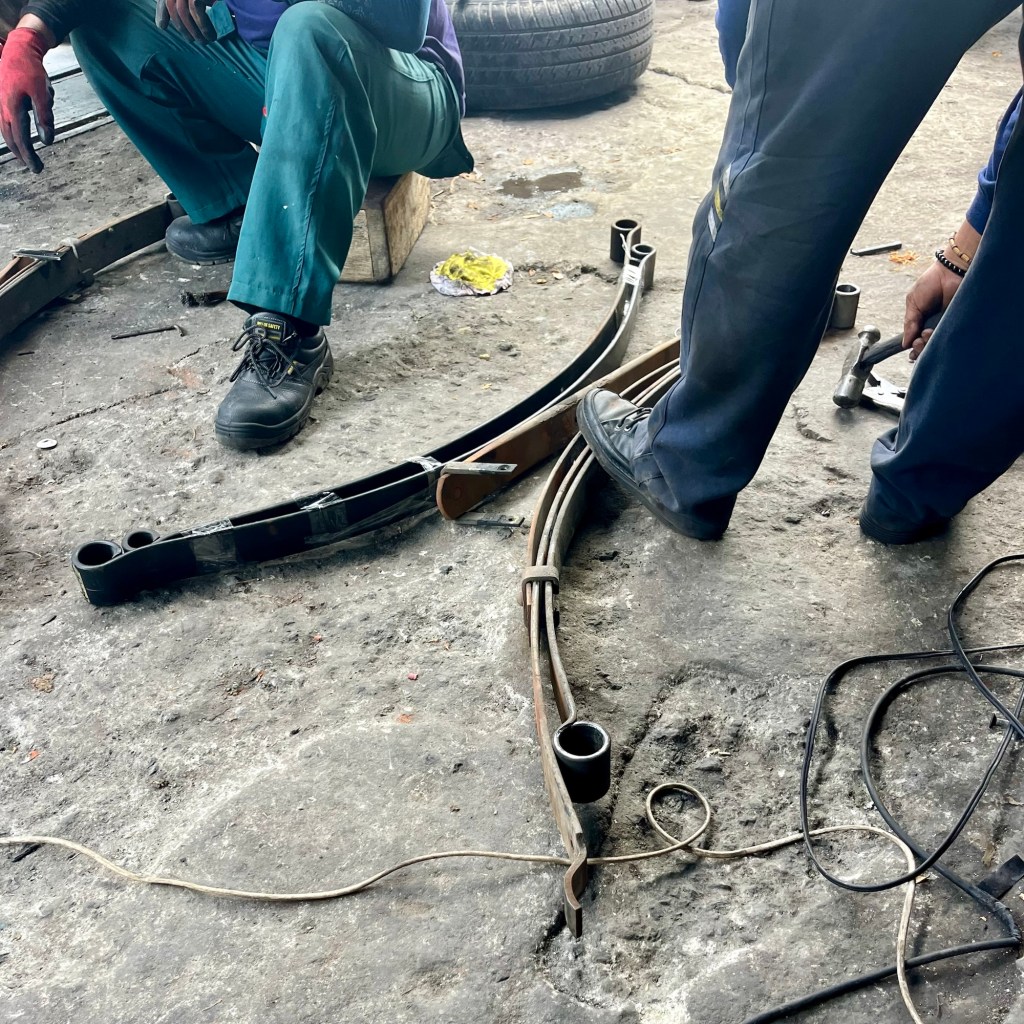
My car had been riding low for quite some time and would occasionally bottom out when fully loaded. So I took it in to Pablo, my regular mechanic. His reply was not car-related but yet surprisingly still related to things in my own life.
“Actually, that’s true of everything in life, isn’t it?”
Pablo is a student of the bible and usually an appointment with him touches on some aspect of life and theology. He always finds ways to connect what he reads there to the real world around him.
My initial reply was a cautious, “Yeah, I guess it is. A lot of things in life are like that,” but then I thought I would get right into the heart of the matter. “In fact, that’s true for me now. I’m sick, and I’ve realized that even with me, some things eventually need to be replaced.”
“Oh? What’s wrong with you?” He replied.
Since I had already committed myself, I continued on. “I have prostate cancer. They discovered it just over a month ago. It also seems to have affected my bones, kidneys, and bladder!”
“Well that certainly fills up your thoughts, then, doesn’t it?” he asked.
“Yeah, it does.”
“Well, I think that as long as you’re ready, everything is okay — If you’re ready, there’s no fear. But if you’re not ready, then you’re afraid,” he said.
“Yeah, that’s true. I’ve spent some time reflecting on my life, and I’ve realized that I have no regrets and nothing I would want to change. I’m ready, and I have no fear of the future.”
What does it mean to be ready?
Yes, it’s true. I have prostate cancer that has metastasized into my bones, kidneys, and bladder. This was not something that I was expecting but it lead me to discover that what Pablo says is true — all of a sudden I came face to face with my own mortality and it did occupy my thoughts. My first thought was, “Am I ready to die?”
On Being Ready & Faith
My life’s leaf springs have flattened out. But where exactly is the problem? Perhaps I need more faith?
But as I reflect, I realise that I have no regrets. I have no doubts. I have a firm foundation. I have assurance.
I remain firmly convinced of the faith that began growing in me from a very young age at my parents knee. A faith that was strengthened through attending churches. A faith that was strengthened through participation in devotionals at our young peoples group. Faith that was strengthened through experiencing a different culture when I was in high school and trying to figure out how the Gospel fit into that. The faith that was strengthened through formal studies, both in university and in seminary. And a faith that I still hold today. That faith is very simply stated: Jesus is Lord, and God has raised him from the dead!
Don’t get me wrong. I’m not a stick in the mud. My faith has grown through those years as I have gotten deeper into God‘s word, as I have conversed with God’s people, as I’ve seen different perspective from the different people in my life, and as I have engaged with people who come from different faith communities. All of this has helped strengthen and deepen the faith that was first started as a seed so many years ago.
But it’s not something that I merely believe while waiting for the age to come. It is something I believe in my day to day life. God also has a task for me. I am called to proclaim the good news of Jesus Christ as ruler of the world. I am called to conform to and live out the values of his Kingdom. I am called to love God and love my neighbour. And I am called to bear witness to the truth.
As Pablo points out, this shapes all that follows.
But my problem isn’t lack of faith. So why, then, have my leaf springs collapsed?
On Being Ready & Buckets Lists
My leaf springs have flattened out. But where exactly is the problem? Maybe I have unfinished business?
When I first received a diagnosis of cancer, my mind immediately went to the end. I began asking myself, “Am I ready to depart this earthly vale and move on into whatever glory God has intended for me?” Very quickly, I came to the conclusion that, “Yes, I am.” I don’t actually have a long list of things I feel compelled to accomplish before that day comes — a bucket list, as it were.
As I reflect, I realize that as a young boy, I dreamed of becoming a hermit living in a log cabin in the bush. At other times, I dreamed of being a soldier or a missionary.
Looking back, I realize that God answered those dreams in ways I never would have anticipated. I never became a hermit, but I spent countless hours in the wilderness — and the wilderness remains one of the places where I feel closest to God. I never became a soldier (apart from a brief time in the NSaskR), but I learned something about commitment to a cause larger than myself. And I did become a missionary, though not in any form I could have imagined as a child. My childhood imaginings involved a missionary standing beside a large cooking pot containing an unfortunate victim — a horrible misrepresentation, but one that says something about the quality of missionary education available to me at the time!
As a child, our family regularly vacationed in the Rocky Mountains. In high school, I paddled hundreds of kilometres through the Churchill River system, sometimes in a group and sometimes solo. I have swum Otter Rapids wearing a life jacket. A few years ago, I went for a midnight swim in the Pacific Ocean with my son Daniel.
I have flown in planes ranging from a Piper Cub to a 747. I have driven Canada from Port Alberni to Quebec City and crossed large stretches of the United States by road. Ministry and teaching have taken me to Mexico, Japan, the Philippines, South Korea, Hong Kong, Vietnam, Thailand, Singapore, Qatar, Georgia, and Brazil. I have ridden in a car along part of the Silk Road and tested how water drains from a sink in both hemispheres.
I was present for the birth of my two children, Emily and Daniel.
I got involved in the World Wide Web near the ground floor and developed one of the first 10,000 websites in the world. I have formally studied four languages — English, French, Ancient Greek, and Tagalog — and speak two of them fluently.
I have preached in more than a hundred churches across Canada and in several countries around the world. I have taught theology internationally and participated in planting three churches in two countries.
I have cooked over an open fire, fished from a canoe, and sat at night listening to loons call across the lake.
There are still things I think about doing, places I would like to see, books I would like to read, and people I would like to spend time with. But I don’t feel that I have been cheated out of life. God has already given me far more experiences than I ever expected to have.
So, yes, I am ready. Not because I have exhausted life, but because I do not feel that I have left life unlived.
Which raises a different question.
If I am not afraid of dying, and if I am not troubled by an unfinished bucket list, then why do I feel as though my leaf springs have collapsed?
On Being Ready & Ministry
My leaf springs have flattened out. But where exactly is the problem? Maybe there is no one left to continue my work?
Pingkian has been one of God’s greatest gifts to me.
When I arrived in Pingkian, I possessed a great deal of knowledge about ministry. I had studied it, taught it, preached about it, and thought deeply about it. I had been present when MMBC was planted, although at that stage I was mostly a kid along for the ride. Later, I helped plant New Hope Community Church in Canada, served on the pastoral staff there, learned to preach, and gained valuable experience in church ministry.
Yet much of my understanding remained theoretical.
When we first moved to the Philippines, we lived in Cubao and were somewhat isolated from the communities around us. Ministry happened at 670 EDSA. We travelled there, did ministry, and went home again.
Pingkian changed that.
For all my knowledge about community ministry, I had never truly learned how to immerse myself in a community. I remained, by nature, a shy and quiet person. In many ways, I was a reluctant pastor. It was the people of Pingkian who taught me what ministry really looks like.
The Riobuya family showed me what it means to have a vision for reaching an entire community.
The Laguda family showed me what it means to be family — not merely to attend church together, but to celebrate life together.
And I could go on much longer, but will have to limit myself to naming names: Ramil & Margie, Kandase, Clark Gonzales, Rose Ann, Kasavina, Kirvi, Kio Gonzales, Thess & Macmac Caparas, Elmer & Emily Belarmino, Marycris & Justin, Red Belarmino, John, Milarose, Marian, Johnuel Riobuya, Dion & Joy Umali, Warlito & Doris, Diane, Dorothy, Warren, Shi Laguda, Kyla Ferer, Edgar & Perlita, LJ, Kaikai Billones, Wency, Jordan, John Billones, Nonoy, Caloy & Liza Walet, Inis & Ging, Gigi, Sean Laguda, Helen Laguda, JR Laguda, Baste & Sandro Laguda, Aling Auring, Boboy & Tata, Angel Yumul, Adel & Elmer, Stephanie Obosa, Mel & Noel Aguilar, Aries & Faith Adrales, Lamberto, Thea, Taiga Demillo, Anisa, Derek Acaso, Gilbert Amistoso, Renz Nabor III, Cian Artates, Enting Nabor, Jessa & Prince Wyler Gulas-Gonzales, Kurt Kevin Suarez, Angela & Princess Satoquia, Rodsille Maurillo, Glayza C. Doctor, Yacymarie Cleofas, Christine & Khrishana Otadoy, Marvin & Ferl Cabtalan, Vince “Izhen” Nares, Margaret, Danica M. Ligayo, Angel Bang-oy, Edchell Montales, Ejay Mojemulta, Isaiah Luke Rivera, Justin & Jazzper Morada, Radam Toling, Alvin & Caloy Ragundiaz, Angel Tanedo, Jun Carl, Sharilaine, Sabrina, Ace, Jack, Nathaniel Onasa, Purificacion Onasa, Kaye, Danica Rosales, Fiona Eugenio, Zyrill Montanses, and Lani.
What struck me most was that ministry in Pingkian was never driven primarily by pastors or programs. It grew because God stirred the hearts of ordinary people.
Women began ministering to women.
People became involved in helping mothers and newborn babies.
Volunteers gathered children through KidsNet.
Young people reached other young people through Friday nights, Saturday programs, ASCEND, 3verlasting, the Student Center, the gym, and countless informal conversations.
Men discipled men.
Families cared for families.
People prayed together, studied Scripture together, worked together, celebrated together, and grieved together.
Again and again I watched God place a burden on someone’s heart and then call them to act on it.
The remarkable thing is that I cannot take credit for any of it.
I did not start these ministries.
God did.
He worked in the hearts of His people and said, “This is what I want you to do.”
And they responded.
The people of Pingkian have done far more for me than I have ever done for them. I had always known academically and theologically that I was called to be the pastor of Pingkian as a community, but I didn’t really know what that looked like until I experienced Pingkian itself.
So it turns out that my collapsed leaf springs are not found in my ministry at Pingkian.
So what is it?
As I continued, my reflections, my thoughts naturally turned to the South East Asian Theological Schools. I have now been involved with SEATS longer than I have lived in the Philippines.
A few years ago, during an accreditation visit, one observation kept surfacing. The accrediting team was concerned that too much responsibility rested on too few people. They were right. Good governance requires clearer boundaries and a broader distribution of responsibility.
Yet I also realized something the accreditation process could never fully measure.
SEATS is a family.
We have certainly built a shared theological vision. Together we have wrestled with what it means for churches to proclaim Jesus Christ as King over every aspect of life, to love God and neighbour, to live out the values of God’s kingdom, and to bear faithful witness in society.
But far more importantly, we have been shaped by one another.
These days, several of us are walking through significant health challenges. Our conversations have naturally become less about programs and projects and more about life, mortality, and the faithfulness of God. Together we have committed ourselves to reflecting daily on Psalm 23 — not merely as a favourite passage, but as fellow travellers walking through the valley of the shadow of death.
Of course we think about the next generation who will carry this vision forward. We pray for them often. But we also recognize that God is still forming us. Even now, He is teaching us what it means to trust the Shepherd.
Looking back, I realize that much of what eventually became Pingkian Family Worship first took shape through SEATS. The way I preach, teach, and think about the church has been profoundly shaped by this community. My prayer is that many others will one day experience the same joy of discovering God’s heart for His church and His world.
So it turns out that my collapsed leaf springs are not found in SEATS.
So where are they?
On Being Ready & Those Left Behind
If my leaf springs had truly collapsed, surely I would see it first in my family.
But of course, one’s thoughts eventually turn toward those who would be left behind — especially the family here. They are understandably not quite as willing to accept the idea that I may be ready to move on. My mother said to me the other day that it may actually be easier for the person who is sick to accept these things than for those who are not. I suspect there is a good deal of truth in that.
If you were to ask me, I would say that my family is perfect.
That’s probably an exaggeration. Like every family, we’ve had our misunderstandings, disappointments, and failures. But when I look back over the years, I wouldn’t change a thing. God has given me exactly the family I needed.
We don’t fight with each other. We don’t really have differences of opinion. We have this bond in this unity that has been formed through a lifetime together. I’m not sure what the secret is. I don’t think that I came into this family thing with a great plan for what the future would look like I didn’t think too much of what it would mean to be a husband. I didn’t think too much of what it would mean to be a father. And I didn’t think too much about what kind of family discipleship program that I needed to implement as our family grew together.
But what I do know is that I would not be the man today if it were not for my family. From Eva, I learned what it means to consider somebody else other than myself in life. To be aware of how other people are feeling about things. To see love for neighbour exemplified through day-to-day experiences to learn what it means to be committed to one another day and day out, even after a lot of life’s experiences, including moving 10,000 km away to another part of the world.
Including experiencing joys and frustrations in church ministry.
Including experiencing wave after wave of culture stress — both in the Philippines and in Canada.
Including learning how to communicate and think in a different language than when the one we grew up in.
Including confronting how much our world has changed from the world that we grew up experiencing in Canada and how sometimes that leads to bumps with other people who have not experienced what we’ve experienced.
Through it all I’ve learned what commitment to a life partner, to a soulmate, to a to the best example of what it means to be a missionary.
I didn’t come into fatherhood with a great plan. I didn’t even know if I would know what to do as a father. I do remember being there for the birth of Emily and for Daniel I do remember how that first experience with them on this side of the womb started something that continues on today.
I’ve learned how to navigate what it means to change seven diapers in one day.
I’ve learned how to navigate what it means when your kids are more popular than the animals we were looking at in the zoo.
I’ve learned what it means to have that protective fierceness that wants to keep my kids from harm, however slight it might be.
I’ve also learned what it means to see my children grow in wisdom and maturity. To see them grow into young people with a deep, heartfelt, genuine, pure conviction that Jesus is their king that they need to live out his values that they need to love God and love, neighbour, and that they need to testify to the truth that they have experienced.
So it turns out that my collapsed, leaf spring isn’t my family. So what is it?
On being ready, but the time has not yet come
As time progressed during my treatment, we discovered that there is hope. We heard account after account of others in the same situation who underwent treatment and continued living a long and full life. So it made me realise that maybe the end isn’t as near as I initially thought.
But then again, since I am still sick, my leaf springs are still collapsed and I need to deal with them.
But just because a leaf spring is broken, doesn’t mean everything is broken. While I may be ready to go at any time that may not in fact be what happens or even be the best option. All of this has also led me to ask: What does God want me to do with the rest of my life, however long or short that may be?
Even though I’ve lived a deeply blessed life and have had many wonderful experiences, are there things I should stop doing so I can devote myself more fully to other things? It has prompted a great deal of reflection.
Initially, when something like this happens, the response tends to remain somewhat intellectual. You have these abstract discussions about life and death and sickness and mortality.
I read a post by Al Hirsch the other day and he had this great summary of some of theologian Hans von Baltasar’s thoughts. The part the struck me was that life only gains meaning when we realise it’s finite nature. “They become, in that moment, irreducibly themselves: a unique person, with a unique mandate, standing before a finite and not merely a limited horizon…. A finite horizon … closes. And in closing, it forces the question of what was actually asked of this particular life, and whether the answer was given.”
How to live that finite life I wonder?
Maybe my collapsed leaf springs have to do with how I view life as a whole?
On Being Ready & The Finite Life 
Honestly, I’ve tended to live my life more as a human doing rather than a human being. Looking at my typical schedule shows a huge pile of things. I remember doing a report to one partnering church in Canada about some of the stuff that Eva and I were doing and immediately after that the worship pastor stood up and said, “You guys are too busy!” I don’t know if I really realized that, but it seems to me that busy-ness is a part of what I think is something that I need to be. I wonder if it stems from my long felt fear that I’m too lazy and so I need to show that I’m doing something. I remember when we first started sending reports into our Edmonton office. My initiation reports were always just a list of the things that I was doing so that people would know I am legitimately doing something here and I’m not slacking off!
But then the other day, I was sitting in the living room with Eva, and suddenly it struck me: I am actually sick.
Up until that moment, I think part of me still assumed this was temporary — that perhaps I simply wasn’t feeling well today, but tomorrow I would feel fine again. And of course, some days are better than others. But then I realized, “Wait a minute. I genuinely have an illness that has been diagnosed, and this illness is affecting my life.”
Being sick opens up a different reality because now all of a sudden I don’t have the energy to do everything and I need to pick and choose the things that I feel are important or not important to do. Making those decisions is very difficult. One of my doctors actually advised that I take and year and focus only on medical care — and that return to Canada for a part of that — but what does that even mean? I don’t understand those words.
Oddly enough, that realization has also become a legitimate invitation to continue becoming the kind of person God wants me to become. I no longer need to minimize things by telling myself, “Maybe tomorrow everything will simply return to normal,” because tomorrow may not, in fact, be normal. I suppose that is simply part of the reality of being sick.
On Being Ready & Following the infinite Jesus — in light of my own finiteness.
Leaf springs are designed to carry the load of the vehicle but the fact that my car’s leaf springs have flattened out means that too much strain has been placed upon them over the years and they need rehabilitation. When thinking about my life — is it perhaps true that I have taken on weight that Jesus hasn’t asked me to carry?
Jesus bridges the gap — not me. He is both infinite and finite. I am exclusively finite. I was created for a purpose that may not include changing the whole world — but it may include changing a finite part of it.
There are a couple of passages that come to mind when I think about my situation.
At the end of John’s Gospel, Peter and Jesus are talking. Jesus is giving Peter his task — what Peter is to do after Jesus returns to heaven. Peter then asks an interesting question: “What about him?” Scholars are generally convinced he is referring to John, the author of the Gospel. In other words: “What about that guy?”
Jesus responds by saying, “If I want him to live until I come again, how does that concern you? Follow me!” (John 21:22).
This tells me that each of us has a purpose. Each of us has a task. Each of us has some finite role to fulfill within this much greater infinite story. We do not have to answer all the world’s questions. We are not called to solve every problem. We do not even need to see the story through to the end. We simply need to fulfill the task God has given us.
God has given me a task, and He has given you a task as well. Sometimes those tasks may overlap; sometimes they may be very different.
There is another passage that comes to mind. In Hebrews 11, there is a long list of the pillars of our faith beginning with the very early ones: Abraham, Moses, Isaiah, and many others. The chapter reflects on the faith of Abraham, Moses, Isaiah, and so many others, and on the contribution each one made to God’s story. But at the end of the chapter, there is a fascinating statement. Even though these people were great examples of faith and powerful witnesses to God’s goodness, they still did not receive the fullness of what God had planned. Why? Because we too — you reading this, me writing this, the people around us — still have a part to contribute to God’s story.
This is actually part of the reason why I included such a long list of names in my testimony above. It’s because my experience in Pingkian reminds me of what the writer Hebrews describing here — people who are faithfully living out the task God has given to them in their daily lives.
That is why I believe the story from the beginning of Scripture to the end of Scripture is one continuous story, not one broken into disconnected segments.
So, the question I am confronted with when faced with my own mortality — when thinking about my finite role in an infinite story — is this: What is my contribution? What does God want me to do today? How does God want me to finish my life, whether that finish comes tomorrow, fifty years from now, or even beyond what I can imagine?
I have given this some thought. There are certain things that I’ve had on my to-do list for quite a while that I haven’t yet accomplished. I think the responsible thing to do is to prepare something that can be left behind. My initial thoughts went to the following:
For many years, I’ve had several writing projects sitting on the back burner. I’m working on a couple of book chapters exploring how the church engages society, and I’ve long wanted to turn my dissertation into a book. Perhaps now is the right time to move those projects to the forefront.
I’ve also thought about mentoring. Beyond my ongoing mentoring of Pastor Renz and Pastor Gibo, several of our younger leaders have expressed a desire to serve as pastors or in church ministry. Walking alongside them and helping prepare the next generation seems like a worthwhile investment of whatever time God gives me.
My colleagues and I have also spent many years helping shape SEATS into the school it is today. Naturally, we think often about the next generation. We want them to inherit something that is concrete. Perhaps this season is an invitation for me to devote more attention to some of the less glamorous administrative work that helps make that possible.
If this is true, then why does teaching always still pop up at the front of my mind? Can I still teach?
One of the unexpected joys of walking through this season has been reflecting on my life. As I think about Pingkian today, one thing brings me enormous joy. Almost none of the ministries that now flourish there began with me. KidsNet, youth ministry, women’s ministry, ASCEND, Young Stewards, the prayer meetings — all of these exist because God placed different burdens on different hearts.
All of these things exist because God didn’t call me to do the entire task but because he called each one of us to our own specific, unique task.
The wonderful thing is that everything doesn’t depend on me!
One of the great joys I have as I look beyond where we are today is realizing that God is in control. God is guiding what is happening in this church. And he will continue to be our guide in Pingkian in the future.
And that brings me both happiness and deep joy.
On Re-Arching My Leaf Springs
The leaf springs on my car have been re-arched. The old ones have been strengthened by a new addition. Now the car rides great and is ready for the next years of carrying the loads they were intended to bear. But as I mentioned at the beginning of this journey, when Pablo first mentioned my leaf springs, I thought we were talking about my car.
It turns out we weren’t.
Over the past weeks I have reflected on my faith, my bucket list, my ministry, my family, and my own mortality. One by one I discovered that none of these were actually the problem. If anything, they have been some of God’s greatest gifts to me.
Instead, what had slowly flattened over the years was something else.
Somewhere along the way, I had begun living more as a human doing than as a human being. I had quietly assumed responsibilities that were never mine to carry. I had forgotten that Jesus bridges the gap — not me. My role has never been to accomplish everything, solve everything, or finish everything. My role is simply to faithfully fulfill the finite task God has given me within His infinite story.
And to remember Jesus bridges the gap — not me.
Perhaps that is what it means to re-arch my leaf springs.
Not to stop serving.
Not to stop teaching.
Not to stop dreaming.
But to remember that I am finite, while Jesus is not.
Regardless of how long this journey turns out to be, there are blessings in travelling a little more slowly. I have begun to notice things I might otherwise have missed. I have more opportunity to stop and smell the roses, to enjoy the scenery, to sit with people instead of merely moving on to the next task. The journey itself begins to matter more than racing toward the destination.
Perhaps that is part of becoming more of a human being than merely a human doing.
And perhaps it’s a part of what it means to not carry the weight I wasn’t designed to carry?
So let me leave you with the same question Pablo unintentionally asked me:
Have your leaf springs flattened out?
Have you gradually taken on weight that Jesus never asked you to carry?
If they have, what might God be inviting you to restore?
Photo of my leaf springs at Pablo’s shop taken by me.