Thoughts on Truth and Reconciliation for Orange Shirt Day

Eva and I spent a couple of hours on Saturday looking for Orange t-shirts. We went to several stores in the area but were surprised that there weren’t any for sale. Eventually we ended up at the Wanuskewin Gift Shop on Broadway in Saskatoon where we found a few shirts in 3X and 4X sizes! We were extremely pleased that we found something even if they are far too large.

“What’s the big deal about orange t-shirts?,” you may ask. Phyllis Webstad tells the story of the orange shirt that inspired Orange Shirt day. As she says,

“I went to the Mission for one school year in 1973/1974. I had just turned 6 years old. I lived with my grandmother on the Dog Creek reserve. We never had very much money, but somehow my granny managed to buy me a new outfit to go to the Mission school. I remember going to Robinson’s store and picking out a shiny orange shirt. It had string laced up in front, and was so bright and exciting – just like I felt to be going to school! 

When I got to the Mission, they stripped me, and took away my clothes, including the orange shirt! I never wore it again. I didn’t understand why they wouldn’t give it back to me, it was mine! The color orange has always reminded me of that and how my feelings didn’t matter, how no one cared and how I felt like I was worth nothing. All of us little children were crying and no one cared.”

Today Orange Shirt Day has become the National Day for Truth and Reconciliation. I have already written on truth and reconciliation here, here, and here. Eva and I wanted to participate this year but I had a couple of questions, the most prominent of which is a logistical one: How can I be involved in Orange Shirt Day without also profiting from it? I would hate to be a participant in some kind of cultural appropriation and it would be an even greater shame for the oppressors to further profit from the day. For example, the Hudson’s Bay Company recently came under fire for selling Orange Shirts. This is especially poignant given the company’s history in Canada. Fortunately, the Company had followed the proper procedures, as outlined in the Orange Shirt Society’s guidelines. But that isn’t the case for every company doing this.

The next question I had was how do I go about the process of reconciliation particularly in a culturally appropriate way. I am working on a post about conflict resolutions in the Bible. Most Christians assume that Matthew 18 is the only way to do things. I happen to disagree with this but let’s agree with this for argument’s sake. What would that entail when it comes to truth and reconciliation in Canada? Since Mt 18 is all about bringing the offending sibling back into fellowship we need to recognise that that is us!

Us. I will say that my family history is full of discrimination and persecution. My father’s side has roots in the Mennonites who moved around the world trying to find places where their pacifism would be acceptable. They moved from the Netherlands to Prussia to the Ukraine and eventually ended up in Canada. My mother’s family has roots in the First Nations particularly in how the fur traders interacted with First Nations women that lead to a group of people known as country born. But in spite of this history of discrimination and persecution, I have grown up completely separated from those identities and live a life of privilege. So when I say that we are the offending sibling I am including myself in that. This is especially true for those involved in churches when talking about residential schools.

What can we do to foster truth and reconciliation? I can think of a couple of options that will lead toward reconciliation.

In reconciliation, the offenders don’t set the agenda. Rather, as the offending party we must place ourselves in a position of powerlessness. It’s not enough to apologise. Often when giving an apology I find myself frustrated that the offended party wants to talk more about how offensive I have been. All this shows is that I am not truly apologetic and I don’t want reconciliation. This is particularly hard when it comes to corporate evil. The Canada we know has been built in part on a flawed foundation that is in need of renovation. What does that renovation look like? Ask someone who is affected by the flaws to find out.

In reconciliation the offenders need to listen. We need to be humble and submissive and to listen to the stories of those we have offended because that is the only way for us to experience their pain. Let’s start this process by listening and watching as Phyllis Webstand tells us her story.

But as Phyllis says, her story is not unique. Another part of the reconciliation process is to find someone in our own community who we can share stories with. Only by sharing stories can we find truth and reconciliation!

Help is available. Call the 24-hour national Indian Residential Schools Crisis Line: 1 (800) 721-0066.

Feedback is always welcome.

Sharing is what friends do.

Image by Rod Long on Unsplash. Video by orangeshirtday.org.

Alam mo na ba na meron sa Bibliya ang Pagpapagaling sa Pamamagitan ng Gamot? (Part 1)

Nalungkot ako noong nakarinig ako ng balita na meron mga pastor sa Pilipinas na nagtuturo sa mga simbahan nila na huwag magpabakuna. Ang ibang sinasabi ay medyo kakaiba, tulad ng ang bakuna ay mark of the beast o 666, demonic, o pagiging Zombie. Meron ding sinasabi na may kinalaman sa teolohiya, tulad ng “mas makapangyarihan ang Diyos kaysa sa bakuna,” at pinoprotektahan ng mga Kristianyo ng “dugo ni kristo.” Meron din akong nakarinig ng ganito mula sa mga pastor sa Canada. Hindi ko alam kung anu-ano ang mga dahilan nito pero mukhang kinakailangang magbuo ng teolohiya ng pagpapagaling sa pamamagitan ng gamot. Buti na lang na naunahan ako ng isang FB friend ko si Matt Stone. Pwede mong basahin ang kanyang blog post sa wikang Inglis dito. Karamihan sa mga sumusunod na puntos ay nagmula sa gawain ni Matt.

Siyempre, maraming halimbawa sa Bibliya ng pagpapagaling sa pamamagitan ng mga himala. Isa ito sa mga malaking gawain ni Jesus at ang kanyang mga alagad sa Bagong Tipan.

So paano ba ang theology of medical healing o teolohiya ng pagpapagaling sa pamamagitan ng gamot? Tama ba na hindi natin kailangang magpagamot dahil mas malakas ang ating Diyos o ang dugo ni Kristo? Siyempre maraming sinasabi ang Biblia patungkol sa supernatural healing pero meron ba’ng sinasabi ang Bibliya patungkol sa pagpapagaling sa pamamagitan ng gamot?

Meron. 

Unang-una kailangan tingnan ang Santiago 5:14 “Mayroon bang may sakit sa inyo? Dapat niyang ipatawag ang mga namumuno sa iglesya para ipanalangin siya at pahiran ng langis sa pangalan ng Panginoon.” Nakikita natin sa mga talata nito na meron dalawang dapat gawin kapag may sakit tayo. Una, “ipatawag ang mga namumuno sa iglesya para ipanalangin siya” at ikalawa, magpagamot. Kasi ang ibig sabihin ng “pahiran ng langis” sa konteksto ng Bibliya ay magpagamot. Tingnan natin ang kuwento patungkol sa good Samaritan. Ano ba’ng ginawa nya sa taong binugbog ng mga magnanakaw? Naglagay sya ng langis sa kanyang mga sugat. Ibig sabihin, ok din magpagamot.

Pero hindi lang yun ang patungkol sa pagpapagaling sa pamamagitan ng gamot sa Bibliya. Maraming ibang mga talata at kuwento patungkol dito. Unang-una, lahat ng nilikha ng Diyos ay mabuti, kaya sa Bibliya may mga iba’t ibang halimbawa ng gamot, may mga doktor, at may mga sumpa kaugnay sa walang gamot.

Lahat ng nilikha ng Diyos ay mabuti. Alam naman natin ito dahil sa sinabi niya mismo sa Genesis 1:31. Kasama doon ang lahat ng mga potensyal na mga hinaharap na mga paggamit. Nilikha ng Diyos mula sa wala pero lahat ng likha natin ay mula sa mabuting nilikha ng Diyos. Ibig sabihin, kahit anong pinagmulan ng ating gamot — hayop, dahon, prutas, o bato — lahat ito ay mabuti. Ang tawag dito ay Doktrina ng Pangangalaga ng Diyos. Nakikita din natin ito sa 1 Timothy 4:4, “Lahat ng nilikha ng Dios ay mabuti, at dapat walang ituring na masama kung tinatanggap nang may pasasalamat.”

Mga sari-saring gamot sa Bibliya. May mga iba’t ibang uri ng gamot sa Bibliya, kasama ang alak, ang pulot-pukyutan, laway, at dinurog na igos.

Alak bilang gamot sa 1 Timoteo 5:23 kung saan sinabi ni Pablo kay Timoteo na “Dahil sa madalas na pananakit ng sikmura mo, uminom ka ng kaunting alak.”

Pulot-pukyutan bilang gamot sa Kawikaan 16:24 “Ang matatamis na salita ay parang pulot-pukyutan, nakakapagpasaya at nakakapagpasigla ng katawan.”

Laway ni Jesus bulang gamot sa Markos 8:22-26 kung saan “dinuraan [ni Jesus] ang mga mata ng bulag.”

Dinurog na igos bilang gamot sa 2 Hari 20:7 “Sinabi ni Isaias sa mga utusan ni Haring Hezekia na tapalan nila ang namamagang bukol nito ng dinurog na igos. Ginawa nga nila ito at gumaling siya.”

Nabanggit din sa Bibliya ang maraming mga halamang gamot. Kasama dito ang Igos (Ficus carica), Nardo (Nardostachys jatamansi), Isopo (Origanum syriacum), Gamot sa Gilead (Commiphora gileadensis) and Mandragora (Mandragora officinarum).

Mga Manggagamot sa Bibliya. May mga doctor din ang binanggit sa Bibliya. Unang-una si Lukas, ang may-akda ng Lukas at Gawa, ay pinaliwanag ni San Pablo bilang “Lucas, ang minamahal nating doktor” sa Col 4:14. Sinabi din mismo ni Jesus sa Markos 2:17 “Ang mga taong walang sakit ay hindi nangangailangan ng doktor, kundi ang mga may sakit.”

Mga sumpa kaugnay sa walang gamot. Moreover, there are many bible passages where lack of access to effective medicine is spoken of as a curse. Nakikita natin ito sa dalawang talata nito:

Jeremias 8:22 “Wala na bang gamot sa Gilead? Wala na bang manggagamot doon? Bakit hindi gumagaling ang sugat ng mga kababayan ko?”

Jeremias 46:11 “O mga taga-Egipto, kahit na pumunta pa kayo sa Gilead para maghanap ng panlunas na gamot, ang lahat ng gamot ay wala nang bisa at hindi na makapagpapagaling sa inyo.”

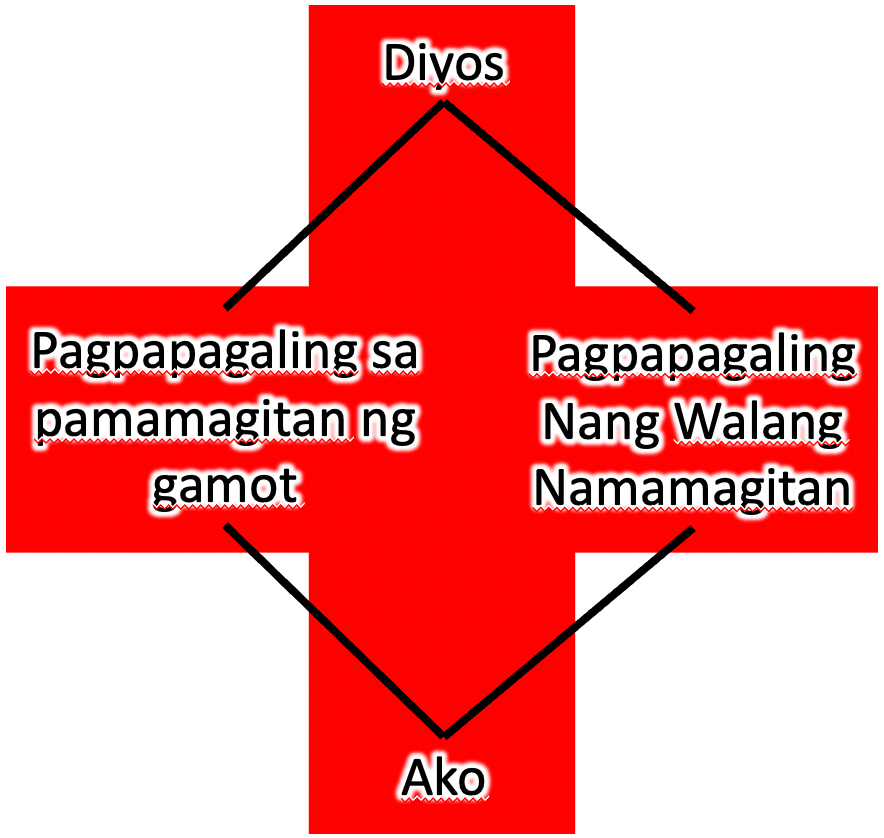
Ayon kay Stone, may dalawang maari paraan na ginagamit ang Diyos para sa ating kalusugan. Paminsan-minsan, nagpapagaling ng Panginoon ang mga tao sa pamamagitan ng gamot. Paminsan-minsan hindi siya gumamamit ng namamagitan — diretso galing sa kanya ang pagpapagaling (tingnan ang larawan sa ibaba). Dapat nating tanggapin ang tulong sa anumang paraan na pinili ng Diyos.

Ang isang magandang halimbawa dito ay ang kuwento ng pagpapagaling ni Naaman sa 2 Kings 5:1-14. Kung naalala nyo, si Naaman ay Heneral ng mga Kalaban ng Israel noong panahon ni Elisha. May malubhang sakit sa balat si Naaman. Meron siyang aliping dalaga mula sa Israel na nag payo sa kanyang amo na meron propeta sa Israel (si Elisha nga) na pwedeng magpagaling sa kanya. Para gawing maiksa ang kuwento, pumunta si Naaman kay Elisha at ang utos ni Elisha ay kinakailangan maligo si Naaman sa Ilog Jordan ng pitong beses para gumaling. Nakita natin na kahit may propeta ang Panginoon sa Israel, ginamit nya ang paligo sa ilog bilang proceso ng pagpapagaling sa sakit.


MGA IDINAGDAG 10 SET 2021:

Baka meron nagbabasa nito na nagsasabi ng ganito, “Dahil lahat ng gamot na binaggit sa Bibliya ay galing sa kalikasan, natural medicines lang ang dapat natin gamitin bilang Kristiyano. Iwasan natin ang pwedeng bilhin sa botika.” Alalahanin natin na ang mga gamot na nakalista sa itaas ay ang mga gamot na meron sila noong panahon nila. Hindi naman nila pinili na puro natural cures lamang — sa totoo lang wala naman silang mga pinagpilian. Ginamit nila kung anong meron sila. Wala naman sila botika noong panahon nila kaya wala silang option na gamitin yun.


Palaging malugod na tinatanggap ang feedback.

Pagbabahagi ang ginagawa ng mga kaibigan.

Akin ang mga larawan.

Pwedeng basahin din ang Part 2.

Ang mga sipi ng Banal na Kasulatan ay kinuha mula sa Ang Salita Ng Dios Biblia. Karapatang magpalathala © 2009, 2011, 2014, 2015 ng Biblica, Inc.® Ginamit nang may pahintulot.

3 Types of Evil: Part 2

Part 1 of this post proved very popular on Facebook. If you haven’t read it yet, head on over to get caught up. Lots of good questions and discussion. In light of that I thought it might be a good idea to flesh out some of the ideas in that post and try to answer any questions that arose.

What should be obvious from part 1 is that evil is a complex subject. For sake of clarity I am using evil as a catch all for everything bad that is in the world. I base this on the statement God repeatedly makes in Genesis after creating stuff: “Everything is very good.” For me that means that if something is bad then it isn’t a part of the original creation. Jumping off on this, I think that our theologising is misguided when we start from the concept of original sin since Adam and Eve were created with original righteousness. So my conceptualisation of evil includes death, sin, suffering, sickness, injustice, rebellion, and self-righteousness/self-trust and anything that causes these things. 

I actually expected most of the comments to be about structural evil since that is a huge topic in the church today. However, as it turned out, most comments related to personal evil and natural evil. 

Any discussion of evil has to start with Genesis 3 where we see the story of Adam and Eve’s sin in the garden of Eden. It’s interesting to look at the three types of sin that are talked about in this passage.

Personal Evil. We begin with the curses that are placed upon Adam, Eve, and the serpent for their personal sins. It is important to point out however, that even though Adam, Eve, and the serpent sinned personally, the bible treats their personal sin differently that our personal sin because their personal sins had an effect on everyone else.

As Saul Samante asks, “Is it safe to conjecture that these three evils are not really separate entities but deeply connected with each other? Let me put it this way: Personal evil (Adamic sin), gave rise to cosmic and systemic evils. Prior to the fall, everything was perfect and harmonious. After the fall, cosmic harmony disintegrated and human structures or systems became oppressive.”

Romans says that death entered through Adam’s sin. This is significant for the rest of our conversation because a large part of our understanding of natural evil is connected to death. We will expand on this below.

Structural Evil. We also see Adam’s sin as it affects his family namely Eve and their unborn children. So here we see that Adam’s personal sin has an effect upon the structures of the day, in this case family but of course eventually expand on to become greater structures in society. As Mike Swalm points out,

“Your examples of systemic evil, for instance, could they stem from some of the systemic curse language (your desire will be for your husband and he will rule over you/enmity between woman and serpent etc)?”

Mike is on the right track. The language used in these two phrases is significant in that we see linguistic parallels between this passage and the account of Cain’s sin a few chapters later. Take a look:

In Genesis 3:16 God says to Eve, “Your desire will be for your husband, and he will rule over you.”

In Genesis 4:6, God says to Cain, “But if you do not do what is right, sin is crouching at your door; it desires to have you, but you must rule over it.”

These simple words set the stage for the battle of the sexes. They set up a struggle of evil desires that each party will have as a result of sin. The woman will desire to control her husband in the same way that Cain’s sin desired to rule over him. On the other hand, the husband response is to rule over his wife.

Of course God had already told us what the relationships should be: a “helper who is right for him,”taken not from his head nor from his feet but from his side. It is a statement of equality, of companionship, of working together, of partnership.

Natural Evil. We also see in the in the curse on Adam that his curse will impact the ground or the environment around him and this is a curse as it exists upon the natural world. Whereas prior to this the ground would give up its riches willingly to him, after the sin he would have to work for these riches with the sweat of his brow and his work would be less than productive. 

Lex Ely Aspiras asks, “In natural evil, what makes natural phenomena evil? It is easy to understand that when people suffer because of typhoon Ondoy, this indeed is evil. Somewhere in the world, a storm is raging without affecting any human being, is this also evil? An earth-size storm is raging in Jupiter for centuries, is that evil? Sunspots adversely affect life on earth, are sunspots evil? Beyond earth’s atmosphere up to the edge of the observable universe, everything appears anathema to life as we know it, is this “everything” evil?”

We saw above that Romans says that death entered through Adam’s sin. This is significant because a large part of our understanding of natural evil is connected to death. It seems that prior to Adam’s sin, there was no death. That means that because death is a direct result of sin that things that cause death are also a part of the evil that pervaded the universe after Adam. Following this along further, events that seem normal in today’s world — typhoons, earthquakes, floods, pandemics — may have existed in the past but they certainly didn’t cause death.

One question we need to ask is, “What is the cause of these weather patterns?” Certainly they are natural but are there also other causes for them? The Bible pretty explicitly says that some weather patterns such as storms, pandemics, and famines can be caused by sin. I have written about that here

There is actually some evidence that weather patterns prior to the flood were different that the weather patterns we have now. Genesis 2:5-6 says there wasn’t any rain but that a mist or underground water watered the earth. This seems to imply that the rains that came before the flood were something unique and unknown during those days. All that to say that storms may not have existed prior to Adam’s sin.

Where do the Spiritual Powers fit into all of this? Another aspect of evil emerged from the online discussion, particularly by Rei Lemuel Crizaldo and Rene del Barrio. “What about,” some asked, “The evil associated with spiritual powers?” We do see within the story the reality of spiritual powers because the serpent, who we later discover is the Satan, is in fact a spiritual power. Because of the curse we see that his power is limited through this encounter because he can no longer walk upright but must crawl on the ground dragging his belly. The question remains as to where these spiritual powers fit into today’s world.

Ultimately the question associated with this is, “Is Satan responsible for causing some of the evil in the world, too?” Many stories of people’s encounters with spiritual evil exist. I have heard stories of people being freed from spiritual oppressions that have caused mental illness and even death. The Bible also has countless examples of Jesus freeing people from unclean spirits. It cannot be denied that spiritual powers exist and are active in the world.

One thing the Bible does say about spiritual powers, however, is that their power is limited. Statements like “Don’t give the devil any opportunity to work,” “Resist the devil and he will run away from you,” and “Put on all the armor that God supplies” mean that it is within human power to not be overcome by Satan. 

Jesus, in the direct context of a discussion of whose power he is using — Satan’s or God’s — says that he needs to “tie up the strong man.” The strong man in this case is the devil.

The Book of Revelation speaks of the end of all kinds of evil, including the end of rebellious spiritual powers — Satan ends up cast into the bottomless pit and the lake of fire. Evil is eventually eliminated from creation and we get a glimpse of what life will be like without any evil.

So it seems that if we give permission or opportunity for these powers to exert themselves then they will. And it appears that if we do not give permission or opportunity then these powers cannot act.

So what then of Job? While it is true that God and Satan do have a conversation or two about Job it’s also important to note that it is in fact God who brings up the subject, not Satan. God clearly lays out the rules of engagement for how Satan is to tempt Job and in the end it is God who is glorified, and Job who is vindicated. Satan is by no means the hero of the story. Also note that Job’s trials were implemented through structural evil (bandits & enemies attack on his flocks), natural evil (a windstorm destroys his kids’ house, fire falls from heaven and consumes his flocks, and boils cover his body), and personal evil (Job prayed for them that God would forgive any sins his kids may have committed). So the tripartite theology of evil is even seen here.

Feedback is always welcome.

Sharing is what friends do.

Image by Joao Tzanno on Unsplash.

How can the church partner with the world while maintaining its identity? By imitating Jesus’ Changing Water into Wine. Lessons from Thomas Aquinas.

“All truth is God’s truth.”

I can’t tell you how many times I heard this while I was in seminary. And that was a good thing because I needed to hear it. I had spent the years leading up to seminary developing my understanding of truth that was pretty much limited to what the Bible (or at least my interpretation of the Bible) had to say. Any claims to truth outside of the Bible were suspect for me.

I even remember a time in a class I took at USask on Religious Perspectives on Death and Dying when I had to comment (in a test) on the validity of the fictional Death of Ivan Illich to my understanding of death and dying. My reply was that since it was fiction it wasn’t true! Wise Professor Robert Kennedy pointed out that truth can be found in a variety of areas of life including fictional accounts.

And it appears this debate isn’t all that new. The other day I took a look at Mitchell Atencio’s interview Why Nathan Cartagena Teaches Critical Race Theory to Evangelicals with Nathan Cartagena on Sojourners and saw a great idea from Thomas Aquinas.

In 1261, a few years before I went to seminary, Thomas Aquinas wrote a commentary on Boethius’ On The Trinity. Apparently some agreed with my early ideas — that blending God’s Truth with rational truths somehow muddies the mixture. Article 3 of Super Boethium De Trinitate by Thomas Aquinas answers this question in a very interesting way:

“5. It may be said: No conclusive argument can be drawn from figurative speech, as the Master (Peter Lombard) says. Dionysius also says in his letter to Titus that symbolic theology has no weight of proof, especially when such interprets no authority. Nevertheless it can be said that When one of two things passes into the nature of another, the product is not considered a mixture except when the nature of both is altered. Wherefore those who use philosophical doctrines in sacred Scripture in such a way as to subject them to the service of faith, do not mix water with wine, but change water into wine.”

Part of the problem that I faced in the early years of my theological formation was that I somehow believed that the world was divided into two parts: Sacred and Secular. As as young Christian I was warned about the dangers of the world — the danger that I would become worldly. This came out in many areas, including concepts like Christian music, Christian schools and colleges, and Christian bookstores. There was also the idea that people needed to leave the world and join the church. Interestingly there was never an idea that through my influence the world would become holy.

How can we apply Aquinas’ concepts of changing water to wine to the whole sacred-secular debate? The sacred-secular debate keeps the two worlds apart because of fear of contamination — but a contamination that always goes from good to bad. Aquinas says that in order for two ideas to mix that they both need to change. When it comes to God’s truth however, the end result is not a mixture of good and bad but a transformation of the bad into good, much in the same way that Jesus changed water into wine.

So, that brings us to current issues where this can be applied. I can think of three examples. When I was younger the bad guy was psychotherapy. Psychotherapy was bad for reasons that I can’t remember. Fortunately today I have personally benefitted from people who have been successful in blending the truths of God that can be found in psychotherapy with the truths of God found in scripture and have applied those truths into my life.

Christians have also had a love-hate relationship with science throughout the years. Some have suggested that vaccine hesitancy among some Christians is a direct result of the religion-science debate. The argument seems to go along the lines of, “Science promotes evolution that directly goes against the creation accounts of the Bible. If then scientists tell us that vaccines are ok that must mean that they aren’t ok.” What we as Christians often forget, though, is that the early scientists were in fact men and women of faith who desired to know more about God’s creation and started an in-depth study of it.

There has been a lot of talk of late in the church about Critical Race Theory. And that is in fact with the Nathan Cartagena interview is about. The main objection appears to be something like, “CRT is bad because it is Marxism.” Once again the fear of the world influencing the church rather than the church influencing the world rears its ugly head. What we often forget is that justice is one of the key aspects of the Kingdom of God but since it has been neglected so much by the church we need the expertise of those who have thought about justice issues in depth.

Of course I am not advocating an uncritical approach to these issues. As Aquinas himself tells us to “subject [rational philosophies] to the service of faith.” But what I am advocating is that Christians tap every resource available as we seek to turn the water of the world into the wine of proclaiming the Good News of Jesus Christ, establishing the values of the kingdom of God, serving God and neighbour, and testifying to God’s truth.

After all, Jesus promises that “the gates of hell will not prevail” against the church. Why should we act as if it already has?

Feedback is always welcome.

Sharing is what friends do.

Image by Klara Kulikova on Unsplash.

Of Governments and Hope: Where should I look for hope?

The Bible doesn’t really have all that great a view of governments. Certainly we are to obey governments but that’s not what i mean. The bible’s best option for human governance is always presented as being God.

We see this throughout the story of Israel in the Old Testament. Israel is freed from Egypt because Egypt’s government had enslaved them. God then led them through the wilderness to the Promised Land.

We see this in the story of Israel’s first king — Saul — a move that God saw as being a rejection of his rule, and even the most cursory of reads of Samuel, Kings, and Chronicles shows us the failure of this system.

We also see this in the choice of Matthew, Mark, Luke, and John to use the term “gospel” when identifying their story type; gospel or good news being the term Roman Emperors used to describe their own ascension to the throne. The four are in essence saying, “Jesus is a better emperor than Rome’s!”

That’s why government in the Bible is often referred to as an animal (most translations maintain the archaic expression “beast,” but as I’ve said here and here that that leads to strange interpretations). What this means is that we shouldn’t be surprised when the government tears us to pieces. The example in Canada at the moment is the whole Indian Residential School system (which I have written about here, here, and here) but I am sure we can come up with countless other ways governments around the world mess things up. Some organisations —such as Transparency International, Amnesty International, and Wikileaks — exist merely to evaluate the level of mess that governments make. Of course in the Biblical examples we also see some animals that have fatal wounds but don’t die, perhaps indicating domesticated governments who aren’t as powerfully bestial.

This is of course the danger of identifying any human political theory or system with God’s way. One recent Facebook conversation I had highlighted this. My friend pointed out the abuses that more leftist firms of government were guilty of, including the top echelons becoming rich while the rest remained poor. Of course the same could be said for rightist governments and their billionaires. Apart from this there are the similarities between parties on a vast range of issues — their differences are often highlighted but their end policies often end up being the same.

Regardless of the level of wildness in government, it is clear that something else is needed. So what’s the solution? I see at least two:

Lamb of God. The Bible describes Jesus as being more like a lamb than an animal. Certainly He is also the Lion of the Tribe of Judah, but in the context of the animal or beast language used in some parts of the Bible, Jesus as lamb is contrasted. No one in the created world — animals included — is found worthy to get God’s plan rolling: “” Eventually it is the lamb who was slain who is able to open the seals.

The kingdom of the world has become the kingdom of our Lord and of his Messiah, and he will rule as king forever and ever.” It’s the phrase “has become” that I would like to focus on. How does this process happen? There are some that view eschatology as something God does at the end of time. Our only tole as humans is to be the cause of the end because of our unbridled wickedness.

But I wonder if that is indeed the way things are meant to happen? If our wickedness brings about the end, is it possible for us to work together with God in the transformation of the kingdom?

Certainly God has included humans in his plans. Jesus did after all commission his human disciples (including us) to make disciples of all nations. Whose disciples are these to be? Jesus’ disciples of course. What will these disciples do?

Disciples are filled with the spirit, whether that means being empowered to do the work of God, to a way to cope with the troubles of the world without using addictions.

Disciples reconcile people to God and to each other. Paul talks about the ministry of reconciliation that we have on earth. This reconcilition imitates what God through Jesus began. He then says that “has given us this ministry of restoring relationships” as well.

Disciples bear fruit. We often interpret this to mean make disciples but fruit in the Bible more often than not refers to a personal transformation. This is best exemplified in lists of comparisons, most famously enumerated in Galatians 5, but also found elsewhere.

Disciples continue Jesus’ Isaiah 61/Luke 4 tasks of proclaiming Good News, forgiving others, giving sight to the blind, and freeing the captives.

Unfortunately the church hasn’t always been successful at fulfilling these tasks. What’s also unfortunate is that I have not always been successful at fulfilling these tasks. We have a lot to work on, both corporately and as individuals, in the process of working together with God for the transformation of our societies.

I wonder what we should work on first?

Feedback is always appreciated.

Follow my blog or subscribe via email (on the left) to stay up to date!

Image by Bill Fairs on Unsplash.

Oh no, Canada: Reflections on Canada on Canada Day

Reflection is good for the soul because it causes us to look back on events that we normally view on default and look at them with new eyes. Canada Day is one of these things, especially in light of a recent push to reconcile history with the past. Even using the term “default” is actually problematic because what may be default thinking for me is different for someone else. The history that I read may be different from the history someone else reads. My understanding of the past is also almost certainly different from the actual past.

Canada’s Truth and Reconciliation Commission identified the residential school system as a form of cultural genocide. What we are beginning to realise is that some form of physical genocide may also have been happening. Certainly the past was a lot more dangerous than the present, with diseases like TB and the influenza pandemic of 1918 taking many lives, but there are also documented cases of abuse and death at the very hands of those entrusted with the care of these young First Nations children. What makes things worse is that it doesn’t seem to be merely a government issue (and governments do tend to be animal-like), but also a church issue. This is because churches were an integral part of the Residential School system.

Because of these issues there have been calls to rethink Canada Day. After all, why celebrate the country when the country is built on such shameful actions that has made some many mistakes? Some communities are cancelling Canada Day celebrations, while others are planning alternative events to help incorporate victims of Residential Schools into Canada’s story.

So what is the answer? I think it lies in the concepts of Truth, reconciliation, and repentance.

Truth. This is the debate between history and the past (that I have discussed elsewhere). In a nutshell, history is “texts” about the past from a certain perspective. Texts can include writing of course but can also include any aspect of society (citation) including statues, memorials, and events like Canada Day. The past is the actual events that have happened and are being interpreted when doing history. History changes all the time as new perspectives create new interpretations but the past remains the same.

Reconciliation, or restoring relationships, is supposed to be a major part of the church. After all, God has given the church the “ministry of reconciliation.” Relationships need to be restored people and God but relationships between people and other people also need restoration. The church has emphasised the first aspect throughout the years — and in many ways this emphasis may have led to the residential school disaster by ignoring God’s command to love our neighbour as we love ourselves — but hasn’t worked as hard on the restoration of interpersonal relationships. We haven’t been as good at this part as we could have been.

“What about forgiveness?” some may ask. Forgiveness does need to happen, as Matt Stovall, writing from a First Nations’ perspective, points out in his great FB post on this. However, forgiveness works best when it is coupled with repentance, which means the church, as the offending party, needs to repent and ask forgiveness.

So what needs to be reflected upon this Canada Day? Where does reconciliation need to happen? Where does truth need to be reevaluated? How can I ask forgiveness?

On Canada Day, let’s reflect on Canada and repent of our sins. Our eyes are finally opening to the our ugly past. How will we make a better future? Listen to someone’s stories of their residential experience. Read the Truth and Reconciliation Commission Report. Read Dr. Peter Bryce’s 1907 Report on the Indian schools of Manitoba and the North-West Territories. Read about residential schools, reconciliation and the experience of Indigenous peoples.

On Canada Day, let’s reflect on the church and repent of our sins. It’s quite simple. For church insiders there is a wide range of church types and theologies, that are unknown and even meaningless to church outsiders. The specific churches involved in the Residential School System cannot be separated in people’s minds from the idea of “church.” As I have said elsewhere, “even if we weren’t physically present during these atrocities, we are still complicit in them because people bearing Jesus’ name did these things. Don’t we also bear Jesus name?” So as churches we need to seek ways to ask forgiveness. We need to reflect on the theologies that we hold that led to the whole Residential School system. We need to find ways to connect with First Nations People. We need to reflect on what repentance looks like for you and me.

On Canada Day, let’s reflect on Truth and repent of the untruths and half-truths we have believed instead. I have written elsewhere on truth. Suffice it to say, none of us has a complete understanding of absolute truth. Don’t get me wrong— I do believe in absolute truth but at best I can say we are approaching absolute truth. That means that part of the way forward includes reflecting on the truths that I know and how those truths coincide with the truths that others know and changing our truths so the future is better than the past.

Feedback is always welcome!

Please consider following or liking this blog.

Remember, sharing is what friends do!

Image by Derek Thomson on Unsplash.

Church, modified.

Church.

It doesn’t matter what you add to the word or how you modify it, it still means the same basic thing.

  • Underground church is a church that remains as hidden as possible due to persecution.
  • Local Church is a church in one community.
  • House church is a church that meets in someone’s house (or office, or third place).
  • Universal church is the church that has existed, exists today, and will exist in the future.
  • Indigenous church is a church that is contextualized to a certain society.
  • Persecuted church is a church that is being persecuted by another religion or by the government.
  • Mega Church is a really big church.
  • Cell Church is a really small church.
  • Online church is the online portion of a local church, whether live or prerecorded.
  • Virtual church is where every aspect of the church exists in the virtual world.
  • Live-streamed church is when a church broadcasts it’s Sunday morning services live online.
  • In-person church is when people gather for face-to-face meetings.
  • Church at home is when families worship at home.

But guess what? It’s all still church.

So what does that mean?

We should continue to be the church regardless of which modifier we pick.

  • We should continue to proclaim the good news the Jesus is our king.
  • We should live out the values of the Kingdom of God.
  • We should love God and love our neighbour.
  • We should bear witness to the truth.

How will you be the church today?

Feedback is always welcome!

Image by Skull Kat on Unsplash.

Of monuments and unmarked graves: Is it right to commemorate those responsible for the residential school system while ignoring its victims?

There have been many calls over the past years to either remove statues/honours or preserve them. Most recently in Canada these include people connected to the Indian Residential School System, including statues of Sir John A. MacDonald, the university named after Egerton Ryerson, and the honorary degree given to Bishop John O’Grady by the University of British Columbia. Those on social media who oppose removing memorials see them as a part of history that shouldn’t be changed.

How can we navigate issues like this? One good place to start is by understanding the difference between the Past and History — and no, they aren’t the same thing.

The events of the Past are unchangeable. The past rolls on continuously and inexorably. But there is no DVR or VHS for the past. The only thing that can be changed is the future. As Jose Rizal said, “Ang hindi marunong lumingon sa pinangalingan ay hindi makakarating sa paroroonan.” [“Whoever doesn’t know how to look to where they came from will not arrive where they are going.”]

History, on the other hand, is different from the Past. History is the interpretation of the events of the past. Because it is interpretation it is subject to change and reassessment.

Now let’s apply these ideas to statues. Is a statue the past or is it history? It’s history because it is the commemoration of a person deemed significant in the past. As Charlottetown, PEI, Coun. Greg Rivard says, “I don’t think removing a statue erases any history. A statue is symbolic of something, and I don’t think right now that the statue is symbolic of the right things.”

What about a grave? Is a grave the past or is it history? Graves are the past. This is because in most cases, actual people are buried in a grave. There are of course many types of grave. There are marked graves, complete with gravestone and epitaph. There are commemorative graves — for example the Tomb of the Unknown Soldier — where the person buried within is unknown but is representative all those who died for their countries but remain unidentified. Then there are mass graves or unmarked graves. Mass graves generally hold the bodies of those who have died in a tragedy.

Now what about when the victims of those memorialised and commemorated with statues are buried in unmarked graves? In May 2021, the unmarked graves of 215 First Nations children, whose deaths were undocumented, were discovered on the grounds of a former Residential School in Kamloops, BC. It doesn’t seem right to continue to commemorate or memorialise those responsible for the residential school system when these children have been abandoned and forgotten does it?

But it is one thing for this to be socially reprehensible. We also need to ask what the Bible says about stuff like this. I can think of two ideas in the Bible that apply here.

The Bible has a high regard for children:

Psalm 127:3 says, “Children are an inheritance from the Lord. They are a reward from him.”

Jesus had a high regard for children, even when society seemingly didn’t. We see this a couple of times, including Mark 10:13-16 that says, “Some people brought little children to Jesus to have him hold them. But the disciples told the people not to do that. When Jesus saw this, he became irritated. He told them, “Don’t stop the children from coming to me. Children like these are part of God’s kingdom. I can guarantee this truth: Whoever doesn’t receive God’s kingdom as a little child receives it will never enter it.” Jesus put his arms around the children and blessed them by placing his hands on them.”

Matthew 18:2-5 says, “I can guarantee this truth: Unless you change and become like little children, you will never enter the kingdom of heaven. Whoever becomes like this little child is the greatest in the kingdom of heaven. And whoever welcomes a child like this in my name welcomes me.”

Caring for widows, orphans, and foreigners is important to God:

James 1:27 says, “Pure, unstained religion, according to God our Father, is to take care of orphans and widows when they suffer and to remain uncorrupted by this world.”

The Bible even has harsh words for those who don’t treat children appropriately:

“These little ones believe in me. It would be best for the person who causes one of them to lose faith to be drowned in the sea with a large stone hung around his neck” (Matthew 18:6).

A millstone around the neck certainly isn’t commemoration is it?

Feedback is always welcome!

Image by NeONBRAND on Unsplash.

Is it possible to sin in the Name of Jesus?

Shocking news out of Kamloops. A graveyard containing the bodies of 215 first nations youngsters was discovered on the site of a residential school. What makes things worse is that the school in question was run by people who bear the name of Jesus.

I should clarify that while the news is shocking for the general Canadian population, First Nations peoples are intimately acquainted with stories like this.

For those unaware, residential schools were a part of Canada’s Aboriginal policy. The Truth and Reconciliation Commission’s report on Canada’s Residential Schools says it this way:

“For over a century, the central goals of Canada’s Aboriginal policy were to eliminate Aboriginal governments; ignore Aboriginal rights; terminate the Treaties; and, through a process of assimilation, cause Aboriginal peoples to cease to exist as distinct legal, social, cultural, religious, and racial entities in Canada. The establishment and operation of residential schools were a central element of this policy, which can best be described as ‘cultural genocide.’

“Cultural genocide is the destruction of those structures and practices that allow the group to continue as a group. States that engage in cultural genocide set out to destroy the political and social institutions of the targeted group. Land is seized, and populations are forcibly transferred and their movement is restricted. Languages are banned. Spiritual leaders are persecuted, spiritual practices are forbidden, and objects of spiritual value are confiscated and destroyed. And, most significantly to the issue at hand, families are disrupted to prevent the transmission of cultural values and identity from one generation to the next.

“In its dealing with Aboriginal people, Canada did all these things.”

What makes the Residential school narrative especially troubling is the deep participation of the church — those who bear Jesus’ name — in the whole mess. It causes a guy like me, who identifies as a Jesus follower and who is into theology and mission, to ask what went wrong?

Bishop Vital-Justin Grandin, of one of the key advocates of residential schools, wrote in 1880 about the purpose of residential schools:

“To become civilized they should be taken with the consent of their parents & made to lead a life different from their parents and cause them to forget the customs, habits & language of their ancestors.”

Unfortunately the history of missions is full of stories like this.

What is odd is that the Bible is very clear when it comes to culture and faith. Revelation 5:9 and 7:9 both speak of people from every nation, tribe, people, and language being a part of God’s kingdom. What does that mean in practical terms? When we bear the name of Jesus we attempt to have people meet him on their own terms, using their own language, in their own cultural context, in their own place. And when people from every nation, tribe, people, and language get to heaven their uniqueness is celebrated!

The rest of the New Testament is a study in contextualization as people from various cultures and places found ways — through the guidance of the Holy Spirit — to embed Jesus into their own contexts.[1]

I will make a bold statement: If your theology states that someone needs to abandon their own cultural identity — and to subsequently adopt a new cultural identity — in order for them to follow Christ, then your theology has no connection to Jesus.

Having said all of that, even if we weren’t physically present during these atrocities, we are still complicit in them because people bearing Jesus’ name did these things. Don’t we also bear Jesus name?

“I pray Lord that I would see where I am wrong in the things I do today. Forgive me for those things I have done in your name that misrepresent who you are. Lord heal our land.”

Image by Leesa Epp.

1. See Dean Flemming’s Contextualization in the New Testament: Patterns for Theology and Mission for more on this.

Nightmares vs Daydreams: Which do you think are more dangerous?

People often said when I was younger that I lived in a dream world — and that was true. I did spend a lot of time dreaming of an imaginary world. It is strange, however, that daydreams are often thought of as being a trivial waste of time. “It’s better,” they say, “to live in the real world.” What is also interesting is that we often think of nightmares as dangerous We worry about nightmares. We try to stop nightmares. We even make movies about them that frighten us into even more nightmares!

In reality, we should really spend more time concentrating on daydreams. Nightmares, after all, only last for a few brief moments. It’s the dreams that we have while awake that are truly dangerous because we can dream them for a lifetime, and in the end make them come true. 

As TE Lawrence says, 

“All men dream, but not equally. Those who dream by night in the dusty recesses of their minds, wake in the day to find that it was vanity: but the dreamers of the day are dangerous men, for they may act on their dreams with open eyes, to make them possible.”

Here are my daydreams:

  • I dream of a world where the rule and leadership of Jesus makes the world a better place. A place where the poor hear good news, where prisoners are made free, where the blind can see, where the oppressed are set free, and where the Lord looks with favour on all people. 
  • I dream of a world where the values of the world are the values of God’s kingdom. 
  • I dream of a world where we love each other like we love ourselves. This is best expressed by the Tagalog word kapwa, or “shared being.” 
  • I dream of a world where the truths we shape is the Truth that is revealed to everyone by God, applied to our own cultural and local contexts. 

It is easy to dream such dreams. It is harder to make these dreams come true. But as the old saying goes, “Begin with the end in sight.” 

Keep on daydreaming!

Photo by Jonathan Mabey on Unsplash.