3 Types of Evil: Part 2

Part 1 of this post proved very popular on Facebook. If you haven’t read it yet, head on over to get caught up. Lots of good questions and discussion. In light of that I thought it might be a good idea to flesh out some of the ideas in that post and try to answer any questions that arose.

What should be obvious from part 1 is that evil is a complex subject. For sake of clarity I am using evil as a catch all for everything bad that is in the world. I base this on the statement God repeatedly makes in Genesis after creating stuff: “Everything is very good.” For me that means that if something is bad then it isn’t a part of the original creation. Jumping off on this, I think that our theologising is misguided when we start from the concept of original sin since Adam and Eve were created with original righteousness. So my conceptualisation of evil includes death, sin, suffering, sickness, injustice, rebellion, and self-righteousness/self-trust and anything that causes these things. 

I actually expected most of the comments to be about structural evil since that is a huge topic in the church today. However, as it turned out, most comments related to personal evil and natural evil. 

Any discussion of evil has to start with Genesis 3 where we see the story of Adam and Eve’s sin in the garden of Eden. It’s interesting to look at the three types of sin that are talked about in this passage.

Personal Evil. We begin with the curses that are placed upon Adam, Eve, and the serpent for their personal sins. It is important to point out however, that even though Adam, Eve, and the serpent sinned personally, the bible treats their personal sin differently that our personal sin because their personal sins had an effect on everyone else.

As Saul Samante asks, “Is it safe to conjecture that these three evils are not really separate entities but deeply connected with each other? Let me put it this way: Personal evil (Adamic sin), gave rise to cosmic and systemic evils. Prior to the fall, everything was perfect and harmonious. After the fall, cosmic harmony disintegrated and human structures or systems became oppressive.”

Romans says that death entered through Adam’s sin. This is significant for the rest of our conversation because a large part of our understanding of natural evil is connected to death. We will expand on this below.

Structural Evil. We also see Adam’s sin as it affects his family namely Eve and their unborn children. So here we see that Adam’s personal sin has an effect upon the structures of the day, in this case family but of course eventually expand on to become greater structures in society. As Mike Swalm points out,

“Your examples of systemic evil, for instance, could they stem from some of the systemic curse language (your desire will be for your husband and he will rule over you/enmity between woman and serpent etc)?”

Mike is on the right track. The language used in these two phrases is significant in that we see linguistic parallels between this passage and the account of Cain’s sin a few chapters later. Take a look:

In Genesis 3:16 God says to Eve, “Your desire will be for your husband, and he will rule over you.”

In Genesis 4:6, God says to Cain, “But if you do not do what is right, sin is crouching at your door; it desires to have you, but you must rule over it.”

These simple words set the stage for the battle of the sexes. They set up a struggle of evil desires that each party will have as a result of sin. The woman will desire to control her husband in the same way that Cain’s sin desired to rule over him. On the other hand, the husband response is to rule over his wife.

Of course God had already told us what the relationships should be: a “helper who is right for him,”taken not from his head nor from his feet but from his side. It is a statement of equality, of companionship, of working together, of partnership.

Natural Evil. We also see in the in the curse on Adam that his curse will impact the ground or the environment around him and this is a curse as it exists upon the natural world. Whereas prior to this the ground would give up its riches willingly to him, after the sin he would have to work for these riches with the sweat of his brow and his work would be less than productive. 

Lex Ely Aspiras asks, “In natural evil, what makes natural phenomena evil? It is easy to understand that when people suffer because of typhoon Ondoy, this indeed is evil. Somewhere in the world, a storm is raging without affecting any human being, is this also evil? An earth-size storm is raging in Jupiter for centuries, is that evil? Sunspots adversely affect life on earth, are sunspots evil? Beyond earth’s atmosphere up to the edge of the observable universe, everything appears anathema to life as we know it, is this “everything” evil?”

We saw above that Romans says that death entered through Adam’s sin. This is significant because a large part of our understanding of natural evil is connected to death. It seems that prior to Adam’s sin, there was no death. That means that because death is a direct result of sin that things that cause death are also a part of the evil that pervaded the universe after Adam. Following this along further, events that seem normal in today’s world — typhoons, earthquakes, floods, pandemics — may have existed in the past but they certainly didn’t cause death.

One question we need to ask is, “What is the cause of these weather patterns?” Certainly they are natural but are there also other causes for them? The Bible pretty explicitly says that some weather patterns such as storms, pandemics, and famines can be caused by sin. I have written about that here

There is actually some evidence that weather patterns prior to the flood were different that the weather patterns we have now. Genesis 2:5-6 says there wasn’t any rain but that a mist or underground water watered the earth. This seems to imply that the rains that came before the flood were something unique and unknown during those days. All that to say that storms may not have existed prior to Adam’s sin.

Where do the Spiritual Powers fit into all of this? Another aspect of evil emerged from the online discussion, particularly by Rei Lemuel Crizaldo and Rene del Barrio. “What about,” some asked, “The evil associated with spiritual powers?” We do see within the story the reality of spiritual powers because the serpent, who we later discover is the Satan, is in fact a spiritual power. Because of the curse we see that his power is limited through this encounter because he can no longer walk upright but must crawl on the ground dragging his belly. The question remains as to where these spiritual powers fit into today’s world.

Ultimately the question associated with this is, “Is Satan responsible for causing some of the evil in the world, too?” Many stories of people’s encounters with spiritual evil exist. I have heard stories of people being freed from spiritual oppressions that have caused mental illness and even death. The Bible also has countless examples of Jesus freeing people from unclean spirits. It cannot be denied that spiritual powers exist and are active in the world.

One thing the Bible does say about spiritual powers, however, is that their power is limited. Statements like “Don’t give the devil any opportunity to work,” “Resist the devil and he will run away from you,” and “Put on all the armor that God supplies” mean that it is within human power to not be overcome by Satan. 

Jesus, in the direct context of a discussion of whose power he is using — Satan’s or God’s — says that he needs to “tie up the strong man.” The strong man in this case is the devil.

The Book of Revelation speaks of the end of all kinds of evil, including the end of rebellious spiritual powers — Satan ends up cast into the bottomless pit and the lake of fire. Evil is eventually eliminated from creation and we get a glimpse of what life will be like without any evil.

So it seems that if we give permission or opportunity for these powers to exert themselves then they will. And it appears that if we do not give permission or opportunity then these powers cannot act.

So what then of Job? While it is true that God and Satan do have a conversation or two about Job it’s also important to note that it is in fact God who brings up the subject, not Satan. God clearly lays out the rules of engagement for how Satan is to tempt Job and in the end it is God who is glorified, and Job who is vindicated. Satan is by no means the hero of the story. Also note that Job’s trials were implemented through structural evil (bandits & enemies attack on his flocks), natural evil (a windstorm destroys his kids’ house, fire falls from heaven and consumes his flocks, and boils cover his body), and personal evil (Job prayed for them that God would forgive any sins his kids may have committed). So the tripartite theology of evil is even seen here.

Feedback is always welcome.

Sharing is what friends do.

Image by Joao Tzanno on Unsplash.

Magpakalalake tayo! Let’s be men! Understanding how the power of manliness comes through joining God on his mission.

Let’s be men!

Today there are lots of phrases designed to help men be men, ranging from the rather tame, “Man up!” to the more crass “Grow a pair!” In the Philippines we say, “Magpakalalake ka!

Did you know that this term is used in the Bible? Try and guess where. You may be surprised. It isn’t used as a command for Jesus’ followers to emulate. It’s not used to stir God’s people to serve Him in a more faithful way. In fact it is used by a group of people who are so inspired that they defeat God’s people and capture their most important religious artifact. 

The story is told in 1 Samuel 4. The scene opens on a battle between Israel and the Philistines where Israel ends up losing. As a way to ensure that they win the next battle, they quickly run home to get the Ark of the Covenant. When the Ark arrives the men of Israel “shouted so loudly that the earth rang with echoes.” This causes the Philistines to be afraid and they say,

“A god has come into ⌞their⌟ camp.” They also said, “Oh no! Nothing like this has ever happened before. We’re in trouble now! Who can save us from the power of these mighty gods? These are the gods who struck the Egyptians with every kind of plague in the desert. Be strong, Philistines, and act like men, or else you will serve the Hebrews as they served you. Act like men and fight.”

What was the result? “The Philistines fought and defeated Israel!” I don’t know about you but this is very surprising to me. This story seems to be saying that if men are men that they can do the following:

  • They can defeat ancient Israel, God’s chosen people. 
  • They can chase everyone back to their own home. 
  • They can kill 30,000 enemy soldiers.
  • They can kill the priests that God has annointed and cause the death of their father, the nation’s leader.
  • They can capture the Ark of the Covenant and take it home as the spoils of war. 
  • They can keep themselves from being slaves of their enemy.
  • They can defeat the God of Israel!

This raises a lot of questions, doesn’t it? One of the key aspects to interpreting the Bible is “if you have a question, keep on reading.” If we keep on reading we will find out more.

When we keep on reading, we find out that the battle was in fact a part of God’s judgement against the evil things that Israel had done over the years. Perhaps the best sum up that we have of how Israel was acting during that time is in Judges that reads, “In those days Israel didn’t have a king. Everyone did whatever he considered right” (God’s Word). Even their priests are described in 1 Samuel 2:12 as “good for nothing,” which is pretty bad, they are also said to have “no faith in the Lord.” God saw what they were doing and pledged to fix things. He gave a sign to Eli, the High Priest, that this would all happen. “What is going to happen to your two sons, Hophni and Phinehas, will be a sign to you: Both of them will die on the same day” (1 Samuel 2:34; see also 1 Samuel 3:13).

In 1 Samuel 5 we read that the Philistines placed the Ark in their own god, Dagon’s temple. This resulted in Dagon’s humiliation. In addition to that “The Lord dealt harshly with the people of Ashdod. He destroyed them by striking the people in the vicinity of Ashdod with tumors.” In an effort to appease the LORD, the people shuffled the Ark around from city to city. Finally they had enough and sent the Ark back to Israel. 1 Samuel 6 tells the story of the Ark’s return to Israel. So in the end, manning up didn’t really work out all that great for them.

There are other accounts in the Bible of how when people banded together, they were able to do the impossible. Genesis talks about the tower that people started building in what was to become Babylon (a name that eventually stands for humans grouping together against God). God, when he saw that they were going to be very successful, ensured that they wouldn’t be able to finish it. He said, “Now nothing they plan to do will be too difficult for them.” He confused their communication systems because he knew that his plans for them were much greater than their own. It wasn’t until Acts 2, when the Holy Spirit removed the language barriers, that God’s purposes are fully revealed. Rather than building a tower to reach the heavens (ie. their own kingdom), God wanted them to build his kingdom, which in the end is a much better kingdom. We know this because Babylon eventually stands for humans grouping together against God and we see it’s animal-like nature every day. I have written about that here and here.

So what does trusting God as men look like?

The enmity between Israel and Philistia continued for generations. One of the most famous encounters we know as the story of David and Goliath, where Israel emerges as the victor. What is interesting about the story of David and Goliath is that Goliath is the epitome of the man’s man — big, strong, famous, and arrogant. David, on the other hand, is just a kid. Even King Saul says in 2 Samuel 17:33, “You can’t fight this Philistine. You’re just a boy, but he’s been a warrior since he was your age.”

Paul’s claims to fame that reads almost like a manly bucket list of fame and adventure in 2 Corinthians 11:21-28:

  • Hebrew? Check.
  • Israelite? Check.
  • Abraham’s descendant? Check.
  • Christ’s servant? Check.
  • Worked hard. Check.
  • Been in prison because of Jesus? Check.
  • Been beaten? Check.
  • Faced death? Check. 
  • Beaten with 39 lashes. Check x 5.
  • Beaten with clubs. Check x 3.
  • Almost stoned to death. Check.
  • Shipwrecked. Check x 3.
  • Drifted on the sea for a night and a day. Check.
  • Faced dangers from raging rivers, from robbers, from my own people, and from other people. Check.
  • Faced dangers in the city, in the open country, on the sea, and from believers who turned out to be false friends. Check.
  • Gone without sleep, been hungry and thirsty. Check.
  • Gone without proper clothes during cold weather. Check.
  • Daily pressure of my anxiety about all the churches. Check.

What’s interesting is that Paul doesn’t give us this list to show us that he grew a pair or manned up. Rather he says something rather odd and seemingly unmanly. He says “If I must brag, I will brag about the things that show how weak I am.” Paul then goes on in 2 Corinthians 12:7-10 to say, “Satan’s messenger, torments me to keep me from being conceited. I begged the Lord three times to take it away from me. But he told me: ‘My kindness  is all you need. My power is strongest when you are weak.’ So I will brag even more about my weaknesses in order that Christ’s power will live in me. Therefore, I accept weakness, mistreatment, hardship, persecution, and difficulties suffered for Christ. It’s clear that when I’m weak, I’m strong.”

Paul’s appeal for healing and Jesus answer can help us find answers on how best to be men. Jesus’ “No!” may seem unfair at first until we look closer. We need to remember how Jesus expresses his own masculinity. First of all, Paul’s appeal for healing and Jesus’ answer can help us find answers on how best to be men. Jesus’ “No!” may seem unfair at first until we look closer. We need to remember how Jesus expresses his own masculinity.

First of all, Jesus himself was a man who gained victory through his weakness. His cry of anguish in the garden of “take this cup ⌞of suffering⌟ away from me” is also answered by his “However, your will must be done, not mine.” He knew that he could achieve victory for himself in his own power but that the victory God wanted through him was achievable only through God’s power because it was so much bigger than just for him.

Secondly, Jesus’ answer to Paul is that he will provide the strength for Paul’s struggle, because Jesus’ dream for Paul is far bigger than Paul can accomplish.

So what should we do instead? It’s clear that the call to “be a man” is powerful enough to cause us to do impossible things. We can defeat the enemy. We can build a tower that reaches to the heavens. It’s also clear that the impossible things we can accomplish are not necessarily good in the end nor are they necessarily what God wants us to accomplish. To truly be men we need to join God on his mission and await his power so that we can help him accomplish it!

Feedback is always welcome.

Sharing is what friends do!

Image by Simone Pellegrini on Unsplash.

Is it possible that my understanding of the Bible is wrong and if so how am I supposed to find out?

“When I began to speak, the Holy Spirit came to these people. This was the same thing that happened to us in the beginning. I remembered that the Lord had said, ‘John baptized with water, but you will be baptized by the Holy Spirit.’ When they believed, God gave them the same gift that he gave us when we believed in the Lord Jesus Christ. So who was I to interfere with God?” When the others heard this, they had no further objections. They praised God by saying, “Then God has also led people who are not Jewish to turn to him so that they can change the way they think and act and have eternal life.”‭‭ Acts‬ ‭11:15-18‬ ‭GW‬‬

In Acts 1011 some incredibly significant changes happen in the early church. Here we read that the good news of Jesus Christ is expanded to include proselytes to Judaism and non-Jewish peoples. 

In Acts 11 some people complain about Peter’s encounter with Cornelius saying, “You went to visit men who were uncircumcised, and you even ate with them.” Peter then goes into a lengthy explanation of what had happened,  repeating every detail of the events of Acts 10. He says, “When I began to speak, the Holy Spirit came to these people. This was the same thing that happened to us in the beginning. I remembered that the Lord had said, ‘John baptized with water, but you will be baptized by the Holy Spirit.’ When they believed, God gave them the same gift that he gave us when we believed in the Lord Jesus Christ. So who was I to interfere with God?”

Once the complainers heard this “they had no further objections. They praised God by saying, ‘Then God has also led people who are not Jewish to turn to him so that they can change the way they think and act and have eternal life.'” 

The argument seems to be based on shared experiences. Jesus promised that they would be baptised with the Holy Spirit and so if anyone else shares in that baptism then that is a good thing. 

It got me thinking about issues that we face today. Issues where we know that we are right, not simply because of our opinions but because the Bible tells us that we are right. Is it like that for us today, too? Is this a model of how to make determinations in these issues? Are there things we are absolutely convinced about that the HS may have a different opinion on? How would the HS make that known to us?

In Acts 10-11 we see two ways that these kinds of changes happen: 

1. Sometimes God intervenes directly and tells people where they need to change. God directly tells both Cornelius and Peter that change is coming.

2. Sometimes people act on their own and God blesses their actions. One could argue that the people from Cyrene who first shared the good news with the Greeks of Antioch were simply following Peter’s example. But we also read that there was another discussion held in Jerusalem about the issue that resulted in the statement of Acts 15 regarding how non-Jewish followers of Christ needed to act. 

Andrew Walls, in The Gospel as the Prisoner and Liberator of Culture, says of theology, “It is therefore important, when thinking of African theology, to remember that it will act on an African agenda. It is useless for us to determine what we think an African theology ought to be doing: it will concern itself with questions that worry Africans, and will leave blandly alone all sorts of questions which we think absolutely vital. We all do the same. How many Christians belonging to churches which accept the Chalcedonian Definition of the Faith could explain with any conviction to an intelligent non-Christian why it is important not to be a Nestorian or a Monophysite? Yet once men not only excommunicated each other, they shed their own and others’ blood to get the right answer on that question. The things which we think are vital points of principle will seem as far away and negligible to African theologians as those theological prize fights among the Egyptian monks now seem to us. Conversely the things that concern African theologians may seem to us at best peripheral.”

What Walls is saying is that theology is developed around questions that are important for people in societies and because there are a variety of societies in the world, sometimes the issues in one society are unintelligible to the people of another society. 

For example, clearly the NT people saw no problem with the prominent role that women played in the spread of the good news of Jesus Christ. From the women who supported Jesus and the 12 financially, to the women who first announced the resurrection, to Saphira who, with her husband Ananias, taught Apollos the ways of the gospel, to Junias who was numbered among the apostles, there were many women who were involved in ministry at the highest levels! If this is indeed the case, why do many have such big issues with it today? 

Justice is also a key biblical issue. When Ezekiel says, ”Put a mark on the foreheads of those who sigh and groan about all the disgusting things that are being done in the city” (9:4) he is telling us that it’s a sign of connection to God to complain about injustice. If justice is so important to God, why is social criticism that is a part of movements such as Critical Race Theory, Black Lives Matter, and #metoo often rejected by the church?

When writing this post I had a lot of issues in my mind that I think others get wrong. But the real question I need to ask myself is where am I getting it wrong? Where do I need to hear the voice of God and change my deeply held convictions and move into conformity with his will? 

Feedback is always welcome. 

Sharing is what friends do.

Image by Robert Ruggiero on Unsplash. 

ECQ na naman! “Kailan ba Panginoon?” o “Nasaan ka ba, Panginoon?”

English

ECQ[1] na naman! Dahil kay Delta Variant ng COVID-19 itinaas muli ang ECQ sa QC. Ito ay para sa ating kaligtasan. Pero, nakakalungkot diba? Akala natin na ok na tayo dahil higit pa sa isang taong nag social distancing, naghugas kamay, nag suot ng facemask at shield, nag stay-at-home pa. At lahat tayo ay ready magpabakuna pag oras natin. Pero mukhang wala sa atin kamay ang solution sa problema nito.

Sa mga ganitong panahon, naalala natin ang sinabi ng Panginoon sa mga Israelita noong Jeremias 29:11, “Alam ko kung paano ko tutparin ang mga plano ko para sa kabutihan n’yo at hindi sa kasmaan n’yo, at plano para bigyan kayo ng pag-asa na magkaroon kayo ng mabuting kinabukasan.” Napatanong tayo kapag naalala natin ito ng “Kailan ba Panginoon?” o “Nasaan ka ba, Panginoon?”

Kinakailangan natin balikan ang konteksto nitong verse sa Biblia upang sagutin ang tanong natin. 
Sa panahon kasi ni Jeremias, hindi maganda ang kalagayan ng bansang Israel dahil sa kanilang mga kasalanan. Ang biling ng Panginoon kay Jeremias ay maipahayag sa mga taong bayan kung ano ang plano ng Panginoon sa kanila. Sabi kasi ng Panginoon na dadahihin sila sa Babylonia bilang parusa ng kanilang mga kasalanan. 70 na taon ang panahon ng kanilang pagkabihag na binigay ng Panginoon sa pamamagitan ni Jeremias. Pero ayaw maniwala ng mga taong bayan at ng mga ibang mga false prophets kaya sabi nila na hindi sila tatagal sa Babylonia. Mga dalawang linggo lamang ang panahon ng pagkabihag doon. 

Kahit pinaparusahan sila ng Panginoon, ok sa Kanya na mawawala sila sa Lupang Pangako for 70 years dahil kapag nasa Babylonia nasa kalooban pa rin sila ng Panginoon. Kahit tayo ay nasa ECQ or anumang antas ng restrictions, nasa kalooban pa rin tayo ng Panginoon!

Unang una, sasabihin ko sa inyo na kahit naniniwala ako na ang COVID-19 ay isang masamang bagay, hindi ako naniniwala na ang COVID-19 ay isang parusa ng Panginoon. Pero naniniwala ako na hindi normal ang pagkakasakit. Noong nilikha ng Panginoon ang sanlibutan hindi pa kasama doon ang sakit (Genesis 1:31). Ang sakit ay dahil sa kasalanan ng mga tao. Kaya may mga sakit ang mundo natin ngayon pero may darating din na panahon kung kailan mawala ang mga sakit sa mundo (Pahayag 21:4). 

Meron tayong pwedeng matutunan mula sa sinasabi ni Jeremias patungki sa mga bagay na hindi normal. 

Medyo kakaiba ang sinabi ng Panginoon sa mga Israelita. Imbis na maghintay lamang ang kanilang pagbalik, dapat makikisalamuha sila sa bago nilang lugar. Magiging bahagi dapat sila ng Babylonia — “Magtayo kayo ng mga bahay at doon kayo tumira. Magtanim kayo at kumain ng inyong ani. Magasawa kayo at nang nagkaanak kayo.”

Hindi tumitigil ang buhay kapag hindi normal ang ating kalagayan. Hindi pwedeng magsabi ng “pag maayos na ang buhay ko tsaka ako ako kikilos.” Sabi sa atin ng Panginoon, “Kumilos na kayo kahit hindi pa ayos ang kalagayan mo.” 

At hindi lang yun. Dapat din “Tumulong kayo para sa kabutihan at kaunlaran ng lungsod sa pinagdalhan sa inyo.” Ano ba’ng ibig sabihin?

  • Maging masunurin tayo sa mga batas patungkol sa pandemya kasi “para sa kabutihan at kaunlaran ng lungsod.” 
  • Mag hugas ang ating mga kamay, mag-social distancing tayo, mag suot tayo ng facemask at face shield, manatili tayo sa bahay kapag kinakailangan, at mag work from home tayo kung pwede. 
  • Magpa lista tayo sa pagpapapbakuna at pag dating ng panahon magpabakuna tayo. 
  • Ipananalangin natin ang mga taong namamahala sa COVID-19 response ng bansa. 
  • Tulungan natin ang mga taong nahirapan dahil sa pandemya. 

Pagkatapos ng sinabi nito, sinabi ng Panginoon, “Alam ko kung paano ko tutuparin ang mga plano ko para sa kabutihan n’yo at hindi kasamaan nyo.” Ibig sabihin, depende din sa atin pagsunod ang pagtupad ng mga plano ng Diyos. 

Meron kasing tao na binabaha ang bahay. Kaya umakyat sa bubongan nya at nagdasal, “Panginoon iligtas mo ako sa baha.” 

Meron dumaan na rescue mula sa baranggay. “Sakay na po kayo para maligtas kayo!” 

“Ok lang ako. Ililigtas kasi ako ng Panginoon” ang kanyang tugon. 

Meron dumaan na taong naka-banca. “Sakay na po kayo para maligtas kayo!” 

“Ok lang ako. Ililigtas kasi ako ng Panginoon” ang kanyang tugon. 

May dumaan na helicopter nang lumalapit sa kanya. “Sakay na po kayo para maligtas kayo!” 

“Ok lang ako. Ililigtas kasi ako ng Panginoon” ang kanyang tugon. 

Sa wakas nalunod sya sa baha at nag-puntang langit. Pagdating nya doon, nag-tanong sya sa Panginoon. “Lord, bakit hindi mo sinagot ang aking hilining sa iyo? Bakit hindi mo ako niligtas sa baha?”

“Ano ba?” sabi ng Panginoon. “Nagpadala ako ng rescue, ng banca, at ng helicopter pero ayaw mong sumakay!”

Minsan kasi naghahanap tayo ng milagro pero ang tugon ng Panginoon ay ang mga normal na bagay. 

Paano ka bang sinasagot ng Panginoon ngayon panahon ng ECQ muli? 

Palaging malugod na tinatanggap ang puna.

Ginagawa ng mga kaibigan ang pag-share. 

Larawan ni Erik Mclean sa Unsplash. 
__________ 
[1] Sa mga hindi nakakaalam, ang ECQ ay Enhanced Community Quarantine. ang ECQ ay ang pinaka-mataas na antas ng anti-COVID-19 measures na pwedeng ilagay ng Philippine Government. 

It’s ECQ again! “When, Lord?” or “Where are you, Lord?”

It’s ECQ [1] again! Due to Delta Variant of COVID-19 the ECQ was raised again in Quezon City. Even though it’s for our safetly, it’s sad isn’t it? We thought we were ok because for more than one year we have social distanced, washed our hands, worn a facemask and faceshield, and stayed-at-home. And we are all ready to get vaccinated when it’s our time. But it seems like things are out of our control. 

At times like this, we remember what the Lord said to the Israelites in Jeremiah 29:11, “I know how to carry out my plans for your good and not for your evil, and plan to give you of hope for a better future” (God’s Word). This makes us ask the question, “When, Lord?” or “Where are you, Lord?”

We need to go back to the context of this biblical verse to answer our question. In Jeremiah’s day, the nation of Israel was in a bad state because of their sins. The Lord’s command to Jeremiah was to reveal to the people what the Lord had planned for them. The Lord said that they would be taken to Babylon as punishment for their sins. The period of their captivity given by the Lord through Jeremiah was 70 years. But the people and the other false prophets did not want to believe so they said that they would not stay in Babylonia. They said the captivity there would only be about two weeks.

Even if the Lord was punishing them, it is ok with Him that they will be gone from the Promised Land for 70 years because when they are in Babylonia they are still in the will of the Lord. Even if we are on ECQ or any level of restrictions, we are still in the will of the Lord!

First of all, I will tell you that even though I believe that COVID-19 is a bad thing, I do not believe that COVID-19 is a punishment of the Lord. But I do believe the illness is not normal. When the Lord created the world, disease was not included (Genesis 1:31). Sickness is due to sin. So while there are diseases in our world today there will also come a time when the diseases of the world will disappear (Revelation 21:4).

We can learn something from what Jeremiah says about things that are not normal.

The Lord said something different to the Israelites. Instead of just waiting for their return, they should socialize in their new place. They were to be part of Babylon: “Build houses and live in them. Plant and eat your crops. Get married and have children.”

Life does not stop when our condition is not normal. It is not possible to say “when my life is in order I will act.” The Lord tells us, “Act now, even when things aren’t perfect.”

And that’s not all. You must also “Contribute for the good and prosperity of the city to which you are brought.” What does that mean?

  • Let us be obedient to the laws regarding pandemics because “for the good and development of the city.”
  • Wash our hands, wear a facemask and face shield, stay home when necessary, and work from home if possible.
  • Let’s make a list of vaccinations and when the time comes we will be vaccinated.
  • Pray for those in charge of the pandemic restrictions, that God may continue give them wisdom. 
  • Find ways to help those who are in need because of the pandemic. 

After saying all of this, the Lord then says, “I know how to carry out my plans for your good and not your evil.” That is, the fulfillment of God’s plans also depends on our obedience.
There was a man whose house was flooding. So he climbed on his roof and prayed, “Lord save me from the flood.”

Soon after that a rescue vehicle came from the local government unit. “Get in and be saved!”

“I’m fine. The Lord will save me” was his response.

Someone passed by in a small boat. “Get in and be saved!”

“I’m fine. The Lord will save me” was his response.

A helicopter passed by as it approached him. “Get in and be saved!”

“I’m fine. The Lord will save me” was his response.

He finally drowned in the flood and went to heaven. When he got there, he asked the Lord.

“Lord, why didn’t you answer my request to you? Why didn’t you save me from the flood?”

“What?” saith the Lord. “I sent a rescue vehicle, a small boat, and a helicopter but you want to get in any of them!”

Sometimes we want a miracle but the Lord’s response is something more normal.

How is the Lord answering you now during this ECQ repeat?

Feedback is always welcome.

Friends do the sharing.

Photo by Erik Mclean at Unsplash.
__________
[1] For those who don’t know, ECQ is Enhanced Community Quarantine. ECQ is the highest level of anti-COVID-19 measures that the Philippine Government can put in place.

Thoughts on drought in a very dry year. Is this drought a call for justice?

Saskatchewan is in the middle of a drought. A drought in its simplest form is when there isn’t enough rain to make the crops grow. The lack of snow and rain over the past year, coupled with record-high temperatures, have succeeded in drying out the soil to the point where crops are not growing. It isn’t the first drought to hit Saskatchewan and probably won’t be the last. Some say that drought is a direct result of climate change, which some say is caused by human activity.

The plight of the Saskatchewan farmer has more meaning for me this year since my wife and I have been spending a lot of time on the farm. It makes me want to find ways to help.

The Bible says that drought can at times be a sign of God’s judgment against structural evil. It got me thinking. Is it possible that the current drought is connected with recent revelations about Canada’s founding principles? For those unaware, headlines in Canada have been dominated by stories of the Indian Residential School System, an official policy by the Government of Canada and church groups to “remove the Indian” from First Nations children — basically the government of Canada had a policy of cultural genocide against First Nations peoples in an effort to both make them better citizens and to convert them to Christianity. North American society has also been rocked over the past several years with calls for justice for the systemic mistreatment of women, for systemic racism, for legacies of slavery, and for other historical injustices. I have written about some of these things here, here, and here.

At this point I need to offer some clarification lest I be misunderstood: As I have written elsewhere, structural and natural evils are different from personal evil. Structural evil is a system or pattern of beliefs or activities in an organization or culture that hinders or opposes the advance of God’s kingdom in this world. Natural evil includes things like famine, drought, disease, wild animals, floods, storms, and disease. So any judgment on structural or natural evil is not on individual farmers for their sins but on society as a whole for its sins.

But even though the reasons may be systemic, the impact is indeed personal. There are mental stresses associated with farming and drought. Farmers are extremely resilient. I recall a conversation I had with someone in the Ag industry in Saskatchewan a few years ago. He said he respects how farmers are able to do everything that they can to grow good crops but the fact remains that a major part of farming is out of their control — namely the weather — and that they continue to do it year in and year out regardless of how the previous year went.

In times like this, Christians like to quote 2 Chronicles 7:14 which reads, “However, if my people, who are called by my name, will humble themselves, pray, search for me, and turn from their evil ways, then I will hear ⌞their prayer⌟ from heaven, forgive their sins, and heal their country” (God’s Word).

Of course Canada has never claimed to be Christian nation so I am genuinely not sure how this verse can be applied today, but the Bible gives many examples of God’s interest in the nations including both blessings and curses.

The very first mention of natural evil in the Bible is in the context of farming. Adam was told by God in Genesis 3:17-19:

”The ground is cursed because of you. Through hard work you will eat ⌞food that comes⌟ from it every day of your life. The ground will grow thorns and thistles for you, and you will eat wild plants. By the sweat of your brow, you will produce food to eat until you return to the ground, because you were taken from it. You are dust, and you will return to dust” (God’s Word).

So it’s not completely crazy to assume that the land responds to structural sin, meaning that even if the 2 Chronicles 7:14 quote isn’t entirely apropos for today’s world, it might be apropos for drought situations since the immediate context of the verse is drought brought upon by society’s sins.

In any case, what would “humble themselves and seek my face” mean in light of the new call for social justice?

One aspect would have to include repentance. Repentance is hard to do because it involves not only humility but admitting that we are wrong. I don’t know about you but I don’t like doing that. So just at that level repentance is problematic. How much more public repentance?

Another aspect would have to be renovation. Repentance also includes making sure the future is better. It means changing the way I think and act. It means rectifying the past — rectification means rebuilding or renovating those past actions that I want to repent from. Renovation is hard because it starts with tearing things down. Some use the word “deconstruction” for this — a rather complex term that we don’t have time to go into today. I will say this, though. While deconstruction may include the use of a sledgehammer, it also has a level of control. It’s not mere demolition but needs to have some order to it, it needs to be systematic, and it needs to be useful.

The Bible does speak of a generational aspect to sin, which connects us to the sins of the past even if we weren’t present during those times. The lives we live today may have been directly impacted by decisions made by our progenitors and that means that we may still benefit from their sins.

Reconciliation also has to be a part of it. To be reconciled is to have a restored relationship. It is what happens when people humble themselves, repent, and renovate.

So then, how can we help farmers? We need to make some decisions. What does our nation need to repent from? What do we need to tear down? What do we need to renovate? How can I participate in building a new nation?

Maybe we can start here:

  • Revisit “truth.” Is what I think to be true actually the Truth?
  • Repent & Ask Forgiveness.
  • Practice Reconciliation.

Feedback is always welcome.

Sharing is what friends do.

Image by Maud Correa on Unsplash.

“I wonder who planted these trees?” Understanding our own defaults, biases, & assumptions.

Each one of us has defaults, biases, and assumptions. That is a reality. These defaults shape the way we see and understand the world. I remember a SEATS class I held on a small island in the east side of the Philippines. We were discussing Jesus’ famous illustration of the lily of the fields. The students were reporting after some group work on what they thought the illustration meant and I was struck by one thing: Interpretation depends not only on linguistic context but also on cultural context. A “lily” in the Philippines grows in the water. You may call them them lily pads or water lilies. The lily Jesus was talking about is different because it grows in the fields. There was a lot of discussion about this.

What is my default? My mind defaults to Saskatchewan. I wasn’t born here, I don’t live here (other than temporarily because of COVID-19) but I did spend my formative years here. I guess that’s what makes it my default. So how does this default manifest? In maps. When I look at a map my mind automatically assumes that the topography around the various map points is similar to Saskatchewan. If you have never been you need to visit sometime. Saskatchewan is an incredibly beautiful place, with vast boreal forests, rushing rivers, magnificent valleys, and living skies. But in spite of all of these things, Saskatchewan is known for being like one thing — a billiard table. It’s flat. There are few trees, at least in the south. When you arrive at in intersection on the highway you can expect to see nothing beyond two roads converging. When we were kids we spent some time planting trees for use as shelterbelts to keep the winds from blowing crops away.

Sometimes we don’t realise our biases. I didn’t realise my bias about geography until I moved to British Columbia in the early 1990s. Eva and I were moving from Saskatchewan to BC and I remember driving down Highway 1 into Langley, BC. The Highway is lined with beautiful, large trees — forests actually. I remember thinking to myself, “Somebody must have spent a lot of time planting these trees.”

It was odd that I assumed they were planted because I had driven through the bush before in several provinces (and even in other countries). I even dreamed of living in the bush at one time. But for some reason this was different. In my mind, these trees were planted. I didn’t realise those were my thoughts until a few months passed and it all of a sudden hit me — these trees were natural! No one planted them. In fact people spent lots of time and effort to cut them down!

It got me thinking about other assumptions that I have about life. Growing up in Saskatchewan told me that the noon meal is called “dinner” and the evening meal is called “supper.” I must admit that years of living in other places has me saying “lunch” and “dinner” but that’s not the way I grew up.

Of course the only way to figure out what your assumptions and biases are is to interact with others or travel to new places but this process is essential for ensuring that we can accurately and fairly present Jesus’ truths to the world.

Do you have any idea what your assumptions and biases are?

Feedback is always welcome.

Sharing is what friends do.

Emic vs Etic: Understanding how insider & outsider perspectives interact when doing theology. An example from the Philippines.

Cross-cultural interactions are a part of my everyday life. Is there a theology of cross-cultural interaction? There have been many. Unfortunately they don’t always have good results. Take for example the whole residential school debacle in Canada that started from faulty theology codified in the doctrine of discovery but stemming from long-seated ideas of cultural superiority.

Churches quite often have deep seated assumptions about “the world” that aren’t in fact true. Case in point. When I was in Grade 5 our class received a Gideons New Testament (is that still a thing). Afterward we were all talking in the boot room about the NT and I said to one of my classmates, “What are you going to do? Rip it up?” He looked at me like I was crazy. What possessed me to say that? I had been told my whole life in Sunday school that the world was opposed to Christians. Guess what? That wasn’t true after all. It seems that I as a Christian had assumptions that were untested.

So how can we move away from assumptions towards actual empirical data about the world around us? Last week I wrote about how the church can partner with the world in things like this. Some commented that the post was short on the “How” so I thought that I might give a more concrete example. We need to develop ways to better understand the world to make sure that we are asking and answering the right questions – to make sure that the message we exegete from the Bible is presented in a relevant way to those who are not yet followers of Jesus Christ. Anthropology can help us understand that. 

The following comes from planning some conversations I had with Filipino men about their masculinity and religiosity. I had heard that men are less religious than women but wanted to find out for myself if that was true. I decided to plan some research that tried to discover what is called the insider viewpoint.

Because many religious systems in the Philippines are from external sources, and because male participation in those systems is universally identified as being lesser than that of women, it is important to discover how Filipino males have constructed their understandings of pagbabalik-loob, pagkalalaki, and maka-Diyos. This calls for an emic approach to the problem rather than an etic one. Oxford defines emic as “studying or describing a particular language or culture in terms of its internal elements and their functioning rather than in terms of any existing external scheme.” Etic is defined as “studying or describing a particular language or culture in a way that is general, non-structural, and objective in its perspective.” Thus, an etic approach looks at the problem from outside, while the emic approach looks at the problem from inside. 

Origins of the Emic/Etic concept. Pike (1967) defined the terms etic and emic as “etic viewpoint studies behavior as from outside of a particular system,” while the “emic viewpoint results from studying behavior as from inside the system” (p.37). Pike wanted to move from etics to emics.

There is a debate about the validity of using an emic approach in seeking to understand a culture on its own terms. In fact, this debate is behind the development of ethnoscience worldwide.  What is often missed in the debate is the reality that all forms of science are emic in that whatever frameworks or structures are developed are developed from the emic perspectives of a specific culture. They merely become etic once applied to another culture.  

Bennagen (1980) discusses the “Asianization” of anthropology “to help strengthen Asia’s rightful claim to its heritage as well as to its visions of man, society and culture” (p. 1; see also Mendoza, 2016).  

Geertz (Geertz 1973b) championed what some have called an “actor-centered view is central to Geertz’s work, however, it was never developed into an actual theory or model” (Hudson et al, 2009). 

Harris (1976) adapted Pike’s terms. For him, emic was the focus on a single culture while etic was the “comparison of two or more cultures as a means of identifying common characteristics” (Olive, 2014). Harris saw emics and etics as equally valid – there was no advantage to be gained from an etic approach and thus no need to try to discover the emic.

He has an example the difference between an emic and an etic understanding of male to female cattle ratios in India. Approaching the issue from an emic perspective, Harris says that locals identify the causes of higher mortality of male calves is due to a variety of naturally-occurring causes. Approaching the issue from an etic perspective, however, causes Harris to ascertain that higher male calf mortality is due to the locals’ manipulation of naturally-occurring events that are economically determined. Harris’ conclusion is that by relying solely on an emic approach, the researcher misses the etic realities of what he calls “bovicide.”  

I suggest that another factor may be at play here. Harris’ emic reasons for the ratio include “that males ate less than the females…. because they were not permitted to stay at the other’s teats for more than a few seconds” (p. 33). I find the words “not permitted” to be telling because here we have the locals themselves giving the reasons for why the male calves die. It seems that Harris didn’t follow up on this clue to discover what else the locals might want to tell him about this process.  

An indigenous approach here might be helpful. Enriquez (1994) discusses pakikipagkapwa, or Filipino interpersonal relations, as divided into two categories — Ibang-Tao [“outsider”] and Hindi-Ibang-Tao [“literally “not-‘other’-person” and therefore an insider”] each in turn divided into several other stages (see also Pe-Pua et al, 2000; Lapiz, 2010, refers to these as Tagalabas [“From the outside”] and Tagaloob [“From the inside”], respectively). Information passed from one person to another varies based upon the relationship between the two parties. If the two parties are in the Ibang-Tao category the informant will seek to pass on information that they perceive to be what the researcher wants to hear. If the two parties are Hindi-Ibang-Tao, then the information passed on more accurately reflects the reality. Pe-Pua et al recommend that “the first level under Hindi-Ibang-Tao, which is pakikipagpalalgayan-loob (level of mutual trust, understanding, rapport) should be reached, at the minimum, in order to be assured of good quality data” (Pe-Pua et al, 2000, p. 59).  

Another hallmark of Filipino communication is pahiwatig [“hint”], or indirect communication. According to Maggay (2002)ang pahiwatig marahil ang pinakalaganap at maaaring masabing pinakabuod ng ating kulturang pangkomunikasyon” [“the hint is perhaps the most widespread and possibly the best summary of our culture of communication”] (p. 24). It is also defined as “hindi tuwirang pagpapahayag sa isang bagay, idea, o saloobin” [“a thing, idea, or thought is not revealed in a direct manner”] (UPDF) or as “di tuwirang pagpapaabot ng mga mensahe” [“messages are not delivered in a straight way”] (Maggay, 2002, p. 24). Information is revealed over a period of time and is not given all at once. The pahiwatig is an invitation for the researcher to dig deeper to find out the truth that is not yet fully revealed. Jocano (1999) speaks of a multilevel process of communication starting with pahiwatig [“hinted at”], moving through pabatid [“informed about”], and finally into pahayag [“revealed”]. Thus discovering truth in the Philippine context is an extended affair as layer after layer of truth is slowly revealed as the relationship between the researcher and the researched draw ever closer together. 

Now granted, Harris’ example is from India that may have different cultural norms from the Philippines, but that doesn’t belie the fact that there was “truth” in the emic investigation that Harris perhaps didn’t explore fully. Harris’ own example shows that the locals did reveal the cause of the ratio (i.e. “males …. not permitted” to eat) but there is no evidence that Harris pursued the conversation to it’s fullest extent.  

Thus in Harris’ example above, the farmers themselves are revealing the reality behind the ratio differences in an indirect way and inviting him to discover more through further communication.  

I argue that an indigenous approach to the issue would have led to Harris’ realization that the locals were in-fact telling him the reasons for cattle ratios but that his framework was unable to adequately aid him in this discovery. Thus his use of an etic framework allowed him to see a disconnect between the ideology (killing cattle is prohibited) and economy (cows are more economically advantageous than bulls) of his subjects in India. Imagine the study Harris could have had in discovering in partnership with the locals their strategies for dealing with the needs of both their ideological system and their economic system!  

The emic approach and Philippine studies of masculinity. The emic approach is common in Philippine studies.  

Pingol (2001), in her study of Ilocano men, states that she want to focus “more on emic rather than etic – the men’s understanding of themselves, how they construct themselves, how they remain men in their own eyes, or as viewed by their relatives and their community” (p. 16). 

Zialcita (2005) also takes an emic approach because it “looks at the data from the point of view of the actor; it seeks to understand in their own terms the reasons advanced by the actor for his thinking and acting” (Kindle location 1924).  

Mojares (2006), in his discussion of trying to recreate the way early Filipinos thought, struggled with the pull of emic and etic. He talked of trying to find a middle ground between “a facile universalizing and the exoticizing of difference; between the location out of which we are speaking and that ‘nation’ we are moving towards; between the need for political constructions and the awareness of their fictive character; between the claim to moral ascendancy and the practical requirements of power; and between the importance of the ‘native’s point of view’ and the dangers of turning it into a fetish” (p. 7)  

Moving into our present study, Houtman offers insights into understanding religiosity without using the frameworks developed by organized religions.  

Emic, Etic and our Problem. Houtman (2014) suggests that the study of religion can benefit from an emic approach. Rather than focusing on general definitions researchers should instead “let those under study decide whether and how religion is ‘real’ or ‘unreal’. It is they who can tell researchers in what sense they consider themselves ‘religious’ and/or ‘spiritual’, what exactly this means for them, and whether and how all this drives their behavior beyond the strictly private realm” (p. 20).  

There are in existence in the Philippines a variety of sets of preconceived notions of what it means to be a man or to even be a godly man. These have been formulated in the various world religions that have taken hold in the Philippines, especially Christianity and Islam. Christianity can be further subdivided into two sometimes-opposing conceptualizations that need to be understood on their own. A look at the intersections between maka-Diyos, and pagkalalaki would benefit from an emic approach. However, this study’s desire for an emic approach to the issue of Filipino male spirituality[1] is not so much a desire to ignore external structures and definitions and to favor indigenous structures and systems. Rather it is based on a desire to discover what, in fact, these indigenous emic structures and systems are. To date there has been very little work done to develop a philosophy or a theology connected with Filipino male spirituality. 

Criticisms of Emic-Etic approaches. There are no pure cultures and thus no pure emic-etic divide. All cultures use their own frameworks to evaluate the things they experience and sometimes these frameworks are in an etic form and sometimes in an emic form.

As Guillermo (2003) said, having too much focus on the emic removes any reason for interpretation to begin with. “The complete unification of the consciousness of the social scientist with an increasingly transparent object of analysis would be none other than the end of hermeneutics itself.” Which raises the question of for whom is the interpretation? It implies a cross-cultural facet that is essential to the process. Certainly someone within the culture is in no need of a hermeneutical framework but also someone who is completely outside of a culture can use no other framework than the one she brings with her. Of course, this is beside the point that no culture is pure or unsullied from outside influences. The key is finding a balance between the two that allows each side to see the other’s perspective and perhaps gain some understanding on their own. Thus, there must be a dialogic aspect to research. 

But the fact that there is cultural relativity (ala Franz Boas) implies that some level of hermeneutics is needed in understanding what one sees. For example, the sight of two men walking down the street hand-in-hand has different meanings in different parts of the world. Growing up in Canada two males holding hands was undeniable evidence that the two were in a homosexual relationship. However in the Philippines best friends not only hold hands but walk unashamedly down the street with their arms around one another shoulders. It is only through dialogue between etic and emic actors that one can determine the hermeneutical key. The goal of balancing the emic with the etic guides this research into a specific series of frameworks. 

I propose that seeking the insider view is a key part of church ministry. Only by having conversations with others can we discover our own blind spots and find ways to connect in meaningful ways with others.

Feedback is always welcome.

Sharing is what friends do.

Image by Brett Jordan on Unsplash.


1. The history of term Filipino is long and storied and beyond the scope of this paper. Coupled with this is the terms’ grammatical gender: Filipino refers to males and Filipina refers to females. Thus the term “Filipino male spirituality” is technically redundant. However since this redundancy is not necessarily seen nor understood outside of the Philippine context, for clarity this paper will use the term Filipino to denote people from the Philippines, regardless of their gender. 


References:

Bennagen, P. L. (1980). The Asianization of AnthropologyAsian Studies, 18, 1-26.

Enriquez, V. G. (1994). Pagbabangong-dangal: Indigenous psychology and cultural empowerment. Quezon City: Akademya ng Kultura at Sikolohiyang Pilipino.

Geertz, C. (1973). Religion as a cultural system. In C. Geertz, The interpretation of cultures: selected essays. London: Fontana Press.

Guillermo, R. (2003). Exposition, Critique and New Directions for Pantayong PananawKyoto Review of Southeast Asia, 3.

Harris, M. (1976). History and Significance of the emic-etic distinctionAnnual Review of Anthropology, 5, 329-350. doi:10.1146/annurev.an.05.100176.001553

Houtman, D. (2014, September). Pure religion and real sacrality: Authenticating Religion beyond Institutions and Traditions. Paper prepared for the summer seminar: Religion and Culture in a Globalized World, Questioning our Research Frames, University Centre Saint Ignatius Antwerp (UCSIA) University of Antwerp.

Hudson, S., Smith, C., Loughlin, M., and Hammerstedt, S. (2009). Symbolic and interpretive anthropologies. In Anthropological Theories, Department of Anthropology, The University of Alabama. 

Jocano, F. L. 1. (1999). Working with Filipinos: A cross-cultural encounter. Quezon City: PUNLAD Research House. 

Lapiz, E. (2010). Pagpapahiyang: Redeeming culture and indigenizing Christianity. [Manila: Christ Strengthening Ministries.]

Maggay, M. (2002). Pahiwatig: Kagawiang Pangkomunikasyon ng Filipino. Quezon City: Ateneo de Manila University.

Mendoza, S. L. (2016). Doing “indigenous” ethnography as a cultural outsider: Lessons from the Four SeasonsJournal of International and Intercultural Communication. doi:10.1080/17513057.2016.1154181

Mojares, R. B. (2006a). Reconstituting the mental life of sixteenth-and seventeenth century Philippines. Philippine Quarterly of Culture and Society, 34(1), 1-10.

Olive, James L. (2014). Reflecting on the Tensions Between Emic and Etic Perspectives in Life History Research: Lessons Learned [35 paragraphs]. Forum Qualitative Sozialforschung / Forum: Qualitative Social Research, 15(2), Art. 6.

Pe‐Pua, R., & Protacio‐Marcelino, E. A. (2000). Sikolohiyang Pilipino (Filipino psychology): A legacy of Virgilio G. Enriquez. Asian Journal of Social Psychology3(1), 49-71. doi: 10.1111/1467-839X.00054

Pike, K. L. (1967). Etic and emic standpoints for the description of behavior. In K. L. Pike, (Ed.), Language in Relation to a Unified Theory of the Structure of Human Nature. The Hague: Mouton de Gruyter, 37-72. doi: 10.1515/9783111657158.37

Pingol, A. T. (2001). Remaking masculinities: identity, power, and gender dynamics in families with migrant wives and househusbands. Quezon City: UP Center for Women’s Studies.

Zialcita, F. N. (2005). Authentic Though Not Exotic: Essays on Filipino Identity. Quezon City: Ateneo de Manila University. Kindle version.

How can the church partner with the world while maintaining its identity? By imitating Jesus’ Changing Water into Wine. Lessons from Thomas Aquinas.

“All truth is God’s truth.”

I can’t tell you how many times I heard this while I was in seminary. And that was a good thing because I needed to hear it. I had spent the years leading up to seminary developing my understanding of truth that was pretty much limited to what the Bible (or at least my interpretation of the Bible) had to say. Any claims to truth outside of the Bible were suspect for me.

I even remember a time in a class I took at USask on Religious Perspectives on Death and Dying when I had to comment (in a test) on the validity of the fictional Death of Ivan Illich to my understanding of death and dying. My reply was that since it was fiction it wasn’t true! Wise Professor Robert Kennedy pointed out that truth can be found in a variety of areas of life including fictional accounts.

And it appears this debate isn’t all that new. The other day I took a look at Mitchell Atencio’s interview Why Nathan Cartagena Teaches Critical Race Theory to Evangelicals with Nathan Cartagena on Sojourners and saw a great idea from Thomas Aquinas.

In 1261, a few years before I went to seminary, Thomas Aquinas wrote a commentary on Boethius’ On The Trinity. Apparently some agreed with my early ideas — that blending God’s Truth with rational truths somehow muddies the mixture. Article 3 of Super Boethium De Trinitate by Thomas Aquinas answers this question in a very interesting way:

“5. It may be said: No conclusive argument can be drawn from figurative speech, as the Master (Peter Lombard) says. Dionysius also says in his letter to Titus that symbolic theology has no weight of proof, especially when such interprets no authority. Nevertheless it can be said that When one of two things passes into the nature of another, the product is not considered a mixture except when the nature of both is altered. Wherefore those who use philosophical doctrines in sacred Scripture in such a way as to subject them to the service of faith, do not mix water with wine, but change water into wine.”

Part of the problem that I faced in the early years of my theological formation was that I somehow believed that the world was divided into two parts: Sacred and Secular. As as young Christian I was warned about the dangers of the world — the danger that I would become worldly. This came out in many areas, including concepts like Christian music, Christian schools and colleges, and Christian bookstores. There was also the idea that people needed to leave the world and join the church. Interestingly there was never an idea that through my influence the world would become holy.

How can we apply Aquinas’ concepts of changing water to wine to the whole sacred-secular debate? The sacred-secular debate keeps the two worlds apart because of fear of contamination — but a contamination that always goes from good to bad. Aquinas says that in order for two ideas to mix that they both need to change. When it comes to God’s truth however, the end result is not a mixture of good and bad but a transformation of the bad into good, much in the same way that Jesus changed water into wine.

So, that brings us to current issues where this can be applied. I can think of three examples. When I was younger the bad guy was psychotherapy. Psychotherapy was bad for reasons that I can’t remember. Fortunately today I have personally benefitted from people who have been successful in blending the truths of God that can be found in psychotherapy with the truths of God found in scripture and have applied those truths into my life.

Christians have also had a love-hate relationship with science throughout the years. Some have suggested that vaccine hesitancy among some Christians is a direct result of the religion-science debate. The argument seems to go along the lines of, “Science promotes evolution that directly goes against the creation accounts of the Bible. If then scientists tell us that vaccines are ok that must mean that they aren’t ok.” What we as Christians often forget, though, is that the early scientists were in fact men and women of faith who desired to know more about God’s creation and started an in-depth study of it.

There has been a lot of talk of late in the church about Critical Race Theory. And that is in fact with the Nathan Cartagena interview is about. The main objection appears to be something like, “CRT is bad because it is Marxism.” Once again the fear of the world influencing the church rather than the church influencing the world rears its ugly head. What we often forget is that justice is one of the key aspects of the Kingdom of God but since it has been neglected so much by the church we need the expertise of those who have thought about justice issues in depth.

Of course I am not advocating an uncritical approach to these issues. As Aquinas himself tells us to “subject [rational philosophies] to the service of faith.” But what I am advocating is that Christians tap every resource available as we seek to turn the water of the world into the wine of proclaiming the Good News of Jesus Christ, establishing the values of the kingdom of God, serving God and neighbour, and testifying to God’s truth.

After all, Jesus promises that “the gates of hell will not prevail” against the church. Why should we act as if it already has?

Feedback is always welcome.

Sharing is what friends do.

Image by Klara Kulikova on Unsplash.

The church post-pandemic will need to pivot, but sometimes pivots don’t work.

That all plants need water is something I have known my whole life but haven’t really experienced until this past few months. Saskatchewan is currently experiencing drought-like conditions and since we are staying at a farm we can see the effects first-hand.

Fortunately the farm has a pivot. A pivot is a large, elevated irrigation system designed to provide water to crops. A pivot is huge! It consists of a large 6-inch pipe about 6 metres off the ground. A series of wheels slowly move the pipe across the field, each rolling at a slightly different pace as it follows an arc across the field. It’s called a pivot because on end of the pipe is fixed to the ground and acts as the point around which the whole thing pivots. A large, elaborate pump supplies water to the pivot from a nearby lake. In the above picture, the white line extending across the field is the pivot. The darker curved lines are the tracks the wheels leave in the field.

Unfortunately the pivot hasn’t been working all that well for the past few years. It has a tendency to shut down automatically for mysterious reasons. After checking everything out multiple times the likely culprit is a problem in the electrical system. So while the pivot is a great idea, especially during times of drought, sometimes it doesn’t work all that well.

Pivot is a word we have seen a lot lately in the realm of ecclesiology. The COVID-19 pandemic has caused a lot of churches to evaluate how they deal with crises. Many say that churches need to learn how to pivot during times like this in order to survive. Churches that have a hard time with the pivot have a harder time adjusting to the changes.

Just as an irrigation pivot makes sure water gets to the whole field, so also a church that pivots makes sure the gospel gets to all of society. But sometimes adjustments need to be made. Which raises an issue when it comes to pivoting. Sometimes we need to change a part for it to work. What parts do I need to change or to switch out for something better?

I attended church for the first time last Sunday where there were no more restrictions. The government of Saskatchewan has decided that they will combat COVID-19 exclusively through vaccination. While there, I noticed a couple of pivots:

  • The pivot towards a paperless church that began with the pandemic has been maintained.
  • The pivot towards those little pre-packaged communion wafer and juice sets has now been pivoted away from back to real bread and those little plastic cups.

But I will say one thing. In spite of all my advocacy over the past months for embracing the virtual church, there are some things that are better done together. Specifically, not once while I was singing in the privacy of my own home, sitting in my comfortable easy chair, did I feel the urge to raise my hands but I certainly felt that while singing with the congregation on Sunday.

What things have you changed over the course of this pivot?

Feedback is always welcome.

Sharing is what friends do.

Image from Google Maps.

Shepherds, work, and the interruption of burning bushes.

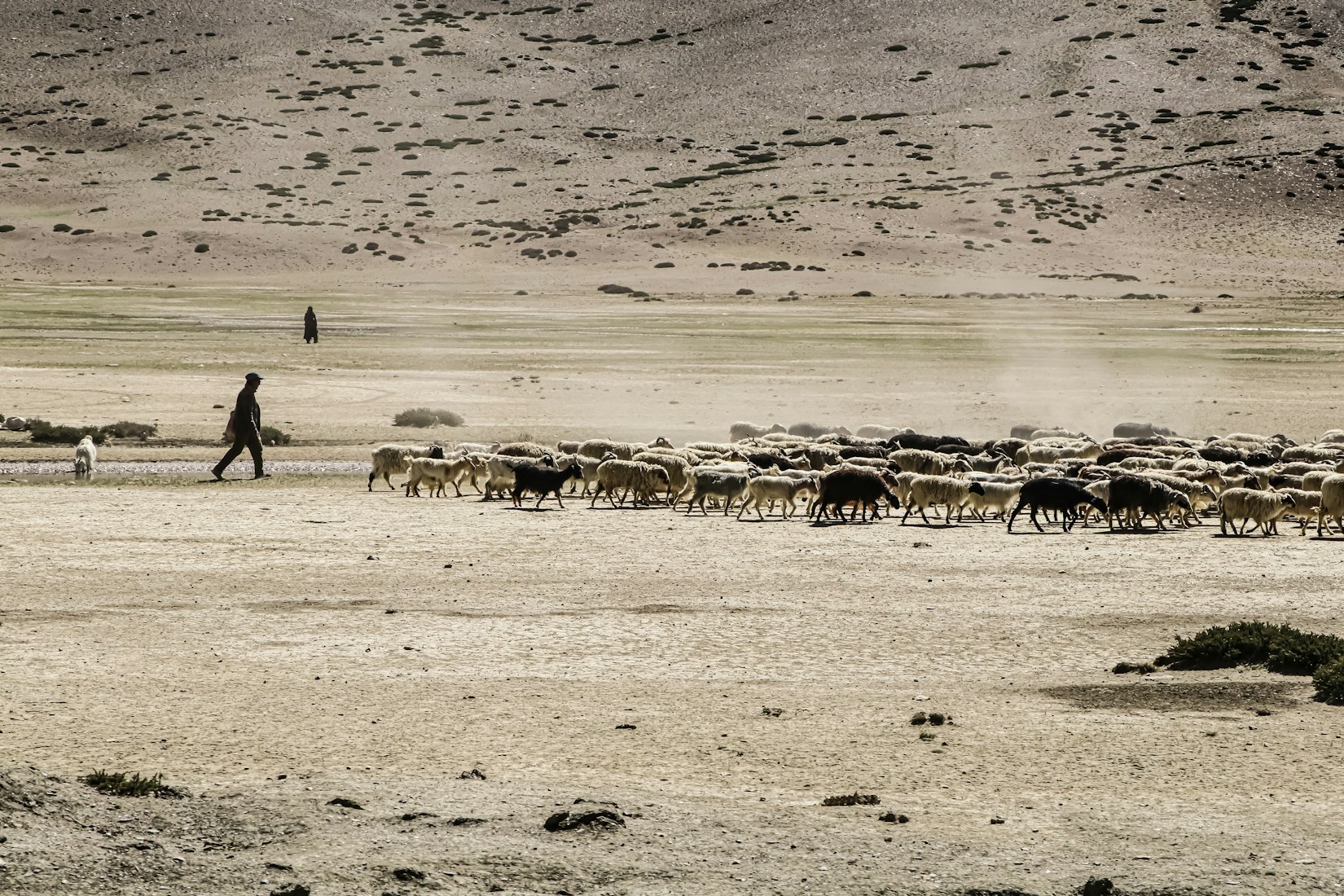
I have it on good authority that farmers work hard and I’m sure shepherds are no different, which is what makes Moses’ story all the more interesting. Some say bushes that spontaneously burn aren’t all that rare in the Sinai area, although that appears to be debunked here. Regardless, the fact that another bush was burning was perhaps more of a distraction than an attraction for Moses.

I have limited experience with sheep. The farm where Eva and I are currently living has three sheep and last week, while the family was away on vacation, we had to take care of said sheep. It isn’t all that hard — we had to take them out to the pasture in the morning, move them around during the day, and return them to their pen at night. It sounds simple but it was a little more involved than that. We had to make sure the sheep made it to their mobile pen in the pasture, a process that involves dragging them past much more appealing foliage to the foliage that we had chosen for them. It also sometimes involves chasing and catching said sheep to make sure they go where we wanted them to go. We also had to carry a 5 gallon bucket of water out to them and make sure that they stayed watered. When the grass in their moveable pen was consumed we needed to move them to a new location, sometimes ensuring that they had some shade. Daniel usually brought them in at night and his technique was running as fast as possible beside them so that they remained focussed on the destination rather than all the sweet grasses along the way.

I also recently watched Clarkson’s Farm on Amazon Prime. In the show, Jeremy Clarkson takes over his farm when his previous manager retired. The show follows him along as he learns the ropes on what it takes to run a farm in Britain. One aspect to Clarkson’s farm is sheep and there are several episodes devoted to what it means to farm sheep, including being up at all hours to birth them, making sure that the mothers and lambs are all caring for each other while in the pasture, and moving them to a new pasture without them getting into the neighbour’s fields.

It is a lot of work for those of us caring for just a few sheep. How much more a traditional shepherd with a full-size herd that she needs to keep track of? [Just as an aside, did you know that Rachel is one of the few named shepherds in the Bible? Check out her story in Genesis 29]

Which leads us to the question, “Why would a busy guy like Moses take the time to go see the burning bush?” What made him realise that it wasn’t merely a distraction and was something work making him take time out of his busy schedule? The Bible doesn’t say a lot about Moses’ thought process other than to say, “I must go over there and see this strange sight.” There was something strange that attracted his attention.

Moses’ situation reminds me to ask myself if I pay attention to “strange sights” in my day-to-day life that may be God’s attempts to get my attention. [Note that God will always eventually get my attention, as I have written about here.] In what ways does my busyness keep me from opportunities to encounter God? How do I distinguish distraction from a God-encounter? Are distractions in fact invitations from God?

I guess one type of distraction is internet use. But while some of the things that we encounter on the internet may be strange, this type of distraction can’t be labelled a “strange sight” in the way Moses labelled the burning bush. The burning bush got Moses’ attention while he was doing other things that he normally did. It pulled him away from the usual into the unusual. So sorry, we can’t use Moses as an excuse for always being on the internet.

Another type of distraction is escapist fiction. Who doesn’t love a great story that takes you away from your present life and allows you to live in a virtual world of adventure, excitement, and love? I am currently enjoying Burrough’s John Carter series. But yet again, this is a type of distraction that we bring upon ourselves and is not the type of distraction that God introduces into our loves for his purposes.

I suspect the kinds of distractions that God tries are things that distract us from our distractions. Some distractions are actually a call back to the real world. They interrupt our escapes and bring us back to reality. That’s what the burning bush did for Moses after all.

Once, many years ago, while I was talking to a friend, my daughter came up to me because she wanted to show me her new dress. Did I look at her new dress? No. I saw what she was doing as a distraction from what I was doing. If I had it to do over again I would say, Excuse me, to my friend and take a look at Emily’s new dress. Perhaps God was saying, “Pay attention to your family.”

What I my response when someone talks to me while I am watching a TV show? Do I see it as an interruption or a call to engage with someone in real life? What is my response when I and deeply thinking about the solution to a problem and my wife approaches me with a solution? Am I reminded that we are a team and can work things out together, or do I feel interrupted? What about when someone offers me constructive criticism? Do I see it as a change to improve or as a challenge to my abilities? I must confess that I often get these kinds of things wrong.

So what types of distractions have turned into God encounters for you?

Feedback is always welcome.

Sharing is what friends do.

Image Sandeep Kr Yadev on Unsplash.