Not everything the Church has done in the past has been good, and I think this is because churches — and by that I mean the organisation, not the organism — are parts of culture, parts of the systems of this world. You may recall me advocating for the idea that not only is my soul enslaved to sin, and not only is the created world around me being enslaved to sin, the structures and systems within our societies are also enslaved to sin, and that includes churches.
Now, don’t get me wrong. The Church is the body of Christ. The Church is the living witness of Christ. The Church testifies and proclaims, “Jesus is King.” The Church represents and lives out the values of the Kingdom. The Church loves God and loves neighbour, and the Church testifies to the truth and tells that truth in the world around it.
Except when it doesn’t.
Each of those four functions of the Church has an opposite and negative counterpart. Sometimes we place our own political systems ahead of Jesus. Sometimes we live out the world’s values rather than God’s values. Sometimes we don’t love God, nor do we love neighbour, or through our understanding of loving God, that means we reject neighbour. And sometimes we don’t testify to the truth. In fact, we continue to perpetuate the problems of this sinful world.
A Complicated Legacy
Today, I’m wearing an orange shirt. This is in honour of Orange Shirt Day and the National Day for Truth and Reconciliation. Because when we get right down to it, the Church has not always treated others the way they should be treated — and this serves as a reminder to me.
Now, for me, this issue is a little bit fraught. I’ve spent my entire life in the Church, and I can trace back through the history of families on both sides, people who have devoted their life to the Church and to proclaiming the good news of Jesus Christ around the world, and to leading churches and communities.
But on the other hand, my great-great-great Grandfather, Rev. James Settee, left his home early as a young child to be educated in the ways of the Church.
He became a bridge between two worlds. Not only a bridge between the worlds of European settlers and First Nations peoples, he also became a bridge between people who were enslaved to sin and the saving power of Jesus Christ.
I’ve recently been going through his autobiography and started reading through some of his diaries, and I have no doubt in my mind that Rev. James Settee was a fully convinced and converted, faithful follower of Jesus Christ.
For example, when reflecting on his life, he writes, “It did not matter any thing to me when I went to whom I ministered the Word, I was ready to go anywhere and do what I could for the Master.”
Wherever he went he advocated for people repenting of their sin and becoming followers of Jesus. But not only that, he also helped them with their daily needs, such as planting gardens and thinking about solutions for the vast number of First Nations peoples who found themselves with inadequate resources to support them. He advocated at the highest levels, all the way up to the Prime Minister and the Governor General.
But he didn’t just talk the talk. He also got his hands dirty, digging in the ground, planting seeds, catching fish, building churches out of logs, travelling 13 miles with a broken rib, leaving his family behind as he travelled around the lakes, rivers, and plains of Rupert’s Land then northern Manitoba and Saskatchewan, all with one goal in mind: To bring the Gospel of Jesus Christ, to bring truth and reconciliation.
Everyone Bears God’s Image
So, this is a great legacy that I have to reflect upon. But even as I reflect on this, I think about the problems that the Church ran into. And a couple of verses came to mind — verses I think that some of these early founders of Canada forgot.
The first verse is “So God created humans in his image. In the image of God he created them.” Genesis 1:27 GW
As we wander the world, nobody we come face-to-face with is created in anybody else’s image. Whether that person looks like me or doesn’t, whether that person sounds like me or doesn’t, whether that person has the same beliefs as me or doesn’t, all are created in God’s image.
That’s why it’s really important for God — through the entire Bible, and through Church history — to not only be interested in, but to actively work towards sending us into the world so we can make disciples of all nations. These disciples are not merely the individuals in those nations, but those nations as well.
After all, in Revelation we read about people from every tribe, nation, language, and people are a part of God’s Kingdom. That’s everyone. No one is left behind — even children.
When Culture Becomes Christianity
One of the mistakes of the past was to equate culture with Christianity, with the idea that as long as I wear my clothes this way, build my houses this way, build my church buildings this way, and live this certain way, that means that I am a follower of Jesus.
But the fact that the Bible tells us that people from every tribe, nation, language, and people are a part of God’s Kingdom means none of those cultural things are important enough to make God overlook us. What’s important to God is that people be encouraged to return to him and to help transform their own cultures from the inside, in ways that are significant and relevant to them, so that their cultures, too, can be freed from the evil that enslaved them.
Transformation from the Inside
One of the key aspects to transforming a culture from the inside is that insiders need to be the ones to manage that transformation. It’s not right for outsiders to come in and say, “This is what you need to change.”
Now fortunately, together with the commission to make disciples of all nations, Jesus also said, “I will be with you always, to the end of the age.” He said that his Spirit will come upon us, and it’s this Spirit that guides us into the truth.
It’s very easy for an outsider to come in and point out all the problems with another society. But once we live together with people and share their lives, we realise, “Wait a minute. There’s things that I need to change in my own life as well.”
The secret for the Church — because this post is primarily about us asking ourselves, “How can we do better?” — is to allow God’s Spirit to move in the way that God’s Spirit wants to move.
What Does Transformation Look Like?
So you may ask, what does this transformation look like? How do I know if my culture has been transformed from the inside?
Dr. Jun Vencer has come up with four markers to indicate whether a culture has been transformed: Is there public justice? Do people have economic sufficiency? Is there national righteousness? And is there social peace?
Now, each of these things may mean something different for each culture or society, but these are the goals that we work towards as we try to transform our own cultures from inside.
And in fact, this blog post is an attempt to try to help us transform who we are, whether we come as an outsider, as an insider, as a settler, as a coloniser, as a First Nations person, as a Métis person, or as a foreigner. What is God calling me to do is to not only become a better person, but to make the world I live in a better world, isn’t he?
Be an Advocate
So, what does this mean for me today?
The word that comes to mind is be an advocate.
What makes me say that? Well, in the past couple of years, I’ve had two fairly serious experiences with the medical system. In 2024, I had a fungus and secondary pneumonia in my lungs, and earlier this year I was diagnosed with stage four prostate cancer that has left me with only one functioning kidney, as well as spread to my bones and bladder.
One of the main struggles that people face when confronted with a medical condition is, how do I navigate this? How do I navigate the medical system? How do I know what to ask my doctor? What do I do when I have to take a medical test? What do all of these results mean?
I’ve been blessed because Eva is a nurse, and she has been a great companion through these processes. But I know others who struggle. They have nobody to help them journey through the issues related to the medical world. And they suffer as a result.
Truth and reconciliation requires advocacy. Who will help people navigate? What is the truth? What does reconciliation mean? How can we navigate this process?
Of course, the problem with navigation is when one person sets themself up as an expert and the other person is someone who’s learning. I think advocacy in the Church should be a two-way street. We work and journey together to try to find out, what this means for us today. How can I love my neighbour who’s created in the image of God? And how can I make this world a place where God dwells with us and we dwell with him?
God’s Home with Humans
A second verse comes at the end in Revelation:
“I heard a loud voice from the throne say, ‘God lives with humans! God will make his home with them, and they will be his people. God himself will be with them and be their God.’” Revelation 21:3 GW
Here God makes his dwelling — his own dwelling — the same as the dwelling of humans. God wants to live in eternity with you and with me and with everyone around us.
So What Do I Do?
So, where does that leave me today as I am faced with the people around me, in the world around me, in my society, in my community, in my family, and in the greater world?
I need to remember that everyone is created in God’s image and deserves to be respected and to be approached and to be loved.
I also need to remember that wherever I go, God is with me, and in the end, God wants us all to dwell with Him forever.
So, what can I do to make the love of God felt by those who are not like me, who don’t come from where I come from, who speak a different language than I do, who wear different clothes than me, who have different levels of education from me, and who have different ways of worshipping God?
I’m wearing my orange shirt today to honour those who were not treated the way they should have been. But I’m also wearing my orange shirt today to remind me of what I should do as someone who God loves and calls to love others like him — I should journey with them advocating for them as they advocate for me.
How can you be an advocate today? How can you become a listener?
At the Baptist General Conference of Canada’s Celebration 2024, I made the statement — in the context of challenging Canadian churches and church leaders to reach out to their neighbours —
“There is no ultimate Canadian. But if there were, it would be Jesus!”
Of course, the quintessential Canadian does not exist. People have been trying to define what a Canadian is for generations but all definitions seem to come up short.
Perhaps the best explanation for our inability to do so comes from Pierre Elliott Trudeau who made the statement:
“What could be more absurd than the concept of an ‘all-Canadian’ boy or girl? A society which emphasizes uniformity is one which creates intolerance and hate. A society which eulogizes the average citizen is one which breeds mediocrity. What the world should be seeking, and what in Canada we must continue to cherish, are not concepts of uniformity but human values: compassion, love, and understanding.”
This Canada Day, let’s talk about Jesus as the only real hope for the future of Canada & the World.
Jesus Identifies as the Great “I AM”
Exodus 3:13-14 — “Then Moses replied to God, ‘Suppose I go to the people of Israel and say to them, “The God of your ancestors has sent me to you,” and they ask me, “What is his name?” What should I tell them?’ “God answered Moses, ‘I AM WHO I AM.’”
Guess what? Jesus himself also used this same name to describe himself. We see this in John 8:12, 18, 24, 28, and 58. We know that that is exactly what Jesus was claiming because immediately after Jesus makes this statement they want to try to stone him to death for blasphemy.
Why is this important to Canada? Since the Scripture elsewhere describes Jesus as the light of the world and the King of kings, it makes sense that included within the world, and the other kings, is every other nation that has existed, exists today, and will exist in the future. If we’re looking for true leadership, if we’re looking for a true representation of what it means to live out the life of a citizen of our nations, we need to look no further than Jesus Christ. Jesus is the only real hope for the future of Canada and the world.
Jesus Knows When to Arrive — At Just the Right Time
The Bible is clear that Jesus arrival to the Earth was at exactly the right time. There are two ways we can look at time. One of them is Kronos time which is time as it flows from one minute to the next, from one hour to the next, from one day to the next, from one week to the next, from one year to the next, and so on. It flows inexorably towards the end. But there’s also a different kind of time that’s spoken of in the Bible and that is Kairos time. This means the right time.
Where this plays out in the Philippines is that I promise that I’m going to go to your birthday party and you’ve invited me several times and I’ve said, “Yes I’ll be there.” But then just as I’m about to leave for your birthday party, one of my relatives from the province arrives at my house and I need to entertain them. My plan to go to your birthday party is Kronos time. My plan to entertain my all-of-a-sudden houseguest is Kairos time.
Romans 5:6-8 — “When the time was right, while we were still weak human beings following our bad hearts and broken ways, the Chosen One died for us.”
2 Corinthians 6:2 — “At the right time I heard your cry…”
Galatians 4:4 — “But when the time was right, Creator sent his Son…”
Just as Jesus came at the right time for the people living in first century Palestine, living under the thumb of the Roman empire, Jesus also came for those who live today in Canada. Right from the beginning, it was God’s plan for the entire world to be saved. Jesus himself testifies to this in John 3:16-17, when he converses with Nicodemus in the middle of the night and he clarifies to Nicodemus that God sent his son to the entire world because of his love for that entire world. Guess what that world includes Canada!
Canada Needs Jesus
That means, as we extrapolate from Jesus, statement of God’s love for the world to our existence today that Canada needs Jesus just as much as the first century Palestinians needed Jesus.
Canada needs Jesus because we as Canadians are enslaved by sin. Humanity was created with original righteousness, which then became slavery to sin after the incident in the Garden of Eden. This action affected all of Adam and Eve’s descendants — including present-day Canadians — their cultures, and even the physical world around them [I have written about that here]
Humanity’s story is one of repeated rebellion. From Adam and Eve to Noah, from Abraham’s family to Israel’s kings, Scripture records God’s faithfulness alongside humanity’s repeated failure. Canada is not unique in this respect. Like every nation, we need a Saviour.
It doesn’t get much better in the New Testament. Everyone trying to get it right whether it’s Jesus’ disciples, or the early churches — in whatever city you would like to choose.
Canadians aren’t much better. In fact, in a recent survey, Evangelicalism was sometimes perceived to be more damaging than beneficial. Coupled with that is the church’s active participation in the Indian Residential School System and implications for us today. And looking inside the church itself we face questions such as How do we hang on to the next generation?
Christ Is the Quintessential Human
Oxford defines quintessential as: “representing the most perfect or typical example of a quality or class.”
the Scriptures are pretty clear that Jesus is a representative of humanity. This is clearly discussed in Paul’s epistle to the Romans. In chapter 5, he talks about these two atoms. He talks about Adam from the garden of Eden as being the first atom. And it’s because of this atom that sin came into the world and that laid to everyone having to die. Because while we were in Adam, we send. But then we also read about the second ad which is Christ. And it’s this Christ that brings salvation to the world — “If humanity died as the result of one person’s failure it is certainly true that God’s kindness and the gift given to the kindness of one person Jesus Christ have been showered on humanity.”
The first Adam represented humanity in the fall into slavery to sin and the second Adam, or Christ, represents humanity in their freedom from that slavery and their restoration back into a right relationship with God.
In some ways, this may be even saying that there are two quintessential humans both of them, Adams in somewhere and other. Adam being the first Representative of humanity at Christ being the second Representative of humanity, but the one who transforms that humanity into a redeemed and saved humanity.
As the Quintessential Human, Jesus Connects with Every Culture
If it’s indeed true that Jesus is the quintessential human that means that Jesus, as that quintessential human has something to say to every culture of the world. This means that just as Christ was able to enter the world of the Jewish man in the first century so too Christ can enter the world of the twenty-first century Canadian human. To be a representative of this quintessential person—to be the second Adam for us as Canadians.
And of course, this applies to every other culture of the world as well—
Filipino,
Vietnamese,
Georgian,
Russian,
Ukrainian,
Kurdish,
Azerbaijani,
and Iranian.
Jesus Clearly Connects the Here and Now with the Not Yet
If Jesus, as the quintessential human, can connect with every culture of the world, that means that he actively connect the hero now with the not yet. Philippians chapter 2 famously speaks about Jesus, leaving his life as a rumour of the universe, taking the form of the servant becoming obedient and showing us what it’s like to be a true human. But in that action, he also connects this world with the world to come.
When I was growing up, my primary understanding of salvation was, will I go to heaven when I die or will I go to hell? It was a primarily future post death scenario. I didn’t expect to experience the joys of salvation until after I had died.
The reality is that Salvation isn’t just something to wait for until after we die. In John 8:1–11, Jesus meets the accusers and the woman where they are and tries to connect them to the gospel through the things that he says. He encourages the accusers to reflect upon their own lives and sinfulness. He encourages the woman by reminding her that she no longer needs to be a slave to sin, but that she can find a new way of living.
In John 9:1–12, people assume the man is blind because of personal sin. Jesus says that’s not the way to look at this man’s problems. Rather blindness serves as a reminder that we too may be blind but it’s OK for us to approach the light of the world who can illuminate us and who can give us sight.
How can we move beyond the question “If you were to die tonight, do you know where you would go?” because I would suspect that this is no longer the primary relevant question for Canadians. People are more concerned about daily needs. How can the church move beyond merely presenting hope for the future by providing hope in the here and now?
A question instead is what does Jesus offer to Canadians in the hero now even as we wait for the not yet?
Jesus Offers Illumination
If Jesus is the quintessential human can connect with every culture of the world, and if he can connect the here and now with not yet, it also reveals that Jesus can offer illumination for us to see the path we must follow in our life. This illumination is not nearly offered to those who are Jesus followers. It’s also an offer that Jesus himself makes to everyone in the world who is seeking illumination. Who is seeking enlightenment. Who is seeking direction for the path set before them.
In John 8:12, Jesus says, “I AM the light shining on this dark world. The ones who walk with me will not stumble in the darkness but will have the light that gives them life.”
I think it’s significant that here is one of the instances in the New Testament when Jesus directly identifies himself with Yahweh, the God of the people of Israel, who first revealed himself by this name when he offered to freedom from Egypt. When Jesus said those words, I am, he was signalling to his listeners that that God of salvation from your history is here with you today and is offering you salvation here and now.
In the context of Canada, it leads us to ask some questions:
How does Jesus illuminate Canada?
Is the church illuminating Canada too?
Does the church live out the values of the kingdom?
What happens if the church hasn’t been successful? Can reconciliation happen?
Jesus Speaks Truth in Culturally Relevant Ways
If Jesus is the quintessential human, if Jesus can connect with every culture in the world, if Jesus can connect the hear and now with the not yet, and if he offers illumination to the world, that means he also speaks truth in culturally relevant ways. Is able to take this universal truth and reality that God loves the world and to distil that down into ways that understandable applicable, relevant in each culture of the world.
John 8:17–18 — “Your tribal law tells you it takes the word of two people to know the truth. So then, I speak for MYSELF, and the Father speaks for me also.”
John 8:28–29 — “When you lift up the True Human Being on the cross, then you will know that I AM who I say I am…”
I’m sure Jesus could see his listeners getting agitated as he kept referring to himself with that name I am. But Jesus continues with that because he knows that those that that name is culturally significant to his listeners. He wants to get his message across. He wants to speak as the one with ultimate authority into the lives of those people living in Palestine in those early days. So we continue using this name I am. Of course we know that it’s true. We know that Jesus himself is the great I am.
Which leads to the next questions on Canada Day:
How do Canadians determine the truth?
What truth does Jesus represent?
Does the church understand how to determine the truth?
For example, in the Philippines we:
Consult the Bible.
Negotiate with family.
Ask advice from experts.
Follow the teachings of various religious congregations.
Reflect on matters and draw our own conclusions.
Is this the same process that Canadians would follow or would there be something different from this? What’s clear is that determining truth is not always the easiest thing to do is it?
Jesus Says He Is the Only Option
If all the previous things are true. If Jesus is the quintessential human, if Jesus can connect with every culture in the world, if Jesus can connect the here and now with the not yet, if Jesus offers illumination to the world, and if Jesus speaks the truth and culturally relevant ways, that means that Jesus is pretty unique. Jesus stands alone. Jesus stands apart from all of the other people saying they have the answer.
And Canadians are looking for the answers aren’t they? In some ways there’s a vast divide perhaps not even one divide but several divides as people think about the best path forward for Canada. What’s the best way is it to look back at some of the values we remember from when we are child and try to return to those? Is it to question everything that we’ve experienced in the past to see the injustice that have happened and so come up with a new path moving forward? Is it a combination of the two? Is it something completely different? It’s complex isn’t it?
Jesus understood the complexity of this and embrace it. His claim was that he was the only option. We see this in John 8:23–24 — “You are from below and belong to the ways of this world. I am from above…”
That’s a rather cryptic way of him saying I’m the one you people need.
And this touches on a truth that we see through the whole length breath and depth of scripture. That is that the Gospel is political. God wants no rivals. He wants to be the one to rule. And that’s not because of some ego trip that God is on. No it simply because he rules with love he has our best interest at heart. He doesn’t want to condemn us, but wants to save us. Therefore, he is the only logical choice for who we want to rule our lives, our nation, and the physical world around us.
More questions than answers:
How does Jesus serve as the way for Canadians?
Does the church point a clear way to that Jesus?
Jesus Says He Is Ultimate Reality
In John 8:58, Jesus States is true identity in a way that was immediately understood by those who were listening to him, and in a way that clearly declared who he was claiming to be. His statement “I was there before Father of Many Nations was born—for I AM” so infuriated his listeners that they wanted to kill him because Jesus was claiming to be ultimate reality. His earlier uses of the phrase I am were just circling around the concept without coming out and stating explicitly who he felt he was.
There is no ultimate Canadian.
But if there were, it would be Jesus.
Questions for the Canadian Church
Why did God rescue Israel from Egypt? Exodus 2:23–25 gives us the exact reason — “After a long time passed, the king of Egypt died. The Israelites still groaned because they were slaves. So they cried out, and their cries for help went up to God. God heard their groaning, and he remembered his promise to Abraham, Isaac, and Jacob. God saw the Israelites being oppressed and was concerned about them.”
Did you noticed those four concepts? God heard their calls for help, God remembered his promises, God saw the oppression, and God was concerned about them.
I think we can say the same thing about Canada. God hears, God remembers his promise, God sees oppression, and God is concerned about Canadians.
How does Jesus exemplify this for Canada?
What is Jesus hearing from Canadians?
What is Jesus remembering about his promises to Canadians?
What oppression does Jesus see in Canada?
What is Jesus concerned about for Canadians?
How do we—as Christ’s body—exemplify this for Canada?
For some reason, God and his wisdom shows humans to be the messengers, bearing the good news of Jesus Christ as a ruler, two live out and teach the values of his kingdom, to love him, and love their neighbors, and to testify to the truth. That means these actions of God in hearing, remembering, seeing, and being concerned are also our actions towards the world around us.
What are we hearing from Canadians?
What are we remembering about Jesus’ promises to Canadians?
What oppression are we seeing in Canada?
What are we concerned about for Canadians?
The Right Choice for Reaching Canada
At the end of all of this, we are forced to make a choice about who we think Jesus is. After Jesus made his claim to be the great I am the people listening to him had two choices. One choice was to pick up rocks and start throwing them at him. The other choice was to submit to him as the great I am.
I always love Mark 8 where Jesus conducts a poll among his disciples as to who they think he is. I don’t think Jesus was surprised by any of their answers, so perhaps he’s asking the question so that it’s a catalyst for their them to think about it.
Here is the account from Mark 8:29–30:
“‘But who do you say I am?’ he asked.
‘You are the Chosen One!’ Peter answered.”
From this point on we see something different in scripture I think. Whereas prior to this Jesus was always saying don’t tell a whole lot of people about what’s going on. But after this, he no longer warns them to be silent. In fact, he commands them to be noisy!
Acts 1:8 “Instead, set your hearts and minds on the Holy Spirit, who will give you strong medicine when he comes. You will then tell my story in Village of Peace, in all the Land of Promise and High Place, and then to the farthest parts of the earth—to all languages, tribes, and nations.”
The Bottom Line
The bottom line is not a line of identity but a line of how far the good news extends. Can we say the message Jesus brings is good news for Canadians or not? Does Jesus have something to say to twenty-first-century Canadian lives? If Jesus brought God’s presence into a first-century Jewish community; If Jesus drew near to those in first-century Jewish society who were on the fringes; If Jesus was able to show his humility in a way that was understandable to first-century Jewish society; And if Jesus was able to proclaim good news to first-century Jewish society;
That means that we can be God’s presence in twenty-first-century Canadian society. That means that we too can draw near to those in twenty-first-century Canadian society who are far from him. We too can show humility in twenty-first-century Canadian society. We too can proclaim good news in ways understandable to twenty-first-century Canadian society.
As a flawed human who is a slave to sin, I cannot be all that is needed for Canadians or any other national churches. I need to look to Jesus for that because only Jesus can truly be a human in any of these contexts.
So, when I say that Jesus is the quintessential Canadian, this is what I’m talking about: Jesus has a voice that Canadians need to hear today.
The one who is the Ultimate Reality is also the one who emptied himself. This is why Jesus can make himself known, be present, be powerless, and proclaim the good news in a way that is understandable to Canadians.
“I guess sometimes the leaf springs flatten out and need to be replaced.”
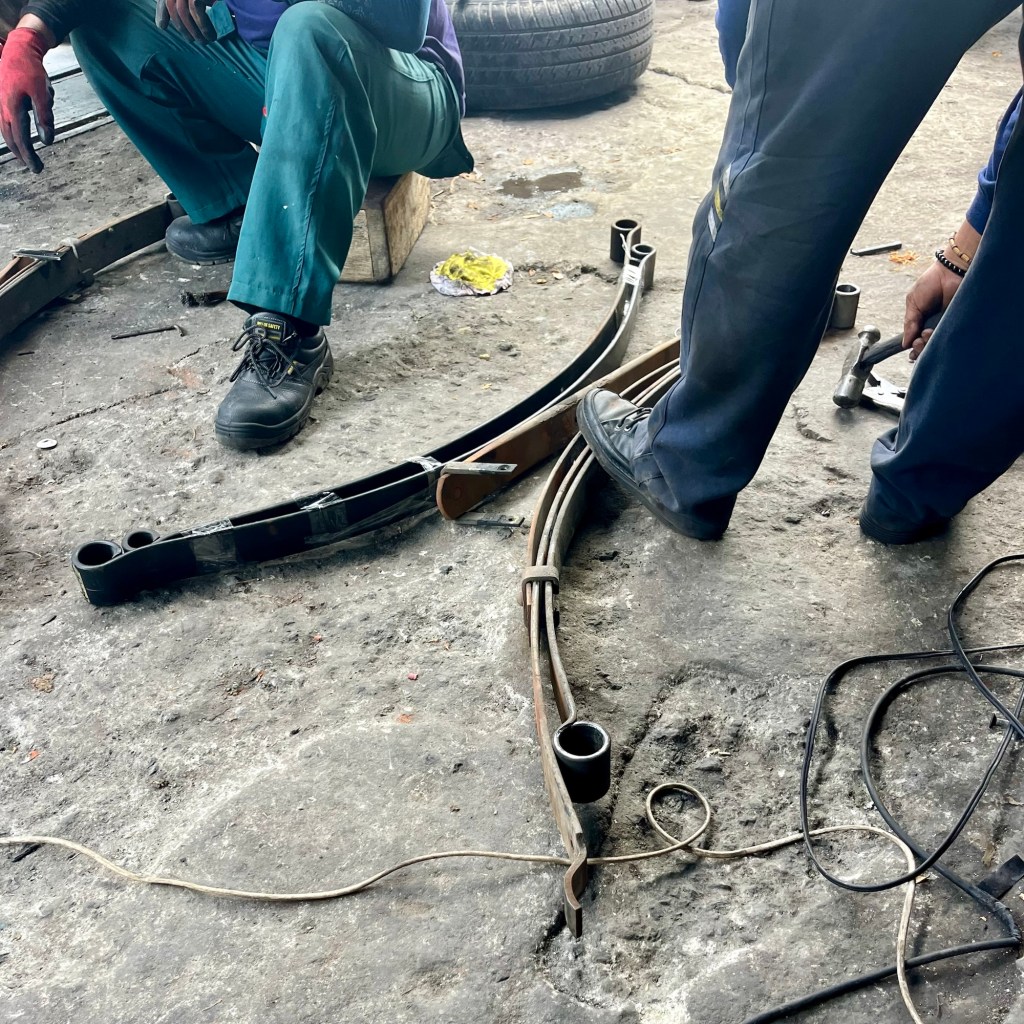
My car had been riding low for quite some time and would occasionally bottom out when fully loaded. So I took it in to Pablo, my regular mechanic. His reply was not car-related but yet surprisingly still related to things in my own life.
“Actually, that’s true of everything in life, isn’t it?”
Pablo is a student of the bible and usually an appointment with him touches on some aspect of life and theology. He always finds ways to connect what he reads there to the real world around him.
My initial reply was a cautious, “Yeah, I guess it is. A lot of things in life are like that,” but then I thought I would get right into the heart of the matter. “In fact, that’s true for me now. I’m sick, and I’ve realized that even with me, some things eventually need to be replaced.”
“Oh? What’s wrong with you?” He replied.
Since I had already committed myself, I continued on. “I have prostate cancer. They discovered it just over a month ago. It also seems to have affected my bones, kidneys, and bladder!”
“Well that certainly fills up your thoughts, then, doesn’t it?” he asked.
“Yeah, it does.”
“Well, I think that as long as you’re ready, everything is okay — If you’re ready, there’s no fear. But if you’re not ready, then you’re afraid,” he said.
“Yeah, that’s true. I’ve spent some time reflecting on my life, and I’ve realized that I have no regrets and nothing I would want to change. I’m ready, and I have no fear of the future.”
What does it mean to be ready?
Yes, it’s true. I have prostate cancer that has metastasized into my bones, kidneys, and bladder. This was not something that I was expecting but it lead me to discover that what Pablo says is true — all of a sudden I came face to face with my own mortality and it did occupy my thoughts. My first thought was, “Am I ready to die?”
On Being Ready & Faith
My life’s leaf springs have flattened out. But where exactly is the problem? Perhaps I need more faith?
But as I reflect, I realise that I have no regrets. I have no doubts. I have a firm foundation. I have assurance.
I remain firmly convinced of the faith that began growing in me from a very young age at my parents knee. A faith that was strengthened through attending churches. A faith that was strengthened through participation in devotionals at our young peoples group. Faith that was strengthened through experiencing a different culture when I was in high school and trying to figure out how the Gospel fit into that. The faith that was strengthened through formal studies, both in university and in seminary. And a faith that I still hold today. That faith is very simply stated: Jesus is Lord, and God has raised him from the dead!
Don’t get me wrong. I’m not a stick in the mud. My faith has grown through those years as I have gotten deeper into God‘s word, as I have conversed with God’s people, as I’ve seen different perspective from the different people in my life, and as I have engaged with people who come from different faith communities. All of this has helped strengthen and deepen the faith that was first started as a seed so many years ago.
But it’s not something that I merely believe while waiting for the age to come. It is something I believe in my day to day life. God also has a task for me. I am called to proclaim the good news of Jesus Christ as ruler of the world. I am called to conform to and live out the values of his Kingdom. I am called to love God and love my neighbour. And I am called to bear witness to the truth.
As Pablo points out, this shapes all that follows.
But my problem isn’t lack of faith. So why, then, have my leaf springs collapsed?
On Being Ready & Buckets Lists
My leaf springs have flattened out. But where exactly is the problem? Maybe I have unfinished business?
When I first received a diagnosis of cancer, my mind immediately went to the end. I began asking myself, “Am I ready to depart this earthly vale and move on into whatever glory God has intended for me?” Very quickly, I came to the conclusion that, “Yes, I am.” I don’t actually have a long list of things I feel compelled to accomplish before that day comes — a bucket list, as it were.
As I reflect, I realize that as a young boy, I dreamed of becoming a hermit living in a log cabin in the bush. At other times, I dreamed of being a soldier or a missionary.
Looking back, I realize that God answered those dreams in ways I never would have anticipated. I never became a hermit, but I spent countless hours in the wilderness — and the wilderness remains one of the places where I feel closest to God. I never became a soldier (apart from a brief time in the NSaskR), but I learned something about commitment to a cause larger than myself. And I did become a missionary, though not in any form I could have imagined as a child. My childhood imaginings involved a missionary standing beside a large cooking pot containing an unfortunate victim — a horrible misrepresentation, but one that says something about the quality of missionary education available to me at the time!
As a child, our family regularly vacationed in the Rocky Mountains. In high school, I paddled hundreds of kilometres through the Churchill River system, sometimes in a group and sometimes solo. I have swum Otter Rapids wearing a life jacket. A few years ago, I went for a midnight swim in the Pacific Ocean with my son Daniel.
I have flown in planes ranging from a Piper Cub to a 747. I have driven Canada from Port Alberni to Quebec City and crossed large stretches of the United States by road. Ministry and teaching have taken me to Mexico, Japan, the Philippines, South Korea, Hong Kong, Vietnam, Thailand, Singapore, Qatar, Georgia, and Brazil. I have ridden in a car along part of the Silk Road and tested how water drains from a sink in both hemispheres.
I was present for the birth of my two children, Emily and Daniel.
I got involved in the World Wide Web near the ground floor and developed one of the first 10,000 websites in the world. I have formally studied four languages — English, French, Ancient Greek, and Tagalog — and speak two of them fluently.
I have preached in more than a hundred churches across Canada and in several countries around the world. I have taught theology internationally and participated in planting three churches in two countries.
I have cooked over an open fire, fished from a canoe, and sat at night listening to loons call across the lake.
There are still things I think about doing, places I would like to see, books I would like to read, and people I would like to spend time with. But I don’t feel that I have been cheated out of life. God has already given me far more experiences than I ever expected to have.
So, yes, I am ready. Not because I have exhausted life, but because I do not feel that I have left life unlived.
Which raises a different question.
If I am not afraid of dying, and if I am not troubled by an unfinished bucket list, then why do I feel as though my leaf springs have collapsed?
On Being Ready & Ministry
My leaf springs have flattened out. But where exactly is the problem? Maybe there is no one left to continue my work?
Pingkian has been one of God’s greatest gifts to me.
When I arrived in Pingkian, I possessed a great deal of knowledge about ministry. I had studied it, taught it, preached about it, and thought deeply about it. I had been present when MMBC was planted, although at that stage I was mostly a kid along for the ride. Later, I helped plant New Hope Community Church in Canada, served on the pastoral staff there, learned to preach, and gained valuable experience in church ministry.
Yet much of my understanding remained theoretical.
When we first moved to the Philippines, we lived in Cubao and were somewhat isolated from the communities around us. Ministry happened at 670 EDSA. We travelled there, did ministry, and went home again.
Pingkian changed that.
For all my knowledge about community ministry, I had never truly learned how to immerse myself in a community. I remained, by nature, a shy and quiet person. In many ways, I was a reluctant pastor. It was the people of Pingkian who taught me what ministry really looks like.
The Riobuya family showed me what it means to have a vision for reaching an entire community.
The Laguda family showed me what it means to be family — not merely to attend church together, but to celebrate life together.
And I could go on much longer, but will have to limit myself to naming names: Ramil & Margie, Kandase, Clark Gonzales, Rose Ann, Kasavina, Kirvi, Kio Gonzales, Thess & Macmac Caparas, Elmer & Emily Belarmino, Marycris & Justin, Red Belarmino, John, Milarose, Marian, Johnuel Riobuya, Dion & Joy Umali, Warlito & Doris, Diane, Dorothy, Warren, Shi Laguda, Kyla Ferer, Edgar & Perlita, LJ, Kaikai Billones, Wency, Jordan, John Billones, Nonoy, Caloy & Liza Walet, Inis & Ging, Gigi, Sean Laguda, Helen Laguda, JR Laguda, Baste & Sandro Laguda, Aling Auring, Boboy & Tata, Angel Yumul, Adel & Elmer, Stephanie Obosa, Mel & Noel Aguilar, Aries & Faith Adrales, Lamberto, Thea, Taiga Demillo, Anisa, Derek Acaso, Gilbert Amistoso, Renz Nabor III, Cian Artates, Enting Nabor, Jessa & Prince Wyler Gulas-Gonzales, Kurt Kevin Suarez, Angela & Princess Satoquia, Rodsille Maurillo, Glayza C. Doctor, Yacymarie Cleofas, Christine & Khrishana Otadoy, Marvin & Ferl Cabtalan, Vince “Izhen” Nares, Margaret, Danica M. Ligayo, Angel Bang-oy, Edchell Montales, Ejay Mojemulta, Isaiah Luke Rivera, Justin & Jazzper Morada, Radam Toling, Alvin & Caloy Ragundiaz, Angel Tanedo, Jun Carl, Sharilaine, Sabrina, Ace, Jack, Nathaniel Onasa, Purificacion Onasa, Kaye, Danica Rosales, Fiona Eugenio, Zyrill Montanses, and Lani.
What struck me most was that ministry in Pingkian was never driven primarily by pastors or programs. It grew because God stirred the hearts of ordinary people.
Women began ministering to women.
People became involved in helping mothers and newborn babies.
Volunteers gathered children through KidsNet.
Young people reached other young people through Friday nights, Saturday programs, ASCEND, 3verlasting, the Student Center, the gym, and countless informal conversations.
Men discipled men.
Families cared for families.
People prayed together, studied Scripture together, worked together, celebrated together, and grieved together.
Again and again I watched God place a burden on someone’s heart and then call them to act on it.
The remarkable thing is that I cannot take credit for any of it.
I did not start these ministries.
God did.
He worked in the hearts of His people and said, “This is what I want you to do.”
And they responded.
The people of Pingkian have done far more for me than I have ever done for them. I had always known academically and theologically that I was called to be the pastor of Pingkian as a community, but I didn’t really know what that looked like until I experienced Pingkian itself.
So it turns out that my collapsed leaf springs are not found in my ministry at Pingkian.
So what is it?
As I continued, my reflections, my thoughts naturally turned to the South East Asian Theological Schools. I have now been involved with SEATS longer than I have lived in the Philippines.
A few years ago, during an accreditation visit, one observation kept surfacing. The accrediting team was concerned that too much responsibility rested on too few people. They were right. Good governance requires clearer boundaries and a broader distribution of responsibility.
Yet I also realized something the accreditation process could never fully measure.
SEATS is a family.
We have certainly built a shared theological vision. Together we have wrestled with what it means for churches to proclaim Jesus Christ as King over every aspect of life, to love God and neighbour, to live out the values of God’s kingdom, and to bear faithful witness in society.
But far more importantly, we have been shaped by one another.
These days, several of us are walking through significant health challenges. Our conversations have naturally become less about programs and projects and more about life, mortality, and the faithfulness of God. Together we have committed ourselves to reflecting daily on Psalm 23 — not merely as a favourite passage, but as fellow travellers walking through the valley of the shadow of death.
Of course we think about the next generation who will carry this vision forward. We pray for them often. But we also recognize that God is still forming us. Even now, He is teaching us what it means to trust the Shepherd.
Looking back, I realize that much of what eventually became Pingkian Family Worship first took shape through SEATS. The way I preach, teach, and think about the church has been profoundly shaped by this community. My prayer is that many others will one day experience the same joy of discovering God’s heart for His church and His world.
So it turns out that my collapsed leaf springs are not found in SEATS.
So where are they?
On Being Ready & Those Left Behind
If my leaf springs had truly collapsed, surely I would see it first in my family.
But of course, one’s thoughts eventually turn toward those who would be left behind — especially the family here. They are understandably not quite as willing to accept the idea that I may be ready to move on. My mother said to me the other day that it may actually be easier for the person who is sick to accept these things than for those who are not. I suspect there is a good deal of truth in that.
If you were to ask me, I would say that my family is perfect.
That’s probably an exaggeration. Like every family, we’ve had our misunderstandings, disappointments, and failures. But when I look back over the years, I wouldn’t change a thing. God has given me exactly the family I needed.
We don’t fight with each other. We don’t really have differences of opinion. We have this bond in this unity that has been formed through a lifetime together. I’m not sure what the secret is. I don’t think that I came into this family thing with a great plan for what the future would look like I didn’t think too much of what it would mean to be a husband. I didn’t think too much of what it would mean to be a father. And I didn’t think too much about what kind of family discipleship program that I needed to implement as our family grew together.
But what I do know is that I would not be the man today if it were not for my family. From Eva, I learned what it means to consider somebody else other than myself in life. To be aware of how other people are feeling about things. To see love for neighbour exemplified through day-to-day experiences to learn what it means to be committed to one another day and day out, even after a lot of life’s experiences, including moving 10,000 km away to another part of the world.
Including experiencing joys and frustrations in church ministry.
Including experiencing wave after wave of culture stress — both in the Philippines and in Canada.
Including learning how to communicate and think in a different language than when the one we grew up in.
Including confronting how much our world has changed from the world that we grew up experiencing in Canada and how sometimes that leads to bumps with other people who have not experienced what we’ve experienced.
Through it all I’ve learned what commitment to a life partner, to a soulmate, to a to the best example of what it means to be a missionary.
I didn’t come into fatherhood with a great plan. I didn’t even know if I would know what to do as a father. I do remember being there for the birth of Emily and for Daniel I do remember how that first experience with them on this side of the womb started something that continues on today.
I’ve learned how to navigate what it means to change seven diapers in one day.
I’ve learned how to navigate what it means when your kids are more popular than the animals we were looking at in the zoo.
I’ve learned what it means to have that protective fierceness that wants to keep my kids from harm, however slight it might be.
I’ve also learned what it means to see my children grow in wisdom and maturity. To see them grow into young people with a deep, heartfelt, genuine, pure conviction that Jesus is their king that they need to live out his values that they need to love God and love, neighbour, and that they need to testify to the truth that they have experienced.
So it turns out that my collapsed, leaf spring isn’t my family. So what is it?
On being ready, but the time has not yet come
As time progressed during my treatment, we discovered that there is hope. We heard account after account of others in the same situation who underwent treatment and continued living a long and full life. So it made me realise that maybe the end isn’t as near as I initially thought.
But then again, since I am still sick, my leaf springs are still collapsed and I need to deal with them.
But just because a leaf spring is broken, doesn’t mean everything is broken. While I may be ready to go at any time that may not in fact be what happens or even be the best option. All of this has also led me to ask: What does God want me to do with the rest of my life, however long or short that may be?
Even though I’ve lived a deeply blessed life and have had many wonderful experiences, are there things I should stop doing so I can devote myself more fully to other things? It has prompted a great deal of reflection.
Initially, when something like this happens, the response tends to remain somewhat intellectual. You have these abstract discussions about life and death and sickness and mortality.
I read a post by Al Hirsch the other day and he had this great summary of some of theologian Hans von Baltasar’s thoughts. The part the struck me was that life only gains meaning when we realise it’s finite nature. “They become, in that moment, irreducibly themselves: a unique person, with a unique mandate, standing before a finite and not merely a limited horizon…. A finite horizon … closes. And in closing, it forces the question of what was actually asked of this particular life, and whether the answer was given.”
How to live that finite life I wonder?
Maybe my collapsed leaf springs have to do with how I view life as a whole?
On Being Ready & The Finite Life 
Honestly, I’ve tended to live my life more as a human doing rather than a human being. Looking at my typical schedule shows a huge pile of things. I remember doing a report to one partnering church in Canada about some of the stuff that Eva and I were doing and immediately after that the worship pastor stood up and said, “You guys are too busy!” I don’t know if I really realized that, but it seems to me that busy-ness is a part of what I think is something that I need to be. I wonder if it stems from my long felt fear that I’m too lazy and so I need to show that I’m doing something. I remember when we first started sending reports into our Edmonton office. My initiation reports were always just a list of the things that I was doing so that people would know I am legitimately doing something here and I’m not slacking off!
But then the other day, I was sitting in the living room with Eva, and suddenly it struck me: I am actually sick.
Up until that moment, I think part of me still assumed this was temporary — that perhaps I simply wasn’t feeling well today, but tomorrow I would feel fine again. And of course, some days are better than others. But then I realized, “Wait a minute. I genuinely have an illness that has been diagnosed, and this illness is affecting my life.”
Being sick opens up a different reality because now all of a sudden I don’t have the energy to do everything and I need to pick and choose the things that I feel are important or not important to do. Making those decisions is very difficult. One of my doctors actually advised that I take and year and focus only on medical care — and that return to Canada for a part of that — but what does that even mean? I don’t understand those words.
Oddly enough, that realization has also become a legitimate invitation to continue becoming the kind of person God wants me to become. I no longer need to minimize things by telling myself, “Maybe tomorrow everything will simply return to normal,” because tomorrow may not, in fact, be normal. I suppose that is simply part of the reality of being sick.
On Being Ready & Following the infinite Jesus — in light of my own finiteness.
Leaf springs are designed to carry the load of the vehicle but the fact that my car’s leaf springs have flattened out means that too much strain has been placed upon them over the years and they need rehabilitation. When thinking about my life — is it perhaps true that I have taken on weight that Jesus hasn’t asked me to carry?
Jesus bridges the gap — not me. He is both infinite and finite. I am exclusively finite. I was created for a purpose that may not include changing the whole world — but it may include changing a finite part of it.
There are a couple of passages that come to mind when I think about my situation.
At the end of John’s Gospel, Peter and Jesus are talking. Jesus is giving Peter his task — what Peter is to do after Jesus returns to heaven. Peter then asks an interesting question: “What about him?” Scholars are generally convinced he is referring to John, the author of the Gospel. In other words: “What about that guy?”
Jesus responds by saying, “If I want him to live until I come again, how does that concern you? Follow me!” (John 21:22).
This tells me that each of us has a purpose. Each of us has a task. Each of us has some finite role to fulfill within this much greater infinite story. We do not have to answer all the world’s questions. We are not called to solve every problem. We do not even need to see the story through to the end. We simply need to fulfill the task God has given us.
God has given me a task, and He has given you a task as well. Sometimes those tasks may overlap; sometimes they may be very different.
There is another passage that comes to mind. In Hebrews 11, there is a long list of the pillars of our faith beginning with the very early ones: Abraham, Moses, Isaiah, and many others. The chapter reflects on the faith of Abraham, Moses, Isaiah, and so many others, and on the contribution each one made to God’s story. But at the end of the chapter, there is a fascinating statement. Even though these people were great examples of faith and powerful witnesses to God’s goodness, they still did not receive the fullness of what God had planned. Why? Because we too — you reading this, me writing this, the people around us — still have a part to contribute to God’s story.
This is actually part of the reason why I included such a long list of names in my testimony above. It’s because my experience in Pingkian reminds me of what the writer Hebrews describing here — people who are faithfully living out the task God has given to them in their daily lives.
That is why I believe the story from the beginning of Scripture to the end of Scripture is one continuous story, not one broken into disconnected segments.
So, the question I am confronted with when faced with my own mortality — when thinking about my finite role in an infinite story — is this: What is my contribution? What does God want me to do today? How does God want me to finish my life, whether that finish comes tomorrow, fifty years from now, or even beyond what I can imagine?
I have given this some thought. There are certain things that I’ve had on my to-do list for quite a while that I haven’t yet accomplished. I think the responsible thing to do is to prepare something that can be left behind. My initial thoughts went to the following:
For many years, I’ve had several writing projects sitting on the back burner. I’m working on a couple of book chapters exploring how the church engages society, and I’ve long wanted to turn my dissertation into a book. Perhaps now is the right time to move those projects to the forefront.
I’ve also thought about mentoring. Beyond my ongoing mentoring of Pastor Renz and Pastor Gibo, several of our younger leaders have expressed a desire to serve as pastors or in church ministry. Walking alongside them and helping prepare the next generation seems like a worthwhile investment of whatever time God gives me.
My colleagues and I have also spent many years helping shape SEATS into the school it is today. Naturally, we think often about the next generation. We want them to inherit something that is concrete. Perhaps this season is an invitation for me to devote more attention to some of the less glamorous administrative work that helps make that possible.
If this is true, then why does teaching always still pop up at the front of my mind? Can I still teach?
One of the unexpected joys of walking through this season has been reflecting on my life. As I think about Pingkian today, one thing brings me enormous joy. Almost none of the ministries that now flourish there began with me. KidsNet, youth ministry, women’s ministry, ASCEND, Young Stewards, the prayer meetings — all of these exist because God placed different burdens on different hearts.
All of these things exist because God didn’t call me to do the entire task but because he called each one of us to our own specific, unique task.
The wonderful thing is that everything doesn’t depend on me!
One of the great joys I have as I look beyond where we are today is realizing that God is in control. God is guiding what is happening in this church. And he will continue to be our guide in Pingkian in the future.
And that brings me both happiness and deep joy.
On Re-Arching My Leaf Springs
The leaf springs on my car have been re-arched. The old ones have been strengthened by a new addition. Now the car rides great and is ready for the next years of carrying the loads they were intended to bear. But as I mentioned at the beginning of this journey, when Pablo first mentioned my leaf springs, I thought we were talking about my car.
It turns out we weren’t.
Over the past weeks I have reflected on my faith, my bucket list, my ministry, my family, and my own mortality. One by one I discovered that none of these were actually the problem. If anything, they have been some of God’s greatest gifts to me.
Instead, what had slowly flattened over the years was something else.
Somewhere along the way, I had begun living more as a human doing than as a human being. I had quietly assumed responsibilities that were never mine to carry. I had forgotten that Jesus bridges the gap — not me. My role has never been to accomplish everything, solve everything, or finish everything. My role is simply to faithfully fulfill the finite task God has given me within His infinite story.
And to remember Jesus bridges the gap — not me.
Perhaps that is what it means to re-arch my leaf springs.
Not to stop serving.
Not to stop teaching.
Not to stop dreaming.
But to remember that I am finite, while Jesus is not.
Regardless of how long this journey turns out to be, there are blessings in travelling a little more slowly. I have begun to notice things I might otherwise have missed. I have more opportunity to stop and smell the roses, to enjoy the scenery, to sit with people instead of merely moving on to the next task. The journey itself begins to matter more than racing toward the destination.
Perhaps that is part of becoming more of a human being than merely a human doing.
And perhaps it’s a part of what it means to not carry the weight I wasn’t designed to carry?
So let me leave you with the same question Pablo unintentionally asked me:
Have your leaf springs flattened out?
Have you gradually taken on weight that Jesus never asked you to carry?
If they have, what might God be inviting you to restore?
Photo of my leaf springs at Pablo’s shop taken by me.
I’m wearing an orange shirt today. This is because September 30 in Canada is the National Day for Truth and Reconciliation aka Orange Shirt Day. One of the ways that this truth and reconciliation is remembered is through the wearing of an orange shirt. Even though I am far removed from Canada and haven’t lived there for any length of time for 26 years, the shirt that I put on today reminds me of two key aspects to what it means to be a follower of Jesus: Truth & Reconciliation.
I should point out before we continue that I do have skin in the game. One branch of my family has a long heritage of both First Nations and Metis peoples and I am a citizen of the Metis Nation of Saskatchewan. My Great-great-great grandfather, the MaškēkowakRev. James Settee, spent his life ministering through Manitoba and Saskatchewan, introducing people to the good news of Jesus Christ and how that good news can help transform their lives.
If you’re a longtime reader of this blog, you’ll realize that these two words are a key aspect to how I think that we need to frame our lives and our engagement as Jesus followers. The whole framework — that we call the functional church — includes the Good News of Jesus Christ, the Values of God’s Kingdom, Loving God and Neighbour, and Truthtelling.
Orange Reminds Me of Truthtelling at Both the Political and Theological Levels
The first is through truthtelling. Jesus came not only to represent the truth, but to be the Truth. And part of this truth means we need to reflect on ourselves, on the way we think, and on the foundations we’ve built, and to find ways that God wants us to change these for the better. Unfortunately, in the history of Canada, Jesus’ followers have not always exhibited the kind of truth that Jesus would have us exhibit. (This is by no means limited to issues in Canada). One of the truths we need to face is that it’s difficult for us to tie up our political beliefs with our biblical beliefs. Sometimes we connect following Jesus to our adherence with a specific political party or political ideology. One of the truths that some of our founding fathers believed was that First Nations identity was bad and this needed to be changed into something good. Thus we have residential schools that were explicitly designed to “remove the Indian from the child.” This is all clearly documented in the reports of the Truth and Reconciliation Commission, and also in quotes like this:
When the school is on the reserve the child lives with its parents, who are savages; he is surrounded by savages, and though he may learn to read and write his habits, and training and mode of thought are Indian. He is simply a savage who can read and write. It has been strongly pressed on myself, as the head of the Department, that Indian children should be withdrawn as much as possible from the parental influence, and the only way to do that would be to put them in central training industrial schools where they will acquire the habits and modes of thought of white men.
John A. MacDonald, 1883
This was not merely a political failure; it was a theological one. These political ideas, in turn, fostered and were justified by a flawed theology. What do I mean by that? There are several theological flaws at play here.
Flawed Understanding of Politics and Theology
The first, of course, is that it represents a marriage between politics and theology where political theory is prioritised over theology rather than the other way around. All of life needs to be informed by scripture.
Where do we see this today? It happens when we assume a political party’s platform is synonymous with God’s will, or when we dismiss a fellow believer’s faith because they vote differently.
Humans Were Created Originally Righteous
The Bible clearly teaches us that humans were originally created good. It was only after a specific choice to rebel that sin entered into the world. I’ve written a little bit about that here. That means we cannot look at people from another part of the world who may have different cultures or different languages or different political structures or different technological levels, and say that somehow because they’re not as developed as we are, they’re not worthy of receiving the gospel of Jesus Christ on their own terms. The message of Jesus must be communicated in a way that is understandable to them. There is no command in scripture for us to transform other peoples’ cultures for them. In fact, each person in each culture is called to do their own internal transformation as their own minds are renewed.
Recognizing that truth is the foundation for repentance, healing, and reconciliation.
Imago Dei
The very first words after the creation story in Genesis 1:27 declare that all peoples on the earth are in the image of God.
“So God created humans in his image. In the image of God he created them. He created them male and female.”
The very truths of the Bible condemn the attempts of others to erase languages, traditions, and identities as not only cruel, but also as a denial of Scripture itself. The Good News of Jesus Christ is not an attempt to replace a lost image, but rather a call for all peoples to be reconciled to God and, in that process, to restore and renew their own cultures in Christ, purifying and elevating what aligns with God’s truth and rejecting what does not (Colossians 3:10; Ephesians 4:24).
The truth of the Bible is far from this idea and clearly teaches that the image of God was not erased by the Fall. Genesis 9:6 plainly states human life is sacred because people still bear God’s image. James 3:9 warns against cursing others because they still reflect God’s likeness. Paul describes men and women as God’s image-bearers in the present tense (1 Corinthians 11:7). The truth runs through the whole Bible: every person, every people, every culture carries this dignity.
One tragedy of the residential schools was deeply theological because of the idea that First Nations peoples were somehow less than fully human, or less than fully made in the image of God. This has been framed as “robbing communities and individuals of their cultural and spiritual identity.”
Heaven Will be Explicitly Multicultural
The truth of the matter is that God accepts people from every tribe, language, nation, and people in the world and each of these groups will be represented in heaven. There’s this great image from Revelation 7:9-10 that sees John open his eyes to the reality of the kingdom of God that contains all of these People.
“After this I saw a great crowd of people, too many to count, from every nation, tribe, clan, and language. They were standing before the seat of honor and before the Lamb, dressed in pure white regalia, holding palm tree branches in their hands. They lifted their voices and shouted, ‘The power to set us free and make us whole belongs to the Great Spirit who sits upon the seat of honor, and to the Lamb!’” Book of the Great Revealing 7:9-10
The truth is that we need to work towards a more intentional welcoming of people from all nations into God’s Kingdom, not as peoples whose cultures have been stripped away in favour of our own, but as peoples whose cultures express God’s goodness and love. Maybe these new perspectives will reveal to us that our own culture is flawed and in need of transformation. Unfortunately, for many, this is a very scary prospect because it means that we all need to admit our flaws and work towards repentance and restoration. The culture that we may want to protect; the way of life that we may want to preserve may in fact not be worth protecting or preserving because of their built-in flaws. Maybe instead of preservation we need to work towards growth.
This isn’t just a historical error. We see it when we dismiss other cultures as “unreached” because they lack Western infrastructure, or when we implicitly value some lives over others based on nationality, wealth, or social status.
Wearing Orange not only reminds me of my commitment to truth, it also reminds me of something else.
Orange Reminds Me Of Reconciliation
The second word that this orange shirt I’m wearing reminds me of is reconciliation. There is good news, even in light of the fact that we have made mistakes in the past there is good news because God is working to reconcile us to himself. He has even indicated that Jesus followers are to be agents of this reconciliation. We are to find ways to connect to God with people and people with God. We are to find ways to bring Hope to a world that is hopeless. We must find ways to help others be lifted up as they journey towards God.
But as I was reminded today, in conversation with my Spiritual Director Len Thompson, we may not always see the fruit that we are looking forward to. Len reminded me of Hebrews 11 and 12 where all of these great heroes of our faith worked very hard to establish God’s Kingdom here on earth, but they did not yet experience that kingdom during their own lifetimes. Each had a contribution to make to establishing the Kingdom but the establishment of that Kingdom supersedes any one lifetime or era. What’s especially significant for us today — as pointed out by Andrew Walls — is that we too are waiting to see that Kingdom established! This not only means that you and I each have our own contribution to make, it also means that our contributions are essential!
The legacy of this theological failure isn’t confined to history books. It echoes in the ongoing trauma of survivors, the systemic inequalities Indigenous people still face, and in our own complacency. So, what’s the next step for us, right now?
What’s the next step?
So, today, feel free to wear an orange shirt. But it’s not merely enough to just wear an orange shirt. We are called to be truth-tellers and reconcilers today, and this historical example shows us what happens when we fail that call. Here’s how we can live it out now.
How can I apply the truth of God to my life? To my society’s life? To my use of the land?
How can I be an agent of reconciliation today? Encourage individuals to return to a right relationship with God? Reshape my society so that it has a proper relationship with God? Improve my relationship with the land in a way that God desires?
Will you join me in being a truth teller? Will you join me in being an agent of reconciliation?
We often focus on punishment and destruction when we think of evil. But the Bible reveals a more profound truth: God’s primary strategy is infiltration and transformation. From Manasseh to Babylon itself, God sends His people into broken systems and lives not to escape or destroy, but to redeem. Our calling isn’t to await the fall of our modern “Babylons,” but to actively participate in their restoration through faithful, everyday work—to plant crops in the cursed ground and pray for the peace of the city, believing that enemies can be turned into friends.
When I was younger, I was an aficionado of Resurrection Band. I even saw them in concert once at the Centennial Auditorium in Saskatoon and wore a signed T-shirt of theirs for many years. One of my favourite songs of theirs was entitled Babylon, which includes the bridge:
“I saw Babylon slowly start to burn I heard the voices crying Refusing ever to learn, Babylon”
The final line — that sticks in my mind until today — is “Babylon. Babylon is fallen!” This imagery hearkens back to the Revelation of John, where the great harlot, Babylon, the city that is opposed to God and works at spilling the blood of the Saints, is finally punished and destroyed. In the Bible, Babylon = evil.
I was mistaken for years in thinking that the only legitimate end for things that are evil like Babylon is punishment, as the song says. And part of me probably anticipated seeing this punishment enacted in my lifetime.
It’s part of our nature to want evil to be punished; especially evil committed against us by others. We’re not entirely excited when our own evils are called out and punished are we? But we like it when the bad guys lose and the good guys win — even if that means turning bad guys into Robin Hoods so that even worse guys can be punished.
But more recently I have come to realise that there are actually two destinations for things that are evil like Babylon. On the one hand, Babylon awaits destruction. Because after all, what does one do with their enemies? One fights against their enemies and seeks to defeat them. But is that what God does with his enemies? It seems that God instead enacts a plan so that his enemies strongholds are infiltrated by his people so that it becomes transformed and turned into something that is good.
The Tower of Babel and the Confusion of Languages
Babylon’s origin story is the tower of Babel, where God confused human languages so that people would spread around the world.
A commentary I recently read said the tower was an attempt by people on the Earth to fulfill God‘s promise of “all the nations being blessed.” Rather than relying upon God for that blessing, they decided to enact that blessing themselves. Perhaps that’s at the core of Babylon‘s label of being opposed to God.
Manasseh
Manasseh was one of the kings of Judah. He was a bad guy. 2 Chronicles 33 outlines the extent of the evils he intentionally implemented to the point that he “misled Judah and the inhabitants of Jerusalem so that they did more evil things than the nations that the Lord had destroyed when the Israelites arrived in the land” (2 Chronicles 33:9).
As a result of this, God calls the army of Assyria to come and carry Manasseh off to his kingdom, where he experienced difficulty.
“When he experienced this distress, he begged the Lord his God to be kind and humbled himself in front of the God of his ancestors. He prayed to the Lord, and the Lord accepted his prayer and listened to his request. The Lord brought him back to his kingdom in Jerusalem. Then Manasseh knew that the Lord is God.”
Wow!
Jeremiah 29
In the book of Jeremiah, the inhabitants of Jerusalem are confronted with a horrible reality. It seems that King Nebuchadnezzar, the Emperor of Babylon, will be successful in conquering their city and carrying them off into captivity. The book outlines Jeremiah’s prophetic words from God to help the people of Jerusalem face this horrible possibility.
Apart from the fact that being a prisoner of war is a horrible thing in and of itself, for the people of Israel this reality was especially difficult to accept because as far as they were concerned they were the people of God who had been blessed by being the owners of Jerusalem and the land of Israel around them. Their understanding was that this was a promise that God gave to them in perpetuity. And so for them to be carried away was almost an impossibility — their theology didn’t support that. In fact, Jeremiah was the sole prophet who prophesied that they would actually be carried off into captivity (verse?). All the other prophets of his time had convinced the people that they would not be carried off into captivity but that they would only be gone for a few weeks or months (verse?). One of Jeremiah’s tasks was to prepare the people for a lengthy captivity in Babylon. In fact, many of them would die in Babylon because the captivity would last for 70 years.
So, what were they supposed to be doing while they were in Babylon? They were supposed to infiltrate Babylon become a part of the fabric of Babylonian community; make their lives in Babylon the lives that God had called them to; they were to build houses, and they were to plant crops, and they were to get married and have children, and have their children get married. All of these things are things that new immigrants do when they come to a new place. Furthermore, they were also to pray for the blessing of the City.
What does Jeremiah 29 teach us about how God deals with evil places like Babylon? God sends people to infiltrate it so that Babylon too can be transformed from a place of evil to a place of goodness.
The Emperor who became a cow
Nebuchadnezzar the Great was the Emperor of Babylon but at a certain point in his life, God turned him into a cow! The point I want to emphasise here is that God chose to interact in an immersive way with the most powerful human king the world has ever seen. As the emperor of Babylon, he personified opposition to God — they called him the King of the Universe. Which is perhaps why God chose to allow his context to change from the most powerful human on th earth to a mere domesticated animal. Nebuchadnezzar’s worldview was deconstructed in a dramatic way but was then reconstructed into something better — he moved from being the so-called “King of the Universe” to submitting himself to the Universe’s True King!
Jesus
Jesus was all about freeing people from sin and the effects of sin in their lives. Jesus’ death on the cross and his subsequent resurrection from the dead ensured that we too would be saved from our sins and have eternal life. But Jesus is about more than merely saving us from death. He wants our lives on Earth to also be reflective of his life on Earth. He wants us to be his disciples. He wants us to be like him. He wants us to be holy. If he was merely interested in saving us after we died, what’s the point in talking about holiness?
One of the clues to Jesus’ purpose on earth can be found in Luke 4. In Luke 4, Jesus returns to his hometown of Nazareth and is invited to speak in the synagogue. He stands up and asks them to read from Isaiah 61. According to the account, this is what was read:
“The Spirit of the Lord is with me. He has anointed me to tell the Good News to the poor. He has sent me to announce forgiveness to the prisoners of sin and the restoring of sight to the blind, to forgive those who have been shattered by sin, to announce the year of the Lord’s favor.”
Jesus concludes his sermon with the words “today this scripture is fulfilled in your presence.”
Surprisingly, the congregation is enraged and wants to kill him. Why do they want to kill him? What’s so significant about these words that he’s saying? When Jesus said these words and when he referred to Isaiah 61 as being fulfilled in him, he was equating himself with God. The inhabitants of Nazareth who regularly attended synagogue knew the work of God was encapsulated in this passage from Isaiah 61.
This is something that we have often neglected is the evangelical church today. We’ve focused on the sweet by and by without thinking too much about the here and now. I realise that’s a generalisation and I generally try to avoid generalisation but if I look at my own journey I can see how at one time in my life I was very fascinated and fixated upon having the right theology and not so much about living a life that’s filled with good works. In fact, good works were identified as a bad thing in my early theology — something to be avoided — because they didn’t serve any purpose. At that stage in my theological development, any good thing that I tried to do was only self righteousness and was not of any benefit in salvation. What I avoided was understanding that we are created to do good works. We’re supposed to be good people. We’re supposed to do good things. We’re supposed to imitate the life Christ lived. This has nothing to do with our salvation, but is a result of our salvation. So my generalisation is based upon my own personal experience. I realise that your experience may be different than that, and if so then that’s wonderful.
What of the Flood or Sodom and Gomorrah?
There, sometimes a perception of the God of the Old Testament and the God of the New Testament of two different people. This perception typically identifies the God of the Old Testament as God of wrath and destruction, while the God of the New Testament is a God of love and peace and restoration. Of course we know this isn’t true. But then people point a certain events that happened in the Old Testament and say how can these be the actions of a loving God? Let’s look at a couple of things, including the story of the flood with Noah and the story of the destruction of Sodom and Gomorrah.
God went to extraordinary extremes to save Noah — the man who found grace in his eyes. Noah testified for 100 years. He lived his righteous life faithfully obeying God’s command to build a ship to save the people of earth from the flood he was going to send. Noah is an agent of salvation for the people of the earth. The flood is not necessarily an event that will destroy them — all they have to do is get on the ship. If they don’t then that’s on them. Isn’t it? This was Noah’s message to the world every day for 100 years.
Abram’s nephew Lot was given a choice of where he wanted to live. He chose to live in the lowlands because the land was richer. Note that this choice didn’t make Lot a bad man but it does lead us to ask the question of how successful Lot would become in the lowlands. We already know he was a successful farmer and business man — would this success follow him? We end up discovering that Lot was not as successful as he might have been because he wasn’t able to have a positive influence on the place he chose to live. We don’t know why this is but it’s clear that his presence in that city wasn’t enough to even influence 10 people to join the path of righteousness. Is that because Lot neglected his role? Is that because the people of the area were unwilling to listen to his message? We are explicitly told the answer but the fact that in the end God saves Lot and his family while fire rains down from the sky implies that those consumed had also made their own choices.
The Psalms provide us with a rationale for why there is war between God and humans in the Old Testament. Psalm 2:1 asks the question, “Why do the nations plot?” And it seems to me that the fact that there is a plot implies an explicit and intended opposition to God. This is a planned event. “We will be in rebellion against who God is.” We’ve talked about the tower of Babel. We’ve talked about Manasseh. We’ve talked about Babylon. We’ve talked about Nebuchadnezzar.
The best argument against claims that the God of the Old Testament is an evil God is that the very passage that describes how God’s people should engage society comes from this same Old Testament. And it’s interesting that in the midst of the distress that Israel is about to experience, there is a glimpse of the hope that God is bringing to the entire world. At this time it’s appropriate to bring out the verse that we most commonly associate with Jeremiah 29, namely verse 11, that says God has plans for us. What’s important for us to realize is that the good plans that God has for us are contingent upon our agreeing to those plans, aren’t they? Don’t the people Jeremiah is talking to within Jerusalem need to say, “OK God, I’m willing to accept the fact that we need to be exiled for 70 years, but that you have good plans for us”? Don’t the people of Babylon and also have to be willing to listen to the testimony of those who are in captivity so they too, can experience the good things that God has a store for them?
God’s love and call to repentance always come first, yet when that love is rejected, judgment surely follows. The fall of Babylon shows us both: an offer of transformation through grace, and, if spurned, the certainty of destruction. To keep both together — love before wrath, repentance before ruin — helps us see the fullness of God’s justice and mercy.
You and Me
Even though we’re talking about structural evil at the level of nations opposing God, we can’t ignore the fact that personal evil is also a major part of what goes on. We notice the engagement strategy that Jeremiah presents to the people of Israel is that they are supposed to live out their lives in a personal way, which includes homes for them to live in, families for their children, crops, etc. So, in order to be a good person in a society like Babylon I need to live out my life in a way as if I have a future there and there is a future for that city.
But this is not merely limited to making sure I live a good life in the midst of an evil city. Rather, it’s an understanding that through my living a good life in the city, setting down roots, and contributing to the economy of the city, I am also interested in the future of that city and praying for the city. Praying means calling upon God to help with the transformation of the city. Praying means calling upon God to make the city a place of justice, a place of goodness, a place of kindness, a place with love, with joy, with peace, with patience, with kindness, with goodness, with faithfulness, with self-control. And being a part of the fabric of the city means that we position ourselves for future leadership and guidance within that city as well.
Jeremiah 29 invites us to “Plant crops.” Even though the process of planting crops seems like a bit of a gamble. One of my friends referred to farmers as the people with the most faith in the world because they do everything they possibly can to invest in a product that is not guaranteed to emerge at the end of the process. Planting is hard but planting actually starts in the middle of the process. Before that we have to prepare the ground. I have to chop down trees and pull out stumps. We have to pick rocks. We have to break the ground. And then the broken ground needs to be broken up again. And only then can the crops be planted.
Growing crops is hard. Harvesting crops is hard. It’s a long and tedious process that takes a lifetime to perfect. And once you harvest him then you gotta try to sell it. Selling those crops at the end is hard, and some of the hardness of that process is directly because of the sin of Adam and Eve in the garden of Eden. The ground is cursed and it’s by the sweat of our brows that we can get something to emerge from the ground. In our farming processes, we need to go beyond adding to the curse of the land and try to find ways that help remove that curse. And of course, beyond planting there are other aspects to it.
An example with a Brazilian connection
I recently attended a seminar in Brazil, where we talked in part about the integration of faith and agriculture. A couple of the things emerged that help inform our discussion today.
I was introduced to a paper that spoke of Palissy’s idea that even an unlearned potter can question accepted wisdom and put forth his own ideas. He derives this from Jesus’ parable of the talents implying that each of us is given a task and responsibility and we need to use that appropriately. These talents for Palissy include the land and the forests that have been neglected and are in need of what he calls a true formula in order to be restored to their original intent.
Palissy’s very direct statements about not wanting to engage in clear-cut logging with no restoration can be directly tied to the concept of eliminating the sin that’s in the world. If the world’s natural state itself is destroyed then what of the task that’s been given to humans to overcome the sin that’s in the world?
These aren’t just better farming techniques; they are acts of spiritual warfare against the curse, a practical way to “pray for the peace of the city” by healing the very ground it stands on.
If these are the examples that the Bible gives us about how to confront evil, that means that you and I have to be intentional as well about confronting evil. Not with the goal that evil will be punished but with the goal that evil people escape punishment because they are transformed into good people. The Bible calls this transformation repentance or changing the way we think and act.
How can I start working on this today? I need to start with my own life and find areas in my life that I need to repent of — I need to start being good. I need to then look at society I’m a part of — whether that’s my community, my church, my city, my province, or my nation — and find areas that we as a group need to repent of. And then we need to start doing better. And then I need to look at the physical world around me and begin the hard, faithful work of planting crops.
Because there is hope, even though the presence of evil in the world makes it next to impossible for us to believe. The hope that the Bible gives us is that Jesus is the key to this hope. Only Jesus can offer a better leadership than the leaders that we have continued electing time and time again — and we can testify to the effectiveness of serving Him over others, proclaiming the gospel of grace that makes it possible. Only Jesus can give us the values we’ve been trying to establish — these can only be found in His kingdom and we can be witnesses to it. Only Jesus can give the hope that I can actually love my neighbour just as much as I love myself — and our love serves as testimony to this truth. Only Jesus can supply hope, through his interaction with us daily, that God is faithful — and we can also testify to that truth.
Getting back to Babylon
The final lines of Babylon show us the way forward:
“Time to build again Babylon, Babylon is fallen”
Is Babylon fallen because it has experienced God’s punishment or is it fallen because it has been rebuilt into God’s kingdom? Revelation 11:15 gives the answer:
“When the seventh angel blew his trumpet, there were loud voices in heaven, saying, ‘The kingdom of the world has become the kingdom of our Lord and of his Messiah, and he will rule as king forever and ever.’”
The fall of Babylon is prefaced by the rebuilding started in Jeremiah 29 where God sent his agents into the enemy camp in order for the enemy to become a friend.
God wants the same things to happen today as well. He wants enemies transformed into friends. And that transformation begins with us.
“I’m only human.” We’ve all said it or heard it. It’s the universal excuse for our limitations and our failures. But what if we’ve gotten it all wrong? What if that phrase isn’t an apology, but a declaration of our greatest purpose? What if being ‘only human’ is actually the whole point of God’s plan?
There is a narrative popular today that views humans as a blight on the earth. This narrative focuses on the bad things that humans do, including environmental degradation, wars, religious conflict, etc. It’s almost as if we’re to believe that humans shouldn’t even exist on the face of the Earth.
A popular example of this, at least from my generation, is the very first episode of Star Trek: The Next Generation where Q puts humanity on trial for all of the bad things that they’ve done. In some ways, the rest of the series is an attempt to address the issues that Q raises.
I was watching Building the Band last night, and in one of the songs they sang was “Human.” The chorus of it goes, “I’m only human after all.” The singers found it powerful because it framed ‘being human’ as an excuse for their limitations and failures — a sentiment I think we all understand.
But the song got me thinking about being “only human after all” and I realized that scripture has a different understanding of what that means. Scripture doesn’t put it in a negative light. To be human is not to be a curse upon the world, but to be a blessing.
What makes me say this? At the very, very beginning of scripture, God creates humans in his image (Ge 1:27). So that means that humans are a significant part of creation. Nothing else is described as being created in his image. Only humans. Humans are also placed into the garden to oversee it, to care for it (Ge 2:15). Adam names all the animals in the world. And humans have a very significant role to play in the care of the earth.
Even after sin enters and messes everything up — and enslaves humans, structures, and the physical world — humans continue trying to free themselves from sin (more on that here). Ultimately, Jesus provides that freedom through his death, sacrifice, and resurrection so that we too might be dead to sin and raised to new life in Christ (Ro 6:1-11; 1Pe 2:24). But to be human is not a bad thing. Jesus did come from heaven to earth, lived here for 30 years, taught, made disciples, and trained a group of humans — both male and female — to carry on His mission. Then, after three years of ministry, He left. He went back to heaven and said, “I’m leaving you all here with a task to make disciples of all nations” (Mt 28:19-20).
To be human is to be somebody significant, to be someone whom God has created specifically to carry out and fulfill his mission here on Earth, and that is the mission of reconciliation with him (2Co 5:18-20), to glorify him, to praise him. In their original, created design, humans are not bad; humans are good.
An Alternative Perspective
At this point, I should point out that there is an alternative perspective to the common science fiction trope that humans are a blight on the universe. There’s a series of Reddit posts that are expanded upon in several TikTok videos that take the form of fanfiction and describe a future where aliens have invaded the world but can’t defeat the humans because of human resourcefulness, because of their idiosyncrasies, and because of their ability to embrace multiple forms of truth at one time. In fact, these fanfic renditions are closer to the truth than we might think.
But there is a Problem
So how do we live up to this potential? How do we overcome this sin problem that is so pervasive it often becomes the defining feature of humanity? (Ro 3:23). How can we do what God wants us to do here on earth?
The frustrating reality is that sin clearly messes things up. It’s the issue that each of us has had to grapple with for our entire existence. It’s so pervasive and its impact is felt so much in our entire world that sometimes sin becomes the defining feature of what it means to be a human. And yet, God still maintains humans as an essential part of his plan for the salvation of the world. Please note that I’m not saying that humans save themselves (Ep 2:8-9) but that God incorporates humans into his plan as key agents. We’ve already touched on the Great Commission. Humans have even had a significant role in deciding how this Great Commission is carried out as we see in Acts 11, where there was a jump made from Jewish followers of Jesus towards Gentiles who had no natural connection to Jesus. Beyond that we are identified as agents of reconciliation (2Co 5:18-20). Even beyond that we are part of the long list of witnesses in Hebrews that have a contribution to make to the story of the good news. And ultimately, we will share together in the celebration of God’s victory in heaven in the end of time (Re 19:1-10).
To step into this role, we must discuss a little bit about the choices we can to make as humans. James talks about this in chapter 4.
Pagbabalik-loob, or Returning to our Authentic Selves
But before we get to that, we have to understand a Filipino concept that has a significant role to play in our discussion. Ka Jose de Mesa has pointed out that the English word translated “conversion” has a variety of meanings in different languages. For example, in Greek, it’s “Metanoia,” which talks about a changing of the mind. Conversion itself talks about a complete refurbishment. In the Philippines, we have pagbabalik-loob which indicates a return to our authentic self. This authentic self is what we see in Genesis 1, where God is happy with the world he has created. Humans have been created in his image, both male and female, and there are no problems. This is the authentic self that we need to return to. There has not been any impact of sin in the lives of humans at this point, and when we harken back to the way things could be when we dream about a better world, we dream about returning to this time before the entry of sin and death into the world. In a nutshell, it means that when we become Jesus’ followers, we start our journey back towards that original innocent condition. 
James’ Steps on Returning To Our Authentic Selves
James (4:7-9) describes a series of steps that help us return.
The first step is to “Submit to God.” This is the ultimate act of humility because it’s where we recognize His authority. As I have said elsewhere, the Gospel is a political statement. It’s a choice we make to either follow other humans as our leader, or to truly follow Jesus as our leader.
Next is to “Resist the Devil and he will flee.” For me, this is one of the most amazing statements made in scripture because typically when we think of the devil, we think of somebody that we’re supposed to be afraid of. Somebody with horns and a fork tail and a trident. Somebody who is the epitome of evil, but yet the only thing we need to do is to resist him and then he’ll just take off? That’s a pretty powerful statement. Ultimately it’s to actively reject the world’s value system. Just before you read about the fruits of the spirit in Galatians 5 we see a list of things that are not so good things that are to be avoided. Resisting the devil is avoiding these things. While the devil is a real, personal being, his primary attack isn’t as a monster we wrestle face-to-face. Rather, he most often works by laying down a set of values that are opposed to the values of God. So the way to resist that is to oppose those worldly values. The key to resisting is to look at the list and find the things that jump out as being difficult to do. Those are the things need to focus on. We don’t need to focus on the other stuff because we’ve already got that covered.
It’s not simply enough to resist the devil and he will flee. We also need to “Draw near to God and he will draw near to us.” How then can we return to God? There are two ways of doing this. First of all we can work on the fruits of the spirit in our lives. Making sure that these things come out making sure that our lives are known as bearing these different fruit. In the same way with the negative values when we come to the fruits of the spirit, we look at those things that jump out at us as perhaps being difficult to do in those of the things we focus on.
There’s a second aspect to drawing near to God and that is to keep connection with Christ’s body here on earth. We is this body? It’s the church. We need to stay connected to the church.
James asks us to “Cleanse our hands.” Purify yourself from being double-minded—trying to serve two masters. The fact that even though I may now be far from God, all it takes for me to return is to wash my hands. This is a hopeful statement because I am not eternally separated but I have an opportunity to return.
Finally, James calls on us to “Be sorrowful, mourn, and weep.” Just as the woman who washed Jesus feet with her tears and dried them with her hair , we too must get to the point where we feel the weight of our broken relationship with God so we can appreciate His blessings. There is a weight to the evil in our world. Without a true understanding of this evil, without feeling the weight of that evil, without being brought tears because of our failure to truly do what God wants us to do, we haven’t truly repented.
So, Now That We’ve Returned, What’s the Next Step?
The narrative is set. The world says we are a blight. God says we are a blessing. The fanfics get it half-right—humans are resourceful and resilient. But the full truth is even better: We are redeemed and repurposed.
Our next step is to live like we believe God’s story. Your humanity is not a liability; it is your qualification for the mission. You are perfectly placed in your family, your job, and your city to be an agent of reconciliation.
Therefore, our call to action is this: Embrace our operational mandate. This is our opportunity:
· It is our opportunity to not only declare that Jesus is our leader, but to practice it, submitting every decision — big and small — to His authority.
· It is our opportunity to not only declare the values of His kingdom, but to practice them, actively rejecting the world’s values of greed, pride, and conflict in favor of love, joy, and peace.
· It is our opportunity to not only declare the command to love God and love our neighbor, but to practice it, making it the practical, daily outpouring of our faith.
· It is our opportunity to not only declare God’s goodness, but to practically live it out, allowing our personal experiences of His grace to become a testament that blesses others.
This is how we step into our potential. This is how we trade the excuse of “I’m only human” for the declaration of “I am made human, for God’s glory.”
A faint trail winds its way through the Bush. Not enough to expose the dirt underneath, but a simple pressing down of the moss that covers the ground. What colour is it? Maybe it’s Golden green?
Squirrels and chipmunks chatter in the background. Once in a while, the raucous cry of a crow disturbs the peace… the faint ratatatat thumping of a woodpecker somewhere in the distance… the cheep-cheep-cheeping of Cedar waxwings and sparrows… the faint rustle of the nearly circular leaves as the gentle breeze moves them… the waves lapping at the shore.
But lest we think the Bush is always quiet and peaceful, I’m reminded a few days later of how noisy it can be. Apart from the noise of birds singing, crows cawing, Eagles screaming, gulls calling, and squirrels chattering, we also have the waves that crash against the shore when it’s windy. The noise is enhanced by the leaves rustling. And of course, the continual noise of the squirrels, and the birds in the background make for a sometimes cacophonous experience. But yet, even in the midst of the cacophony, the Bush is declaring the glory of God. The stones continue to cry out. The heavens continue to declare. Testimony abounds from the Bush that tells us about God.
This is the Bush. God’s creation. Why did God create this particular part of the Bush, I wonder? Today, houses and cabins are interspersed in the bush, but for the past gazillion years or so, no human eyes looked upon the wonders that surround me. Did God create this little corner simply so I could experience it today? I don’t think so simply because I am not the central figure in creation. I think experiencing this piece of Bush is coincidental to God’s creating it at the beginning of time. Psalm 19 tells us that “all heavens declare the glory of God.” The fact that this little corner of the bush exists testifies about God. But to whom does it testify? Merely to humans who might by chance come across it or is this testimony something different? It’s a question that’s difficult to answer.
Testimony implies some kind of a trial that’s happening — a trial that needs witnesses who can testify to something. Who is on trial? Is it God? And if God’s on trial, then who is the judge?
It’s we humans who are the judges! When we ask questions like, “If there is a God in heaven, why does such evil exist in the world?” we put God on trial. And God seems happy to be put on trial! That is what’s behind the many statements in the Bible of how God says that he is faithful. Even statements as blatant as “test me in this and see if I will prove to be faithful,” or things such as “taste and see that the Lord is good,” are examples of God saying to us, “You be the judge.” His constant statements of His worthiness are His calls to judge him — “I am the best God for you to choose.”
And creation is one of the ways that He testifies. When we put God on trial with questions like “Why does evil exist?” He responds like He did to Job — not with theological treatises, but by directing our gaze to the wild, intricate, untamed world He sustains (Job 38-41). The Bush isn’t just scenery; it’s Exhibit A in God’s defense.
What does this little corner of the Bush that I am enjoying today contribute to that conversation? What about the contributions of the moss, the rocks, the dirt, the shiny insects wandering across the rocks’ faces in the sun, the driftwood-coloured sticks that litter this area? Of the lowbush blueberries that grow around me? Of the broken cedar bows and rotted cedar trunk? Of the blue-green-rippled-smooth surface of the lake that I gaze upon? Of the sun glinting on the tiny waves washing up on the shelf of rocks on the island in front of me? Of the fact that a float plane can both ‘float’ in the air as it flies by and eventually on the water when it lands later today? Or the seagull doing the same thing? How does all of this testify to the goodness of God?
The variety of colours and species that I see around me testifies that God loves detail and diversity and noise and colour. The views of the lake that reveal both a vast expanse of water as well as individual waves, reveal that He loves simplicity and complexity. The variety of noises at various times of the day show that He loves silence and peace. The rotted cedar trunk testifies that God doesn’t simply get rid of things that are past their expiry date. The lowbush blueberries testify that God provides food even in the very corners of the earth — the bear tracks nearby attest to their tastiness! The birds’ ability to soar, swim, and dive coupled with the fact that they are all feathered hints that He loves freedom and order. He is clearly a God that not only embraces a variety of things but is also the source of that variety. That means that even though God has created a unified whole creation, the diversity of that creation itself exemplifies that he does not need uniformity. He doesn’t only want to hear one voice — he wants to hear all voices.
The Bush leads me to ask questions, too
But is there more to it? Scripture tells the story of how God prepared the world for human habitation. He assigned food for us to eat and places for us to live. One of the first words the bible uses is commonly interpreted earth actually also encompasses land — a word that has specific connection to humanity. That means that there is a direct connection between the land God created and the humans that he created it for, as Ps 65:9-13 reminds us, “You even prepare the ground. You drench plowed fields ⌞with rain⌟ and level their clumps of soil. You soften them with showers and bless what grows in them.”
Which brings us back to my experience in the Bush. Of what significance is the land? Our reading of Job implies that the land — i.e. this little slice of Bush — is one of the ways God mediates his relationship with us. I am not talking about Jesus’ role as the exclusive mediator when it comes to salvation. Rather, I am talking about how creation mediates knowledge of God. We’ve touched on the Psalms that talk about the glory of God being mediated through the Bush. Can we also find solutions to the other questions that we use to judge God here in the Bush? How would I even begin trying to answer that question? Furthermore, as I sit here in the Bush, am I merely listening to my own thoughts on this matter or is God communicating with me as well?
Far removed from the problems we face as humans, and in a part of the world not dependent upon people, God still makes himself known. He makes himself known through directly revealing himself to us as well as indirectly revealing himself. It’s not only God speaking to me about Himself or the Bush is speaking to me about who God is — God’s revelation is not dependent upon my recognising it.
What’s more, even though the Bush is tainted by sin (cf. Ro 8:20-22) — enslaved as a result of Adam’s actions back in the garden — there is still enough here for everyone to acknowledge that God is God. Does that mean that enough of God’s image remains in me, even though I too am a slave to sin, so that God is revealed through me?
As a part of creation myself, God also then reveals Himself through me, doesn’t he?
Because humanity’s role is more than simply listening to the testimony of the Bush and judging which God is the best. As a part of creation, we too are tasked with testifying about God. God can speak through me but I can also speak on God’s behalf, doing the work of truthtelling. The fact that this is called testimony means it’s something I have personally experienced.
Truthtelling (marturia) is focussed on bearing witness to Christ, defending truth, and resisting falsehood. Multiple parts of the bible, in both Old and New Testaments, repeat this basic command: “You shall be my witnesses; be reconciled to God” (Is 43:10,12; 44:8; Ac 1:8; 2Co 5:20).
Unfortunately I am not always as successful at connecting people with God as creation is. My own personal enslavement to sin hinders my ability to behave in an optimal way — even though I try to work at it. It’s much like Paul’s struggle in Romans 7 where I face a daily struggle between wanting “to walk in a good way, but I end up doing the things I hate.”
My lack of success is also compounded by the fact that the culture I live in has also been enslaved by sin, thereby normalising some of the evil that I end up participating in. My privilege becomes expected. My power becomes protected. My prejudices become sacrosanct. Scripture speaks against this in multiple places, including Ex 23:6-8; De 16:19; and Is 10:1–2, that testify of our need to prioritise Others over self and condemn the abuse of power through unjust laws that oppress the vulnerable. What’s worse, when my prejudices silence others, I hinder their ability to testify.
To top it all off, the very Bush that we have talked about since the beginning of this post is also enslaved by sin, hindering its ability to testify clearly. Instead, it often turns into a part of life to be feared — natural disasters, sicknesses, labour, etc. — rather than a place of wonder, strength, prosperity. Scripture promises that it too will be redeemed.
At this point we have to tackle the question of whether my own human recognition of God‘s revelation of himself is essential to God revealing himself or not? Of course as a human I like to recognise myself as the pinnacle of creation but scripture is also very clear that there is far more to creation than merely me and you. If it’s true that humans are enslaved to sin, and that our structures and societies are enslaved to sin, and the physical world is enslaved to sin, that means that each of these has the privilege of being capable of declaring the glories of our risen Lord. So, even though I may not be willing to fulfill my role of proclaiming God’s glory that doesn’t mean that society or the physical world is also unable. Rather each of these three aspects of creation can fulfill its purpose independent of the other two.
This means that the small piece of Bush that I’m enjoying right now declares the glory of God merely because it wants to! I just happen to be here now to share in the experience.
All voices singing in harmony
“All heaven declares” might seem to imply that there’s only one voice speaking. But our reality with experiencing the Bush and with experiencing connection with fellow humans shows us there are many voices that can be heard, each of them intended to be used to declare the glories of God. If all creation testifies, how do we join this chorus? Our goal must be to learn to sing in harmony with these other voices.
And according to Revelation 5:13, this is our ultimate goal. We read,
“Then I heard all of creation, those in the spirit-world above, on the earth below, under the earth, and in the sea of great waters. They were singing, “All blessing, respect, honor, and chiefly rule belong to the one who sits on the seat of honor and to the Lamb, to the time beyond the end of all days!”
Which raises some questions for us to act upon today:
1. How can I hear the voices of the Bush? If I can’t hear the voice, does that mean that the voice itself needs help or does it mean that I need to be attuned to the voice? The simplest way for me to help the physical world around me declare the glory of God is to throw my garbage in the garbage can.
2. How can I make my voice heard in declaring the glories of God by recounting my own experience with God? Before opening my mouth, I need to make sure that my life itself reflects God’s glory — I can’t just tell; I also need to show.
3. How I can help society’s voice be heard? We sometimes think that the only hope for our society is to choose the right politicians so that they will make things right. That obviously hasn’t happened yet. We need to choose Jesus as our king, actively living as citizens of His kingdom — using our skills (business, teaching, caring) to dismantle injustice. What one skill can you leverage this week to amplify a marginalized voice?
If this reflection resonates, share in the comments how you’ll join creation’s testimony this week.
Photo taken by yours truly on the northern shores of Lake Superior.
At first glance, the grey concrete Soviet block-era high rises across the street from me. Lifeless, uniform, and uninteresting. There’s no sense of individuality, just one window after another after another after another. Lifeless. Uninteresting. Uniform. Bland. Blah.
I have heard of places like this all of my life. Places designed to crush a human soul. But despite the cloudy, rainy skies that are covering this town — that I’m only just visiting for the first time — there is not a sense of dismalness here but a sense of life.
They were designed and implemented by a philosophy that says all humans should be the same with no one rising up and no one lower down. But equal. Egalitarian. Balanced. The same.
And the philosophers can’t be faulted for their good intentions. They wanted to eliminate discrimination and inequality, and they sought to use something as simple as a domestic domicile in order to do that. The home is where our heart is after all, and if we can modify the home, it might also modify our heart. But just as evil has enslaved our hearts and has enslaved our natural world so too it has enslaved our concept of domicile. So rather than merely pushing us and nudging us in the right direction, the evil that enslaved these buildings has eliminated all sense of individuality and diversity and joy.
But then I look closer and I realize in this later end of their life, these solidly poured concrete structures do exhibit life. I can see on the end of the buildings, the inlaid fancy designs in the concrete that show arches and curves and nibs and bumps and nubs; that show some sense of style. And as I look towards the neighbouring buildings, I realized that they’re not entirely uniform, but each has its own distinct features. Is each of these minor details and differences evidence of resistance on the part of the original designers and architects?
And now, at this time, probably at least 50 years since they were built, there’s a sense of individuality. People have changed their balconies. People have applied paint. People have installed air conditioners, people have installed new windows. And you realize that these buildings that were designed to be uniform and lifeless and proletarian have now become something else entirely: a place where life can continue, a place where people must not merely subsist, but survive and thrive. A place people can call their own and they can say, “Oh, I have some differences.” “I have some preferences.” “I have some changes.” “I like things to be the way they are.” “I like the light gray. I like cream.” “I like dark gray and brighter cream color.” “I like white.” “I like to have aluminum windows.” “I like tiles.” “I like air conditioning.” “I like fancy railings.” “I like plain cement.” “I like reflective windows.” “I like clear windows.” “I like brown windows.” “I like white windows.” “I don’t like windows at all and I want to brick them up.”
But these personalisations aren’t intended to infringe upon other’s spaces — in spite of the difficulty of painting the exterior wall on the sixth floor or the 10th floor people’s individual spaces remain clearly demarcated. The only infringement upon the neighbors is through the sense of sight, but there’s an idea that this sense of sight is meant to be influenced in a positive way rather than a negative way.
And then there’s the signs of life. These aren’t just inanimate concrete structures, but inanimate concrete structures that house life. A string of laundry left out too long, now soaked by rain. Five lights of a chandelier seen through one window; another window ajar where a face looked out moments before; and families emerging from the streets in between these buildings, heading somewhere. Revealing their diverse senses of fashion in their attire and in the vehicles they drive.
The city, which is the historical centre of Georgia, abounds in religious imagery! Crosses appear at street corners. Churches dot the mountain tops. Even the national flag with its five crosses, denotes the five wounds of Christ on the cross. I wonder how these religious ideas have impacted this Soviet Block community that I’m looking at? How deeply has the truth behind those images and icons transformed the people who live within these blocks? This is a profoundly, starkly Christian nation. How has that Christianity worked at chipping away the years of negative political philosophy that formerly controlled this place?
As the legend goes, the Georgians were the last ones in line to receive a land from God. According to the story, they were too busy partying and didn’t make it on time. When they finally arrived and came face-to-face with God, he said “I have no land left because you guys are late.” In response, they happen to mention part of their celebration included a toast it to God himself. God‘s response of, “Since you have toasted me then I have a piece of land here that I was reserving for myself. I would like to give it to you instead” reveals a deep-seated Georgian understanding that even the very land that they live in is blessed by God.
It makes one wonder why humans decided to reshape this perfect landscape into the form of concrete apartments. And I also wonder how the deep embedded Christianity of Georgia made it resistant to Soviet philosophy? Was there truly no hope that this philosophy would take hold and thrive? Was it inevitable that Jesus and his influence on not only people’s individual lives but also on their national life would make them inherently resistant to other philosophies?
Is the metal cross, bell, and icon planted at the foot of one of these buildings, a sign of this pervading hope in the divine? Is this a more recent addition or does its presence here today signify this religious attitude’s continual presence in the hearts of the people here?
Somehow the human desire for uniqueness and beauty and colour and life emerges, even though the original plan meant to suppress and hold this back. It reminds me that there’s always hope for a better future and that when God created us, he created us with the ability to not be satisfied with the way people want us to be, but to live and thrive, and enjoy life.
Turns out people are the same after all aren’t they? They like to have beauty and joy and colour and variety and diversity.
We waited several hours for the ferry to arrive. Soon upon its docking, it disgorged its contents: A bus, several 10-wheeler trucks, a few cars, some motorcycles, and then 250 people carrying luggage, bags, pushing carts, holding babies, returning home for some much needed vacation — their journey towards rest and relaxation nearing it’s end.
Soon it was our time to embark for our return. We found our spot — comfy, cushy seats that seemed to be stuck on ‘Recline.’ An opportunity to sit back and enjoy the ride. Looking out through the windows, a wondrous revelation of God’s creation. A small gap between two rope-tied tarpaulins, just above a rusty railing. An imperfect vehicle used as a lens into a wondrous world. Waiting and wondering: Who else will join our journey home?
Turns out it’s kids. A young family. Mother and father lovingly spending this journey with their kids. Their kids that are noisy. Their kids that run around. Their kids that play. Joining me on my seat. Looking straight into my eyes with no shame. Exploring the outside. Having snacks. Enjoying their toys. A reminder of a lost innocence right here in our midst.
The leisurely advance of the ferry over the waves allows me to immerse myself in the world around, and to reflect on what God is saying to me today through his creation that groans and speaks and reveals.
There has to be brightness doesn’t there? I mean a brightness brighter than the sun?Sparkling, listening, shining reflecting, colorful, kaleidoscope divided into planes. Shades of blue. Azure. Shiny. Faded. Solid. Liquid. Light.
There has to be darkness doesn’t there? I mean a darkness darker than the blackest night? Inhibiting my senses. Developing. Overwhelming. Deadening.
But then there has to be both doesn’t there — a blending of darkness and light? Which tells me that neither is right or wrong. But they are complements. Partners. Joined together. After all if we only have one or the other, we can perceive or define nothing can we? They work together …
… Sometimes forming a line as straight as straight can be with no variation. Sometimes forming a different line giving shape to the imagination as I try to compare what I see to what I know. Other times forming fuzzy fluffy, faded, blurry lines, and then no lines at all and finally distinction connects to imagination.
It’s a very big big big big picture — bigger than my own understanding. But it’s also the smallest picture you can imagine — detail with no end. The big picture made up of so many small tiny details, each one of them just as interesting and fascinating as the next. I could spend a lifetime exploring everything I can see just in the glimpse between the ship’s tarpaulin awnings, looking off into the distance … could spend time studying oceans and waves, and how the light shines on them and how they break in the gentle breeze. I could look at the islands beyond, exploring the beaches around them, working the way up through the lowlands into the highlands to the peaks of the mountains.
I could then look at the clouds and wonder where they come from, where they go, how they’re formed, what their purpose is. Ethereal turning to concrete. Is rain coming or not? Is it a storm or not? The sun not only perceives them, but adds to their wonder, picking them out — giving shapes through lights and darknesses and colours at sunfall.
And then, beyond that I can look to the sky that goes on seemingly … infinitely …. Taking me farther than I can even imagine. And realising, finally, indefinitely, that all of this is just a small part of all that exists and a small part in relation to who God is.
If I wanted to create — create! Haha! As if that word can apply to me! Perhaps ‘jury rig’ is more apropos — something as wonderful, I’d need to use what has already been made. I can’t do it on my own. I must explore and scrounge and scrape and gather and collect. I must experiment and question and discover. And finally fabricate. And then the glory of whatever it is that I make it’s only there because of the glory that reflects God through his creation.
Even if I were to take a part of myself — that I could argue I’ve had some role in making — I still couldn’t do anything with it. Everything I do merely an imitation of what I perceive and a poor one at that.
The railing, serving the valuable purpose of keeping me safely on board, is also a reminder that all I see around me is marked by sin. Not because it’s a barrier, but because it is pitted and gouged by rust — rust that helps prevent even the barrier from doing its job of being a barrier. It’s the rust that’s a reminder that all that I see is enslaved. Trapped. Just a shadow of its former self.
What would it have been like in its pristine, pure, unsullied, rust-free, unsinful state? I can’t even imagine.
I have rust in my life too. Sometimes it gets chipped away. Other times it gets painted over. But its constant presence is a reminder of not only the realities of the world, but also how the processes of nature can be strong-armed towards being evil.
‘It’s OK to take care of myself isn’t it?’ Perhaps not if someone else needs taking care of, too.
‘It’s OK to build a wall around myself isn’t it?’ But not if people around me are feeling unloved, too.
‘It’s OK to walk the easy path isn’t it?’ But not if the difficult path bears more fruit.
‘It’s OK to just do just enough to get by isn’t it?’ But not if there’s an opportunity to have something deeper and more fulfilling — a genuine relationship rather than dimensionless status quo.
Paint covers and looks nice for a while, but eventually the rust emerges again. Much better to get a chipping gun and let it do its work at excising the rust from my life. Rat-tat-tat-tat-tat. And the chipping gun has many settings. The tried and tested word of God. The seemingly timeless doctrines of my faith. The instruction and advice of significant people in my life. My family’s loving guidance. And my own reflections that identify those rusty parts that need to be chipped away.
In spite of it all, I remain safe here floating on top of the waves, safe in a rusty ship, outfitted with lifejackets, lifesavers, and lifeboats ensuring that any perceived danger is kept at a distance as I live my life and try to do the tasks that God has in store for me today. Even this marred world inhabited by marred people can still do things that bring glory to the pure and perfect God above. And perhaps even more amazing than that, he permits us to do this and even guides our steps as we journey along, allowing the wonder of the creation around us to draw us back to himself. And when we arrive back with him, we experience the ultimate rest and relaxation.
What glimpses of God’s grace have you discovered through life’s ‘rusty’ moments? Share your story below and let’s encourage one another on this journey toward renewal.
Between Rust and Radiance: Catching God’s Voice on the Waves first appeared on michaeljfast.com
I recently had a chance to speak at the British Columbia Baptist Conference’s annual equipping session entitled Improving Your Serve. The theme this year was Abide to Thrive. In the seminar and subsequent reflection and discussion sessions, we reflected on how understanding our church identity informs community actions. We also considered how the good news, kingdom values, serving others, and truthtelling shape our identity. Then we explored where churches may need to realign their focus to be more present in today’s cultural conversations. All in all, we examined how abiding in Christ can lead to a more fruitful and impactful presence in the world.
If you missed the seminar, a video version of my talk can be found here, and a livestream here, but for those who are interested in getting the text of what I said here it is in its complete form.
Personal Story
When I was a kid, joining the church wasn’t just a formality – it was a process with theological requirements. Part of that process involved sharing my testimony. First, I had to present it to the church board. Once they approved, I had to stand before the entire congregation. Both groups had to vote before I could officially become a member.
I remember envying those who had dramatic testimonies – stories – of being saved from lives of obvious, even salacious sin. My story wasn’t like that. It felt ordinary. I hadn’t strayed far or hit rock bottom. I didn’t have a before-and-after moment that felt remarkable.
For a long time, I wrestled with the idea that my testimony wasn’t enough – that it didn’t measure up. But more recently, I’ve been struck by Connie Duarte’s words: ‘We are not called to be believers but disciples.’
That statement has challenged and reshaped how I see my journey of faith. It’s not merely about believing the right things or about meeting theological checklists. Nor is it about the level of initial transformation from darkness to light. Rather, it’s about abiding in Christ every day – submitting to Him, walking with Him, and letting His life flow through mine – journeying with him on a lifetime of being transformed. Being a disciple isn’t about how dramatic my testimony is; it’s about how deeply I abide.
This shift in understanding has led me to see the gospel – and my place in it – in a whole new way. The gospel isn’t just something to believe; it’s something to live out daily. And abiding in Christ, particularly in His proclamation is at the heart of that.
The Vine Metaphor: A Living Metaphor
The title of our seminar is Improving Your Serve: Abiding to Thrive. When discussing the concept of abiding, there’s no better passage for us to examine than John 15. Here Jesus talks about us being the branches and he’s the vine. There’s lots and lots of rich imagery in this metaphor that we will spend some time looking at today. But if we want to get down to brass tacks, the basic message of this story is that whether we like it or not our lives are organically bound up in God’s and in each other’s – I like the fact that Jesus’ use of an organic example here shows that abiding is dynamic, not static. Adding to that, a vine is communal rather than singular: Fruit comes in clusters, and not in isolation; Pruning is necessary for the entire plant to both grow and produce fruit.
It’s this organic story of connection, care, growth, and production that’s a fabulous story of our identity. But we often stop here and say, “Okay, I can live my life now in satisfaction because I’m connected, and I’m identified with who I am.” Once we identify ourselves, we remain satisfied with that identity.
Identity is important. Let’s look at the church, for example – especially since that’s why we have gathered today. In the church we have a series of things that identify us for who we are.
Debie Thomas, in her Into the Mess and Other Jesus Stories: Reflections on the Life of Christ, says, “If God is the vine grower, Jesus is the vine, and we are the branches, what should we do? We have only one task: to abide. To tarry, to stay, to cling, to remain, to depend, to rely, to persevere, to commit. To hang in there for the long haul. To make ourselves at home.”
Our seminar is entitled Improving Your Serve. And each of these three words in the title are significant for today’s conversation. That’s why, when speaking of identity, we will begin with the centre word: “Your.” So, let’s get into the nitty gritty of John 15!
ABIDING AS IDENTITY
The story starts with Jesus declaring “I AM.” This is God’s identity word – the name he uses when he introduces himself. Jesus’ ultimate identity, and we see this throughout the book of John, is his constant referral back to who he really is. He uses the technical term “I AM” to indicate that he is declaring that he is the same as the God who saved Israel from Egypt.
What’s interesting to note in John 15 is that Jesus does not simply say, “I AM.” Much like God’s declaration of who he was to Moses at the burning bush was not simply saying, “This is who I AM, period.” Jesus identifies himself as “I AM the vine.” I AM is connected to his creation – which is really how God initially identified himself in Exodus isn’t it? God made himself known to Moses at the burning bush, in response to hearing cries for help from his people!
YHWH exists for more to happen than mere existence – he exists also to save humans! We, too, are called to make this same movement from one thing to the next. And this progression starts with identity – Who are we? Who is God? – but then moves into ideas of purpose. It moves from merely being a vine and branches towards bearing fruit.
1. Worship as Identity
For example, we all engage in worship of some kind or another. Every now and then we decide, “Hey, let’s worship without singing,” Matt Redman-style, but in all reality, singing forms the core of how we see worship. There’s all of this kind of stuff that we do that helps us identify who we are and the kind of church we are – and all of those things are music-related: Are we going to sing praise and worship songs? Are we going to sing from the hymn book? Are we going to use instruments? Are we not going to use instruments? Is there going to be a worship team in a band on the front or is it just going to be a guy in a toque playing a guitar with a candle burning? Years ago, at Missions Fest one church advertised “a massive wall of sound.”
All of that to say that sometimes rather than identifying ourselves as those who worship, we instead identify ourselves as those who worship this way.
2. Word as Identity
We also identify ourselves through how we approach the Word of God. The Word of God – is it a significant part of our time when we gather, isn’t it?
Sermons, children’s songs such as “read your bible pray every day, and you’ll grow, grow, grow,” bible verses hanging on the church wall, arguments over bible translations, etc.
One of the churches I serve in the Philippines thought long and hard and eventually came up with the name, Metro Manila Bible Community – because for us as Bible believing Christians, the Bible is our sole source for faith and conduct. So much so that it becomes our identity.
But word is more than these things.
But then again, we often attach identity to the length of sermon – or bible translation used, or the place where the sermon is preached from, or whether or not we read through the bible in a year or not – rather than the fact there is a bible.
3. Sacrament as Identity
We have a third identifying mark. I have used the word “sacrament” here but some of you may be squirming in your seats because we generally avoid using that word. We say, “No, no, no, we’re Baptists. We don’t have sacraments; we have ordinances!”
In the long run, it doesn’t really matter what word we use. Rather what’s important is that we do have these things that are a significant part of how we identify ourselves. It’s right in there in our name: We are the BC Baptist Conference. Other groups don’t centralize baptism as much as we do, but rather they centralize the Lord supper. As members of BCBC, both of these are fairly intense processes for us.
I already told you my baptism story. There was a similar process when I wanted to participate in the Lord’s Supper. Mind you I didn’t have to convince the board. Rather, before I could take Lord’s Supper, I had to convince my dad that I understood what was happening so that I wouldn’t “partake in an unworthy manner.”
It’s different in the Philippines. Here children go through First Communion where they’re formally introduced into the rite. Why all the process? Because we have these things that we identify as being important, so much so they identify us with who we are.
4. System as Identity
A fourth identifying feature is system. I actually struggled with what word to use here. We could use governance. We could use discipline. We could use polity. But regardless, it’s the way we make sure that everything is orderly in our worship and our organization. How do we organize ourselves? We all have some kind of organizing system – whether we’re organized to attend church at a specific time, whether we’re organized into having a corporate worship and then a small discipleship or small group or Bible study, whether we have a Sunday school, whether we have a board of trustees or board of elders or board of directors, whether we have a pastoral team or not whether we agree that pastors are only male or can they also be female – all of this stuff is part of our discipline. It’s our way of addressing what’s in 1 Corinthians 12 to having an orderly experience and that’s also how we identify ourselves.
And of course we joke about this, right? Whenever you have two Baptists, you have three opinions! Maybe we have an organizing system but maybe it’s not always that great.
ABIDING AS THRIVING
Now that we’ve looked at identity, let’s come back to abiding. Sometimes when we think about abiding, we think about abiding as identity – I’m connected to the Father, I’m connected to the vine – who is Jesus – because I’m one of the branches connected to this vine and I’m happy with that. But if we take the vine motif to its very end as Jesus does in his passage, we realize that this vine motif is more than merely identity and there’s this transition that happens as we transition from “being” to “doing.”
If we return to our title – Improving Your Serve – we’ve moved beyond Your to the Serve portion of the conversation.
When I was younger, we tried to avoid talking about doing largely because of Bible verses that say things like “We are saved by faith not by works.” We internalised this so much that when we came to other verses that seemed to value good works – such as James’ “faith without works is dead” – we struggled.
Another struggle with is avoidance of doing checklists as followers of Jesus Christ. And we have lots of checklists don’t we. When I was a kid, it was “Don’t drink, don’t smoke, don’t chew, or go with them that do.” Another checklist might be
go to church every Sunday – & invite your friends,
read your Bible and pray every day,
share the gospel with whoever comes across your path,
be involved in the church through other things, such as teaching a Sunday school class or singing in the choir.
We even found biblical support for this. We looked at the story of Mary and Martha, and we interpreted Jesus words to imply that we should simply be sitting at the feet of Jesus and not be so busy doing the things that need to be done.
There’s a pushback against checklists in part because we don’t want to turn our relationship with Jesus into some kind of a cosmic game of Good Manners and Right Conduct. We’re looking for something more authentic than that. We’re looking for something more organic than that.
What we realize is that these checklists are in fact ways for us to engage in discipleship. We are confronted by two questions: How can we be disciples of Jesus Christ? Is it possible to be disciples of Jesus Christ without doing the things Jesus Christ wanted us to do?
This adds a different nuance to the checklist. Instead of checking off things on the list we evaluate each situation we came to in life. You may have heard of this phrase that has actually appeared over the past hundred years of the church at least – It was illustrated by an acronym WWJD? meaning What would Jesus do? It was a question we asked ourselves when confronted with a situation we needed to evaluate. An area perhaps that wasn’t directly spoken about in scripture but was an area where we needed a make a decision. With no to pull out of scripture to serve as our guideline, we rather tried to understand the mind of Christ and applied that our situations.
The story of the vine and the branches has some troubling features to It. It talks about a gardener. It talks of being proved. And it talks about bearing fruit. These things are troubling to us because it seems to imply there are actions associated with our abiding. There’s an expectation of care, discipline, & fruitfulness.
Which is why Jesus spoke about this as a gardener-vine-branches-fruit process. It helps us understand this as something that’s natural and organic rather than something that’s forced and required.
Debie Thomas again:
“But ‘abide’ is a tricky word. Passive on the one hand, and active on the other. To abide is to stay rooted in place. But it is also to grow and change. It’s a vulnerable-making verb: if we abide, we’ll get pruned. It’s a risky verb: if we abide, we’ll bear fruit that others will see and taste. It’s a humbling verb: if we abide, we’ll have to accept nourishment that is not of our own making. It’s a communal verb; if we abide, we will have to coexist with our fellow branches.”
Gardening is all about growing a garden that produces delicious fruits. There are so many different kinds of fruits, and they come from all sorts of plants. Right now, I can see a bunch of fruits hanging from the trees outside my window. Some of them are picked for their leaves and used in soups, while others are eaten right off the tree, like coconuts, mangoes, avocados, and papayas. And let’s not forget the beautiful gardens themselves! We love looking at them, which is why there’s a magazine called Better Homes and Gardens. It shows off all these amazing gardens and tells us what makes them so special.
The parable of the talents tells of one of the servants who hid his money in the ground because he fundamentally misunderstood his master’s desires. The purpose of investment is the same as the purpose for a garden – to bear fruit. Do you know you do if you have money? Invest it. Do you know what you do if you have a garden? You prune and cultivate it, so it bears fruit. Do you know what you do if you have a family? You want the outcome of your kids’ lives to be better than your own.
So, what about the church? Do we know what we do if we have a church? We have seen what the church is. Now let’s look at what the church is all about. This means moving beyond checklists and identity and transitioning into thriving and fruitfulness. What does thriving and fruitfulness look like as the church abides in the vine? This is an important question because without asking this, we tend to focus on checklists and end up making statements such as, “Oh you’re not a part of us because you don’t keep the right lists you haven’t done everything haven’t checked everything off enough.” It leads to us creating lists that we argue about – lists to determine whether someone is in or out or not. But what Jesus really wants us to do in the church is to bear fruit. This is because fruit bearing is a natural outpouring, the organic result of what we do. As Jesus followers we bear fruit.
How do we get to that thriving point because mere identity is not thriving unless there’s fruit that is borne. It means while we keep our identifying features – while worship God in spirit and in truth, while we focus on the word as the sole standard of faith and conduct, while we continue to see the significance of the sacraments in our lives, and while we continue to maintain orderly worship – we also go beyond that and ask ourselves, “How does all of this help me bear fruit?”
A. From Worship towards Promulgating Kingdom Values to Those Outside the Church’s Four Walls.
The first level of this interconnectedness is with the vine himself. Verse 1 says, “I am the vine, my Father is the vinedresser,” and a few verses later, “remain in me, as I remain in you.” There’s a mutuality to our connection with God and with the other parts of the vine. None of these branches grow in isolation from either the vine or the other branches; together they bear fruit.
The values of the kingdom are so important that we should share them with others. We want to worship God and live according to these values, but we also realize that they’re not just personal; they’re values we incorporate into our lives and should share with the world. We enjoy being one with God, imitating Christ, and being Jesus-followers. But how do we connect with others? Understanding kingdom values, bearing fruit, and being part of the vine requires a shift from individual to communal understanding. True worship creates genuine community through mutual transformation in Christ’s presence. Christ’s work in us produces fruit, which isn’t just food but a seed that sprouts and bears new vines and plants, spreading around the world.
The most explicit description of these values is found in the fruit of the Spirit and includes love, joy, peace, patience, kindness, goodness, faithfulness, gentleness, and self-control. The fact that they are fruit means they are obvious in the lives of Jesus’ followers.
We can work at revealing the joys of the kingdom of God to people outside of our faith community through active participation with like-minded faith communities, active cooperation with like-minded groups, and active accountability in both the religious and secular world. All this is typified with the Christian attitude of unity in matters essential, liberty in matters non-essential, and charity in all other matters.
B. From Word towards Proclaiming Jesus Christ’s Role as Shepherd-Lord to Those Outside the Church’s Four Walls.
One could be forgiven for assuming when reading v7 – “If you remain in me and my words remain in you” – that this means that all we need to do is remain connected to Christ. He’s with us and we are with him. But the story doesn’t stop there because in the very next verse, we read “you will bear much fruit.”
There is good news – we are connected to Christ – but that good news extends beyond the salvation moment, and into our lives as followers of Jesus Christ.
The Good News of Jesus Christ is that Jesus Christ is not only our Savior. He is also the Lord Jesus Christ. Jesus connects him with humanity, Christ connects him with being God’s plan for the salvation of all peoples, and Lord connects him with being the one in charge of the universe – the One ultimately responsible for ensuring we have peace and order, economic sufficiency, public justice, and national righteousness. We know he was responsible for this because of the way he introduced himself to the world laid out his terms of engagement with humanity. And what are these terms of engagement? We see them in Luke 4:18-19:
“The Spirit of the Lord is with me. He has anointed me to tell the Good News to the poor. He has sent meto announce forgiveness to the prisoners of sin and the restoring of sight to the blind, to forgive those who have been shattered by sin, to announce the year of the Lord’s favor.”
To see the gospel being limited to merely the salvation moment is to do it a disservice. While the salvation moment holds significance, it is not confined to that single event. Traditionally, the gospel has been understood as a one-way transaction, flowing from those who possess knowledge to those who lack it. However, the gospel transcends this notion and becomes a shared journey among all who seek the fulfillment of this message. Our journey through salvation extends beyond that, encompassing discipleship and a deeper commitment to following Jesus. We are not merely labeled as “Jesus people,” but as “Jesus followers,” embodying the essence of our faith.
If Jesus terms of engagement includes these things – if his presentation of what the good news is is described in this way – then we too must engage in more than merely the salvation moment but rather join into the salvation journey with our neighbors.
We see that in the book of Acts. In the city of Antioch the followers of Jesus were first called Christians. Now I don’t want to talk about Greek, but I’m going to talk about Greek. The word Christian is a grammatical construction in Greek; it’s a diminutive form of the word Christ. That means when people saw those who proclaimed Jesus walking around them, they identified them as being “little Christs.” There was something about these people that move beyond merely Jesus people, but people who followed Jesus and imitated him so much so that they became little Christs themselves.
I am reminded of Oscar Romero’s 1978 sermon where he says,
A community is a family that believes; it is a group where each member accepts God and feels strengthened by the others. In their moments of weakness, they help one another and love one another; they shed the light of their faith as an example for others. When that happens, the preachers no longer need to preach because there are Christians whose very lives have become a form of preaching.
Even though we have this authentic identity as Bible followers, this authentic identity leads us to proclaim the truths that we find in the bible. This is because, to abide is to remain connected for the purpose of bearing fruit. The thriving is bearing fruit through being connected to the vine.
Practically, this could look like declaring the Good News of Jesus Christ to all people. We declare Jesus as Lord and Saviour of our community and we recognise His central role in transforming the world through intentional evangelism, communicated effectively in a culturally relevant way by people who have themselves experienced the transforming power of God.
C. From Sacrament towards Serving God and Serving Those Outside the Church’s Four Walls.
If the sacrament is a way to be reminded of grace in our lives, how can we be grace to our community through this natural outflowing from sacrament to serving God, neighbor, and others?
In verses 4 and 5, the importance of connection is highlighted, saying that “no branch can bear fruit by itself” and “bears much fruit.” This shows how our relationship with the vine and the natural flow of that union into producing fruit are connected.
This connection starts fruit bearing, but it also means we can’t stop bearing fruit when we’re with the vine. This is because being with the vine naturally leads to the showing of fruit.
If we follow the vine and bear fruit, it changes us. Other people who follow the same path and bear fruit also have rituals that set them apart. Our rituals help us reflect, mourn, confess, and be restored. This reality, shown in our organization and how we’re run, can sometimes make us feel like we’re not in the world. But we need to move beyond these rituals and live a real life where we actively serve, love God, and love our neighbors as we love ourselves.
Sometimes, this emphasis on the daily details can be reduced to a checklist, focusing only on feeding, distributing, and doing enough. But the real meaning is being a real presence in our world.
Our connection to Christ is the foundation of this journey. By copying His example, we don’t necessarily mean sacrificing ourselves like Jesus did on the cross. Instead, we try to keep His life and teachings. Jesus was really interested in the everyday things of life, which is why He used parables, healed the sick, fed the hungry, clothed the naked, and comforted the grieving.
Practically, this could look like showing the love of God to people both inside and outside of our faith community though acts of mercy, relief rehab and development. We will be engaging in educational ministry services such as establishing schools of all levels. We will be delivering free medical-dental clinics. We will be conducting livelihood programs for the poor of our communities.
D. From Systems towards Testifying to Our Experience with the Truth to Those Outside the Church’s Four Walls.
The story starts with the Father’s role as a gardener, but it goes beyond that. We see that the whole purpose of the gardener is for us to show ourselves to be his disciples. This is evident from the beginning, where we read, “He cuts off… he prunes” all the way to the end, where we read, “showing yourselves to be my disciples.”
We’ve been so caught up in defining ourselves and setting rules that we’ve forgotten why we’re doing it. We need to go beyond just having clear terms and start living out our faith. Our goal is to become disciples of Jesus Christ, not just to have a well-defined identity.
The church has a problem: we’ve pulled away from engaging with the world. And guess what? That’s actually changed the world and made it more secular. We’ve been so caught up in the rules and systems of our churches that we’ve forgotten about the world around us. But Jesus’ story of the vine and branches is a wake-up call for us. It’s a reminder that we’re meant to be part of the world, not separate from it. We’re Christ’s body, and the gardener is taking care of us. We’re connected to the vine, so we can re-engage with the world from a place of authenticity. And when we do, our witness and our call to truth come from a genuine connection to Christ. That means we can connect with others on a deeper level and share our faith in a meaningful way.
Practically, this could look like being prophetic voice by engaging society with biblical truth through participation in public advocacy, social justice, value transformation, promotion of freedom, engagement in the public square, involvement in marketplaces, and the transformation of public perception through education, evangelism, church planting, intercessory prayer, and discipleship.
Momentary Conclusions.
The brilliance of the vine metaphor lies in its ability to portray fruit bearing as organic and natural, rather than programmatic. Identity isn’t merely a state of being; it’s not just about being connected to the vine, which would imply that our identity is solely determined by that connection. The very purpose of a vine, as well as all plants, animals, and organic processes in the world, is to bear fruit – and their identities are tied in with the fruit they bear. Therefore, our identity cannot be reduced to a mere connection with “being” – there must also be a “doing.”
However, it’s crucial to emphasize that this “doing” is not merely a means to an end; it’s organic and natural. It’s an inherent expression of our connection to the vine. Bearing fruit is an essential aspect of the nature of a vine. Without this bearing of fruit, there’s a sense of incompleteness, as our being is intrinsically linked to our actions. This is the essence of the Thrive aspect of our topic for today.
Where are we headed with all this? What does it mean for us in the BCBC as we strive to Improve our Serve, and Abide and Thrive? We must not only assert our identity but also become present wherever we are. We are integral to what we engage with, as Jesus became one with the world when he descended from heaven in Philippians 2. By this, he declared his intertwined future with the world’s. Similarly, our future is connected to the world’s. How can we unite our futures to connect with God? It’s a call to re-enter cultural spaces and engage authentically with the world as we strive to abide but thrive.
Debie Thomas, again:
“If only we would consent to see reality as it truly is. ‘I am the vine,’ Jesus tells his disciples. ‘You are the branches.’ It’s a done deal. Whether we like it or not, our lives are bound up in God’s and in each other’s. The only true life we will live in this world is the life we consent to live in relationship, messy and entangled though it might be. The only fruit worth sharing with the world is the fruit we’ll produce together.”
So, we’ve covered two of the three words in the name of our seminar improving your serve. We talked about Your which is our identity, we’ve talk about Serve, which means the responsibility we have to wear fruit, and now we get to the Improving part.
We’ve prepared a series of questions that you can discuss and there’s a panel discussion as well after this to help us as we think about how we can move onto the next step and Improve our serve.
So, from Quezon City, Philippines, this is Michael Fast greeting you a Magandang Araw! God bless you.