I overheard the young virtual tour guide as she interacted with a school class in some other part of Canada. She held a phone on a gimbal and narrated as she walked through the Canadian Museum for Human Rights. I was particularly interested when she started talking about these wonderful ramps that lead from one floor to the next. The ramps are covered by this translucent yellow stone that the guide said was alabaster.
The design is intentional, leading the eye as one looks up. As you can see in the above picture, the eye moves from darkness to light and is a metaphor for the entire purpose of the museum — to move people from darkness to light in the realm of human rights. As the website says, “Alabaster ramps carry visitors between galleries. Glowing with LED lights, they criss-cross upwards for 800 metres between chalkboard black concrete walls – a literal path of light through the darkness.”
The alabaster was significant for me because it reminds me of the woman with the alabaster jar in the Bible. You may recall the story that is recounted in all four gospels. Here is how Matthew tells it:
“Jesus was in Bethany in the home of Simon, a man who had suffered from a skin disease. While Jesus was sitting there, a woman went to him with a bottle of very expensive perfume and poured it on his head. The disciples were irritated when they saw this. They asked, “Why did she waste it like this? It could have been sold for a high price, and the money could have been given to the poor.” Since Jesus knew what was going on, he said to them, “Why are you bothering this woman? She has done a beautiful thing for me. You will always have the poor with you, but you will not always have me with you. She poured this perfume on my body before it is placed in a tomb. I can guarantee this truth: Wherever this Good News is spoken in the world, what she has done will also be told in memory of her.”
The thing about alabaster jars was that you had to go all in to open them. There was no cap — you had to break the neck of the jar in order to get the perfume out. That means that it was saved for a very special occasion. The theme of all in is important.
This story is in the context of the Passover feast celebrated by Jesus and His disciples (also known as the Last Supper — also in Mt 26). Passover celebrates God’s salvation of His people from oppression and its associated punishment of the enemy. It’s when both parties went all in so that they can assure the salvation of God’s people.
The same could be said for the fight for human rights — we need to go all in. If we only wanted to go half way it would be called “human right.” But all humans have rights. Saving the world means looking at everyone’s rights, not just those of a few.
Jesus alabaster jar experience, meaning his decision to be the saviour of the world, was also all in. Jesus couldn’t go half way in His plan to save the world.
There is the other side of the story that makes alabaster all that more symbolic for a human right museum. The story also talks of those opposed to the woman’s actions — namely Simon, the host, and Judas.
Simon’s criticism merely sees the woman’s actions based on their monetary value and tries to redirect the investment somewhere else — not realising that the woman and Jesus are planning something priceless — the salvation of the world!
Judas decides to betray Jesus to the authorities for 30 pieces of silver. I guess Judas’ decision was to go all in in the wrong direction.
What is your alabaster jar experience? What are you willing to go all in on?
Your voice is important to me. That’s why I look forward to your feedback.
Sharing is what friends do.
Please consider clicking “Follow” so you can be assured of getting the most timely updates.
Image taken at the Canadian Museum for Human Rights is mine.
Tanungin ang sinumang Kristiyano kung paano makitungo sa tunggalian at huhugot nila ang Mateo 18 sapagkat inilalabas nito kung ano ang nakikita ng marami bilang TANGING PARAAN para makitungo ang mga Kristiyano sa kasalanan ng interpersonal. Sa loob ng maraming taon ay inilatag ng simbahan ang proseso ng pakikipag-usap sa tao nang paisa-isa, kung kung walang resolusyon magdala ng isang tao bilang saksi. Kung wala pa ring resolusyon, dalhin ang tao sa harap ng simbahan at kung wala pa ring resolusyon ay paalisin ang tao mula sa simbahan. Ito ang pamantayan ngunit paano kung sinabi ko sa iyo na hindi lamang ito ang biblikal na paraan na harapin ng pamilya ng Diyos ang kasalanan? Mayroong talagang hindi mabilang na mga halimbawa ng iba pang mga paraan ng paggawa ng parehong bagay na maaaring mas may kaugnayan sa iba pang mga konteksto ng kultura.
Sapagkat ang magkakaibang kultura ay mayroong magkakaibang paraan ng pagharap sa hidwaan. Ang di-tuwirang komunikasyon, sa pamamagitan ng mga konsepto tulad ng pahiwatig at pakikiramdam, ay pangunahing batayan ng komunikasyon at hidwaan ng ilang mga mamamayang Pilipino at mga Sinaunang Tao [First Nations] sa Hilagang Amerika. Ang Lupon Tagapamayapa ay isang mahalagang bahagi ng lipunang Pilipino at isang mabisang paraan upang mapanatili ang kapayapaan sa ating mga pamayanan.
Para kay Elmer, ang diskarte sa Mateo 18 ay lalong kapaki-pakinabang sa tinaguriang mga lipunan sa Kanluranin kung saan ang paghaharap at pagiging prangka ay mga pagpapahalagang pangkultura. Tulad ng sinabi ni Elmer, kahit na “ang pagiging diretso, komprontasyon, pagiging lantad at lantad na pagsasalita ay pinahahalagahan at inaasahan sa kultura ng Kanluranin, sa karamihan ng mundo ang kaparehong mga halagang ito, kahit na ipinakita nang may paggalang, ay itinuturing na masungit, walang pino, masamang asal, masungit at nakakainsulto” (p. 62). Ang diskarte na ito ay hindi gaanong kapaki-pakinabang sa iba pang mga setting ng kultura kung saan ang komprontasyon at pagiging prangka ay talagang lumilikha ng mas maraming hidwaan. Idadagdag ko na ang pagtuon lamang sa Mateo 18 ay nagbibigay ng mga dahilan para sa mga nahuhuli sa kasalanan kasi ginamit ito paminsan-minsan bilang isang dahilan upang tanggihan ang anumang proseso ng pagkakasundo.
Hinahati ni Elmer ang kanyang diskarte sa apat na kategorya. Magbibigay ako ng isang maikling balangkas ng argumento ni Elmer kasama ang kahulugan at mga halimbawa mula sa bibliya sa bawat kategorya. Ang aklat ni Elmer ay higit na lumalagpas dito sa pagbibigay ng mga halimbawa mula sa tunay na mundo kung paano naging epektibo ang paggana ng iba’t ibang mga pamamaraan sa mga setting na cross-cultural subalit dapat kong ipahiwatig na lumalapit si Elmer sa karamihan ng mga sitwasyong ito bilang isang taong nasa labas ng kultura. Gayunpaman, hindi ito nakakaapekto sa teolohiya sa Bibliya na binuo niya sa libro.
Pamamagitan at ang Tagapamagitan [Mediation and the Mediator]. Ang isang hanay ng mga talata sa bibliya ay nagsasalita tungkol sa kung paano minsan nalulutas ang salungatan sa pamamagitan ng paggamit ng isang tagapamagitan. Ang pamamagitan ay sa katunayan isang malaking tema sa lahat ng banal na kasulatan, tulad ng nakikita natin sa ibaba.
Malinaw na sinabi ng 1 Timoteo 2:5-6 – “Sapagkat iisa lang ang Dios at iisa lang ang tagapamagitan sa Dios at sa mga tao. Itoʼy walang iba kundi ang taong si Cristo Jesus. Ibinigay niya ang buhay niya bilang pantubos sa lahat ng tao. Ito ang nagpapatunay na nais ng Dios na maligtas ang lahat ng tao , at inihayag niya ito sa takdang panahon.” Ang tungkulin ni Jesus bilang tagapamagitan ay pinalawak sa Juan 3:17, Roma 5:10-11, at Mga Hebreyo 7–8.
Nais ni Job ang isang tagapamagitan upang tulungan siya sa kanyang kaso sa Job 9:33 – “Mayroon sanang mamagitan sa amin para pagkasunduin kaming dalawa ….”
Nagtayo si Joab ng isang tagapamagitan sa pagitan ni David at ng kanyang anak na si Absalom sa 2 Samuel 14:1-4 sa pagsisikap na makamit ang kapayapaan.
Sinabi ni Elmer na ang isang tagapamagitan ay isang “iginagalang, walang kinikilingan, at layunin” at kumikilos bilang isang tulay sa pagitan ng dalawang partido na may salungatan na may layunin na makamit ang isang win-win solution. Ayon kay Elmer, ang paggamit ng isang tagapamagitan kapag naghahanap ng pagkakasundo ay normal sa maraming mga kultura. Tulad ng sinabi ni Elmer, “maraming mga kultura ng mundo ang mas gusto ang mga hindi direktang pamamaraan para sa paghawak ng salungatan at mga potensyal na salungatan. Ang isa sa mga pinaka-karaniwang hindi direktang pamamaraan ay ang paggamit ng isang tagapamagitan. Ni ang pagkakaroon ng isang tagapamagitan o ang mga pagpapaandar ng isang tagapamagitan ay dayuhan sa account sa banal na kasulatan. Habang ang lipunan ay maaaring nahawahan ang papel ng tagapamagitan o ginamit ito para sa makasarili, kahit sa mga masasamang hangarin, ito ay isang lehitimong papel na kailangang maunawaan at naaangkop na gamitin ng mga Kristiyano.”
Ang posisyon ng isang-baba at kahinaan [The one-down position and vulnerability]. Ang isa pang hanay ng mga sipi ng Bibliya ay nagsasalita tungkol sa kung paano nagaganap ang resolusyon kung kailan inilalagay ng isa o pareho ng mga partido ang kanilang mga sarili sa alinman sa mahina o mas mababang posisyon. Halimbawa, kapag ang mga pastol nina Abram at Lot ay nagkasalungatan sa mga karapatan sa pag-gamit ng pastulan sa Genesis 13:8, kinuha ni Abram ang isang-pababang posisyon sa paghingi ng resolusyon sa pamamagitan ng pag-aalok na ilipat sa ibang lugar.
Mamaya si Lot ay nasa posisyon na isang-pababa dahil siya ay nakuha ng ilang mga namamayagpag na hari sa Genesis 14:5-12. Si Abram ay dumating upang iligtas si Lot mula sa posisyon na ito sa Genesis 14:13-20.
Si David, sa kanyang pagkakasalungatan kay Absalom, ay nagpapalagay din sa posisyon na one-down. Sa 2 Samuel 14:1-4 sinenyasan ni Joab ang babae na sabihin, “Tulungan nʼyo po ako, Mahal na Hari!” sapagkat mailalagay nito ang babae sa isang pababang posisyon sa hari, na may obligasyong tulungan siya.
Sinabi ni Elmer, “Ang pagkuha ng one-down na posisyon ay nangangahulugang gawing mahina ang iyong sarili sa ibang tao o ipahiwatig na wala ang kanilang tulong ikaw ay nasa panganib na mapahiya o mawalan ng mukha.” “Mahalaga para sa iyo na huwag maging sanhi upang mawala ang mukha o mapahiya ng ibang tao, ngunit kung may panganib na mangyari sa iyo, maaari kang tumawag sa iba upang protektahan ka mula sa pagkawala ng mukha. Sa katunayan maaari ka ring tumawag sa sarili nitong nagbabanta sa iyong karangalan upang iligtas ka mula sa parehong kahihiyang maaaring dumating sa iyo. ”(p. 80) Binigyan ni Elmer ang pakikitungo ng Diyos kina Abram at David bilang mga halimbawa.
Pagkukuwento at salawikain [Story-telling and proverbs]. Ang pangatlong hanay ng mga sipi ng Bibliya ay nagbibigay diin sa mga kwento bilang mga tool sa paglutas ng hidwaan.
Marahil ang pinakamahusay na halimbawa nito sa Bibliya ay nang harapin ng propetang si Nathan si Haring David dahil sa kanyang kasalanan kay Batsheba (2 Samuel 12:1-9). Si Nathan ay nagsasabi ng isang detalyadong kuwento ng isang mayamang tao na nagnanakaw ng minamahal na tupa ng isang mahirap na tao. Kapag nagalit si David, pinapagal siya ni Nathan sa pagsasabing, “Ikaw ang taong iyon!” Ang resulta ay ang pagsisisi ni David.
Ginamit din ito ni Jesus nang maraming beses nang sinabi niya sa mga talinghaga na magturo ng mga pagpapahalagang nais niyang ituro. Kumbaga, maaari siyang direktang maglibot at hamunin ang mga tao tungkol sa kanilang kasalanan at masabing, “Magsisi kayo!” Sa halip ay pinili niya ang pagkukuwento bilang kanyang pangunahing anyo ng pakikipag-ugnayan.
Mayroong maraming mga halimbawa ng pagsasabi ni Jesus ng mga talinghaga, ngunit ang ilang mga makabuluhang halimbawa ay kasama ang Lucas 18:10-14, nang ikinuwento ni Jesus ang tungkol sa Fariseo at sa Maniningil ng Buwis sa isang pagsisikap na parehong maipakita ang pag-asa sa mga maniningil ng buwis at hikayatin ang pagsisisi ng mga Pariseo.
Ginagamit din ni Jesus ang pamamaraang ito nang harapin ng mga pinuno sa Mateo 21:23-27. Nang tanungin, “Ano ang awtoridad mong gumawa ng mga bagay na ginagawa mo? Sino ang nagbigay sa iyo ng awtoridad na iyan?” sumagot si Hesus sa pamamagitan ng paglalagay ng palaisipan na nagpapahintulot sa kanya na maiwasan ang isang direktang paghaharap.
Ang bisa ng pamamaraang ito ay ipinakita sa paglaon sa Mateo 21:33-46 nang ikuwento ni Jesus ang tungkol sa taong umarkila ng kanyang ubasan. Ang kanyang mga tagapaglingkod, na ipinadala upang kolektahin ang kanyang bahagi ng ani, ay pinapintasan at ang kanyang anak ay pinatay. Kapag natapos na ang kuwento nalaman natin na ang Punong mga Pari at Pariseo ay alam na pinag-uusapan sila ni Jesus – ibig sabihin ay hindi direktang naihatid ni Jesus ang kanyang mensahe.
Elmer muli: “Ang pagkukuwento sa ganitong pang-unawa ay hindi simpleng paggamit ng mga kwento ngunit… ang pagtuturo, pagwawasto at nuanced na paggamit ng mga salita …. upang makisalamuha ang mga mas batang kasapi ng isang lipunan sa mga pamantayan at halaga ng lipunang iyon. Gayunpaman ang parehong mga tool na ito ay madaling gawin sa mga tugon sa mga sitwasyon ng kontrahan.”
Tandaan din ang pag-unlad na kasama sa pagpipiliang ito: Ang isa ay pinapayagan na maging mas direkta kung ang mga inilaan na target ng kuwento ay hindi masyadong makakonekta sa kanilang sarili.
Hindi pagkilos, maling direksyon, katahimikan, at mga taong walang katiyakan [Inaction, misdirection, silence, and indefinitepersons]. Ang huling hanay ng mga sipi ng Bibliya ay titingnan natin ang mga pag-uusap tungkol sa kung paano nalulutas kung minsan ang pagkakasalungatan gamit ang hindi direktang paraan. Ang ilang mga kultura ay binibigyang diin ang higit na hindi tuwirang mga paraan ng pakikipag-ugnayan at humantong ito sa isa pang uri ng pamamahala ng salungatan na binibigyang diin ang kawalang-derekta.
Dalawang Hebreong komadrona sina Shifrah at Pua na tinalakay sa Exodo 1:8-19. Matapos mag-utos ng Paraon “Kung magpapaanak kayo ng mga babaeng Hebreo, patayin ninyo kung lalaki ang anak, pero kung babae, huwag nʼyo nang patayin” tumugon ang mga kumadrona sa hiling ng Paraon sa maraming paraan: katahimikan dahil walang direktang sagot mula sa kanila sa utos ng Paraon; hindi pagkilos (v17) sa “hindi nila sinunod ang iniutos ng hari”; at maling direksyon (v19) sa kung saan sinisi nila ang kalusugan ng mga babaeng Hebrew bilang dahilan kung bakit hindi sila maaaring sumunod. Ang kwentong ito ay maaaring mukhang kakaiba, hindi bababa sa mula sa isang pananaw sa Kanluran na maaaring bigyang kahulugan ang mga komadrona bilang hindi matapat. Gayunpaman, ang katotohanang “kaya pinagpala ng Diyos ang mga komadrona” ay nagsasabi sa atin na inaprubahan niya ang kanilang mga pamamaraan.
Nakita rin natin ang mga prinsipyong ito sa mga kwento ni Haring Saul (1 Samuel 10:27) at sa Esther.
Sa Marcos 9:33-37 mababasa natin na ang mga alagad ni Jesus ay “hindi sumagot.” Ito ay dahil nais nilang iligtas ang kanilang mga sarili mula sa kahihiyang pagkakaroon ng pagtatapat sa kanilang tinatalakay sa kalsada. Hindi sila hinarap ni Jesus tungkol dito ngunit sa halip ay gumagamit sya ng isang hindi direktang object lesson upang matulungan silang mas maunawaan ang mismong tanong na pinagtatalunan nila.
Si Hesus mismo ay gumagamit ng katahimikan nang subukang pilitin siya ng mga Pariseo na kondenahin ang babaeng nahuli sa pangangalunya sa Juan 8:1-11. Gumamit siya ng maling direksyon upang ibalik ang tanong sa mga akusado nang sabihin niya na, “Kung sino sa inyo ang walang kasalanan ay siya ang maunang bumato sa kanya.”
At syempre si Jesus ay nanatiling tahimik din sa Mateo 27:14 nang tinanong sya ni Pilato.
Sa pakikipag-usap sa katahimikan sinabi ni Elmer, “ang katahimikan ay hindi nangangahulugang naayos na ang isyu o naabot na ang kasunduan. Karaniwan nang nangangahulugan ito ng pagkaantala hanggang sa maaaring magamit ang ibang naaangkop na diskarte …. Mayroong oras para sa katahimikan at oras para sa pagiging maingay. Tila ang grabidad ng isyu ay isang tagapagpahiwatig para sa pagpili, tulad ng pagiging maagap.”
Ang ilang mga huling pangungusap. Napagtatanto na wala sa mga pagpipiliang ito ang eksklusibo ay ang susi sa pag-unawa sa iba pang mga anyo ng paglutas ng salungatan sa Bibliya. Sa halip maaari nating paikutin ang iba’t ibang mga paraan ng mga pamamaraang ito na may layunin na makarating sa isang sitwasyon na win-win sa huli. Mahalagang tandaan din na kailangan nating gamitin ang mga porma ng paglutas ng tunggalian na angkop sa kultura , na may hangarin ng aktwal na resolusyon. Hindi lamang natin nais na pumili ng pamamaraan na pinakamahusay na susuporta sa aming panig ng isyu. Kailangan nating piliin ang diskarte na pinakamahusay na hahantong sa resolusyon.
Ito ay maaaring isang pagkakataon na pumunta sa palengke upang mamili lamang ng gusto natin pag dating sa conflict resolution at piliin ang pinakamahusay na magsisilbi sa aming panig ng hidwaan. Hindi iyon ang punto ng ehersisyo na ito. Ipinapakita sa atin na paminsan-minsan ang ating paggamit ng Mateo 18 ay nagpapatibay sa hidwaan kaysa sa paglutas nito sapagkat nilalayon itong magamit sa isang partikular na setting ng kultura. Ang pagpili ng isa sa iba pang mga pagpipilian ay maaaring humantong sa mas mahusay na mga resulta sa iba pang mga konteksto.
Ito rin ay isang magandang lugar upang banggitin na ang tinatawag na mga Western theology ay hegemonic. Nangangahulugan ito na mayroon sila, ayon sa dami ng isinulat ng mga taga-kanluranin, kinuha ang pamamayani at ginamit na kapangyarihan sa Iba. Kailangan itong magbago habang ang ibang mga kultura ay pumasok sa pag-uusap kasama ang kanilang sariling mga konteksto at system. Ang resulta ay magiging isang teolohiya na mas mayaman sa huli.
Ano ang palagay mo sa mga iginigiit ni Elmer? Sa palagay mo ba ay nagbibigay ito sa simbahan ng ilang mga mas mahusay na pagpipilian para sa pagharap at paglutas ng hidwaan? Mayroon bang mga hindi nalutas na isyu na mayroon ka sa isang tao na maaayos kung sumunod ka sa ibang proseso?
Gusto kong marinig ang boses mo. Kaya palaging malugod na tinatanggap ang feedback.
Ask any Christian how to deal with conflict and they will pull out Matthew 18 because it lays out what many see as THE way for Christians to deal with interpersonal sin. For years the church has laid out the process of talk to the person individually, then if things don’t work out bring someone as a witness. Then, if things still don’t work out, bring the matter before the church and if that doesn’t work out then expel the person from the church. It’s pretty standard but what if I told you that this wasn’t the only biblical way that God’s people deal with sin? There are actually countless examples of other ways of doing the same thing that may be more relevant in other cultural contexts.
Because different cultures do indeed have differing ways of dealing with conflict. Indirect communication, through concepts such as pahiwatig [hinting] and pakikiramdam [sensing non-verbal cues], are at the core of communication and conflict resolutions of some Filipino and First Nations peoples. The Lupon tagapamayapa, or peacemaker board, is a key part of Philippine society and is one effective way in keeping peace in our communities.
For Elmer, the Matthew 18 approach is especially useful in so-called Western societies where confrontation and frankness are cultural values. As Elmer says, even though “directness, confrontation, forthrightness and candid outspokenness are valued and expected in Western culture, in most of the world these same values, even when demonstrated respectfully, are considered rude, unrefined, ill-mannered, discourteous and even contemptuous” (p. 62). This approach is less useful in other culture settings where confrontation and frankness actually create more conflict. I would add that focussing solely on Matthew 18 provides excuses for those who are caught in sin because it can be used as an excuse to reject any process of reconciliation.
Elmer divides his approach into four categories. I will give a brief outline of Elmer’s argument including a definition and biblical example or two of each category. Elmer’s book goes far beyond this by giving real-world examples of how these various methods have worked effectively in cross-cultural settings however I should point out that Elmer approaches most of these situations as a cultural outsider. However, this doesn’t impact the biblical theology that he also develops in the book.
Mediation and the Mediator. One set of bible passages talks about how conflict is sometimes resolved through the use of an intermediary. Mediation is in fact a big theme in all of scripture, as we can see below.
1 Timothy 2:5-6 explicitly states — “There is one God. There is also one mediator between God and humans—a human, Christ Jesus. He sacrificed himself for all people to free them from their sins. This message is valid for every era.” Jesus’ role as mediator is expanded in John 3:17, Romans 5:10-11, and Hebrews 7–8.
Elmer says a mediator is a third party who is “respected, neutral, and objective” and who acts as a bridge between the two parties in conflict with the goal of achieving a win-win solution. According to Elmer, the use of a mediator when seeking reconciliation is normal in many cultures. As Elmer says, “many cultures of the world prefer indirect methods for handling conflict and potential conflict. One of the more common indirect methods is the use of a mediator. Neither the existence of a mediator nor the functions of a mediator are foreign to the scriptural account. While society may have contaminated the role of the mediator or used it for selfish, even evil purposes, it is still a legitimate role that needs to be understood and appropriately employed by Christians.”
The one-down position and vulnerability. Another set of Bible passages talk about how resolution sometimes takes place when one or both of the parties place themselves in either a vulnerable or a lower position. For example, when Abram and Lot’s shepherds have a conflict over grazing rights in Genesis 13:8, Abram takes the one-down position in seeking resolution by offering to transfer to another area.
Later on, Lot was in the one-down position because he had been captured by some rampaging kings in Genesis 14:5-12. Abram comes to rescue Lot from this position in Genesis 14:13-20.
David, in his conflict with Absalom, also assumes the one-down position. In 2 Samuel 14:1-4 Joab prompts the woman to say, “Help ⌞me⌟, Your Majesty” because this would put the woman in a one-down position to the king, who would then be obligated to help her.
Elmer says, “Taking the one down position means you make yourself vulnerable to another person or indicate that without their help you are in danger of being shamed or losing face.” “It is important for you not to cause another person to lose face or be ashamed, but if there is danger of this happening to you, you may call on another to protect you from losing face. In fact you may call even on the very one endangering your honor to save you from the same shame that may befall you” (p. 80). Elmer gives God’s dealings with Abram and David as examples.
Story-telling and proverbs. A third set of Bible passages emphasise stories as tools for resolving conflict.
Perhaps the best example of this in the Bible is when the prophet Nathan confronts King David over his sin with Bathsheba (2 Samuel 12:1-9). Nathan tells an elaborate story of a rich man who steals a poor man’s beloved lamb. When David is enraged, Nathan stuns him by saying, “You are that man.” The result is David’s repentance.
Jesus also used this many times when he told parables in order to teach the values that he wanted taught. Conceivably, he could have directly gone around challenging people with their sin and saying, “Repent!” Rather he chose storytelling as his main form of interaction.
There are countless examples of Jesus telling parables, but some significant examples include Luke 18:10-14, when Jesus tells the story of the Pharisee and the Tax Collector in an effort to both present hope to tax collectors and encourage repentance by the Pharisees.
Jesus also uses this method when confronted by the leaders in Matthew 21:23-27. When asked, “By whose authority do you do these things” Jesus replies by posing a puzzle that allows him to avoid a direct confrontation.
The effectiveness of this method is shown later on in Matthew 21:33-46 when Jesus tells the story of the man who rented his vineyard. His servants, sent to collect his portion of the produce, are mistreated and his son is killed. When the story is over we learn that the chief priests and Pharisees knew Jesus was talking about them — meaning that Jesus was able to indirectly get his message across.
Elmer again: “Storytelling in this sense is not simply the use of stories but … the instructional, corrective and nuanced use of words …. to socialize the younger members of a society into the norms and values of that society. Yet these same tools are easily crafted into responses in conflict situations.”
Note also the progression included in this option: One is allowed to become more direct if the intended targets of the story don’t quite make the connection with themselves.
Inaction, misdirection, silence, and indefinitepersons. The final set of Bible passages we will look at talks about how conflict is sometimes resolved using indirect means. Some cultures emphasize more indirect forms of interaction and this leads to another type of conflict management that emphasizes indirectness.
Shiphrah and Puah are two Hebrew midwives discussed in Exodus 1:8-19. After being ordered by the Pharaoh “When you help the Hebrew women in childbirth, look at the child when you deliver it. If it’s a boy, kill it, but if it’s a girl, let it live,” the midwives respond to the Pharaoh’s request in several ways: silence in that the passage doesn’t record any direct answer from them to the Pharaoh’s order; inaction (v17) in that “they didn’t obey the king of Egypt’s orders”; and misdirection (v19) in that they blamed the Hebrew women’s health as the reason why they couldn’t obey. This story may seem odd, at least from a Western perspective that might interpret the midwives as being dishonest. However, the fact that “God was good to the midwives” tells us that he approved of their methods.
We also see these principles in the stories of King Saul (1 Samuel 10:27) and in Esther.
In Mark 9:33-37 we read that Jesus’ disciples “were silent.” This is because they wanted to save themselves from the shame of having to confess what they were discussing on the road. Jesus doesn’t confront them about this but rather uses an indirect object lesson to help them better understand the very question they were arguing about.
Jesus himself uses silence when the Pharisees tried to force him to condemn the woman caught in adultery in John 8:1-11. He then uses misdirection to turn the question back to the accusers when he says, “The person who is sinless should be the first to throw a stone at her.”
And of course Jesus also remained silent in Matthew 27:14 when being questioned by Pilate.
In talking about silence Elmer says, “silence does not mean the issue is settled or that some agreement has been reached. It usually means a delay until another appropriate strategy can be employed…. There is a time for silence and a time for forthrightness. It seems that the gravity of the issue is one indicator for choosing, as is timeliness.”
Some concluding remarks. One key to these alternative biblical forms of conflict management is to realise that none of them are exclusive. Rather one can cycle through various forms of these approaches with the goal of arriving at a win-win situation in the end. It is also important to note that we need to use culturally appropriate forms of conflict resolution, with the goal of actual resolution. We don’t just want to pick and choose the method that will best support our side of the issue. We need to choose the approach that will best lead to resolution.
This might seem like an opportunity to go “conflict resolution shopping” and choose the option that will best serve our side of the conflict. That isn’t the point of this exercise. What this is trying to show us is that sometimes using Matthew 18’s approach solidifies the conflict rather than resolving it because it is intended to be used in a particular cultural setting. Choosing one of the other options may lead to better results in other contexts.
It is also a good place to mention, at least in passing, that so-called Western theologies are hegemonic. This means that they have, by virtue of the volumes written by westerners taken predominance and exterted power over the Other. This needs to change as other cultures enter into the conversation with their own contexts and systems. The result will be a theology that is richer in the end.
What do you think of Elmer’s assertions? Do you think this provides the church with some better options for dealing with and resolving conflict? Are there unresolved issues that you have with someone that would be fixed if you had followed another process?
I want to hear your voice. That’s why feedback is always welcome.
Last week I posted some thoughts on truth and reconciliation on Canada’s National Day for Truth and Reconciliation. My thoughts centered around Mark 9:42-50 GW, and how these verses about protecting children’s faith is in the context of the verses that talk about dealing with sin our lives. If your hand cause you to sin cut it off. If your foot causes you to sin cut it off. If your eye causes you to sin pluck it out. I realize that the sins of the hand, the foot, and the eye are central to the legacy of the abuse suffered through Indian Residential Schools.
Krystal Wawrzyniak, one of my colleagues at BGC Canada and currently seconded to Indian Life Ministries, asked, “I’m curious about your thoughts surrounding the application of ‘if your hand causes you to sin, cut it off,’ or the foot or eye. Speaking into truth and reconciliation, how would you apply this??” I did respond to Krystal on Facebook but thought it might be a good idea to flesh out some of my ideas in another blog post.
First off I need to say that the best approach is to listen because it’s only through listening to Others’ stories that we can both understand them and see the things that need to be changed in ourselves.
It’s also important to examine ourselves to see if we can find areas that need change. This happens through reflection and through listening. I think that because few of us were directly involved in the Indian Residential School system (the last school closed in 1996) we can’t simply call for repentance on a personal level. The areas where change needs to happen (ie. the parts that need to get cut off) are the systems and structures that still exist in our society — including our churches and theology — that are a part of the framework that led to Indian Residential Schools. These need to be excised from our identity as both Christians and Canadians.
On the theological level we need to revisit our understanding of God’s prevenient grace, get rid of our theological superiority that prioritises theologies from the Global North over and above those of the Global South, and read the Bible through the eyes of the Other. Jose de Mesa’s hermeneutics of appreciation is a good starting point for this and will teach us how to listen.
Ka Jose de Mesa (1946-2021) was a Filipino lay theologian who worked for many years on issues surrounding contextualisation and theology. In his Mga aral sa daan: Dulog at paraang kultural sa Kristolohiya he develops a hermeneutics of appreciation as a way to correct errors he saw in how the church crossed cultures.
The “Hermeneutics of appreciation” is presented as a series of attitudes that serve as guides for those engaging in cross-cultural interactions. How can we apply them to the Indian Residential School issue?
Attitude #1: Presume the cultural element or aspect under consideration to be positive (at least in intent) until proven otherwise. Indian Residential Schools were designed to do the exact opposite of this — to remove all traces of “Indian” from the children who were forced to attend. There is certainly nothing positive about this. A better approach would be to recognise that the Kingdom of God consists of people from “every nation, tribe, people, and language” and that includes First Nations and Metis peoples.
Attitude #2: Be aware of your own cultural presuppositions and adopt the insider’s point of view. When we look back at some of the statements made by the proponents of the Indian Residential School system we can’t help but wonder what they were thinking? To people living and thriving in the postmodern world of 2021’s Canada, the ideas of our forefathers are more than odd — they are offensive. But did they know that? Did they realise the meaning of statements like “Kill the Indian, save the man” and that ideas of assimilation were actually cultural genocide? It’s hard to believe that they didn’t realise these things. Knowledge of de Mesa’s Attitude #2 would have gone a long ways towards developing a true understanding between the various cultures.
Attitude #3: Go beyond the cultural stereotypes. It is obvious that the use of terms such as “Indian problem” and “dirty Indian” that stereotypes were the only standard of practice in these schools. As Duncan Campbell Scott said when developing his policies, “I want to get rid of the Indian problem. I do not think as a matter of fact, that the country ought to continuously protect a class of people who are able to stand alone. . . . Our objective is to continue until there is not a single Indian in Canada that has not been absorbed into the body politic and there is no Indian question, and no Indian Department, that is the whole object of this Bill.”
Attitude #4: Use the vernacular as a key to understanding the culture in its own terms. Indian Residential Schools made a concerted effort to eliminate the various languages of the First Nations. A deeper understanding of language always leads to a deeper understanding of culture.
Unfortunately, nothing about the experience that First Nations and Metis peoples have had with either the government or the church in Canada seems to reflect these attitudes. Let’s hope that we can work towards changing some of these attitudes as we work towards truth, healing, and reconciliation.
Kamakailan lamang ang ilang mga Kristiyano ay nag-aalala tungkol sa pagkuha ng isang bakuna sa COVID-19 sapagkat naniniwala silang ito ang “Tatak ng Mabangis na Hayop” (AKA ang Tatak ng Halimaw). Hindi ako magpo-post ng mga link sa mga taong ito dahil hindi ko nais na palawakin ang kanilang platform ngunit ang ganitong uri ng pag-iisip ay hindi bago. Naalala ko ang pakikipag-usap ko sa isang kaibigan mahigit 30 taon na ang nakakalipas na nag-angkin na ang tatak ng halimaw ay ang mga code ng UPC na matatagpuan sa halos lahat ng mga produktong mabibili mo sa tindahan. Ang iba ay inaangkin na ang RFID chips ang tatak. Kapag napagtanto namin na si Juan ay nagsusulat ng isang liham sa mga taong buhay noong ika-1 siglo, at samakatuwid ay kailangang maunawaan at nauugnay sa kanila, nakikita natin na wala sa mga interpretasyong ito ang totoo sapagkat ginawa ang mga ito gamit ang teknolohiya na hindi pa natuklasan noong ika-1 siglo (ang parehong mga barcode at RFID chips ay binuo noong 1973). Maaaring sabihin ang pareho para sa mga bakuna, na hindi natuklasan ni Edward Jenner hanggang mga 1798.
Maraming isinulat ng mga iskolar na nagpapakita na ang pagbibigay kahulugan sa mga bakuna sa COVID-19 bilang tatak ng halimaw ay mali (narito, dito, at dito halimbawa). Nais kong lapitan ang isyu mula sa ibang pananaw, at iyon ay sa katunayan mayroong dalawang biblikal na halimbawa ng mga tatak na mailalagay sa kanang kamay at / o sa noo. Ang unang tatak ay isang magandang tatak.
Ang Exodo 13:9, na pinag-uusapan ang pag-alala sa araw na umalis ang Israel sa Ehipto, ay nagsabing, “Ang pistang itoʼy katulad ng isang tatak sa inyong mga kamay o sa inyong mga noo na magpapaalaala sa inyo na dapat ninyong sabihin sa iba ang mga utos ng Panginoon, dahil inilabas niya kayo sa Egipto sa pamamagitan ng kanyang kapangyarihan.”
Sinasabi ng Ezekiel 9:4, “at sinabi sa kanya, ‘Libutin mo ang buong lungsod ng Jerusalem at tatakan mo ang noo ng mga taong nagdadalamhati dahil sa mga kasuklam-suklam na mga ginagawa roon.’”
Marahil ang pinaka-makabuluhang ibang talata ay matatagpuan sa Pahayag 14:1 kung saan mababasa natin, “Pagkatapos, nakita ko ang Tupa na nakatayo sa bundok ng Zion. Kasama niya ang 144,000 tao. Nakasulat sa noo nila ang pangalan ng Tupa at ng kanyang Ama.” Ang talatang ito ay kaagad na sumusunod sa talata na nagsasalita tungkol sa tatak ng halimaw.
Makikita natin na ang unang marka ay ibinibigay sa mga nakikibahagi sa mabuting gawain ng Panginoon. Naaalala nila ang Kanyang mga gawa sa pagliligtas, nalulungkot sila sa mga bagay na nagdadalamhati sa Kanya, at nakikilala sila kasama ng Kordero at Kanyang Ama.
Pagkatapos ay ihinahambing ito sa isang markang nakalagay sa noo ng mga nanunumpa ng katapatan sa ibang direksyon – sa “halimaw.” Nakita natin ito sa Pahayag 14:9-12 kung saan magkakasabay ang pagkakaroon ng marka at pagsamba sa hayop.
Tulad ng isinulat ko ilang buwan na ang nakakalipas, “Napaisip ako tungkol sa tatak ng mabangis na hayop at nagtaka ako kung ang pagkakaroon ng tatak sa iyong noo at kanang kamay ay sa esensya ng pagkakaroon ng pananampalataya sa pamahalaan bilang magandang balita kaysa kay Hesus bilang magandang balita? Ang genre ng ebanghelyo sa Bibliya, pagkatapos ng lahat, isang pampulitika na binuo ng Roman Emperor upang ipakita kung gaano sila kahusay.”
Kaya ngayon na natukoy natin ang dalawang tatak na ito kailangan nating tanungin ang ating sarili kung ano ang hitsura ng mga markang ito?
Mayroong maraming mga listahan ng iba’t ibang mga tatak ng Espiritu, ang pinakatanyag – tinawag na prutas – sa Galacia 5:22-23 – “Ngunit ang likas na espiritwal ay nagbubunga ng pag-ibig, kagalakan, kapayapaan, pasensya, kabaitan, kabutihan, katapatan, kahinahunan, at sarili -kontrol. Walang mga batas laban sa mga bagay na tulad nito.” Ang ugnayan sa pagitan ng bunga ng Espiritu at ng tatak ay nagmula sa ideya ng pagbubuklod ng Banal na Espiritu, kung saan ang Banal na Espiritu sa pamamagitan ng Kanyang personal na presensya ay permanenteng kinikilala at sinisiguro ang bawat naniniwala sa katawan ni Cristo. Tinalakay ito sa Efeso 1:13. Ang mismong tatak na binanggit sa itaas ay sa katunayan ang pagkakaroon ng Banal na Espiritu sa buhay ng mga tao. Sa gayon ang kanilang mga aksyon – kanilang prutas – nagsisilbing ebidensya ng tatak.
Ang Galacia 5 ay talagang mayroong dalawang listahan. Ang isa (vv 19-21) ay isang listahan nga mga “sa ninanasa ng laman” at isinama ang “sekswal na imoralidad, kalaswaan, kahalayan, pagsamba sa mga dios-diosan, pangkukulam, pagkapoot, pag-aaway-away, pagkasakim, pagkagalit, pagkakawatak-watak, pagkakahati-hati, pagkainggit, paglalasing, pagkahilig sa kalayawan, at iba pang kasamaan. Binabalaan ko kayo tulad ng ginawa ko na noon: Ang mga namumuhay nang ganito ay hindi mapapabilang sa kaharian ng Dios.” Dalawang bagay na dapat tandaan. Ang mga ito ay “makilala” at ang mga gumagawa ng mga halatang bagay na ito “ay hindi mapapabilang sa kaharian ng Dios.” Mukhang kumonekta ito nang malapit sa katangian ng isang tatak (makilala) at mga resulta nito (hindi mapapabilang sa kaharian ng Dios).
Sa madaling sabi, sa halip na ang bakuna (o anupaman) na tatak ng halimaw, ito ay talagang mga bunga ng ating buhay na naghahayag kung saan nakasalalay ang ating katapatan. Ang mga tatak ay tagapagpahiwatig ng katapatan at pagkakakilanlan. Ang bunga ng espiritu ay nagpapatunay na tinatakan tayo ng Espiritu ngunit ang mga epekto ng masamang kalikasan ay nagpapakita na tayo ay minarkahan ng tatak ng hayop. Sa gayon, kung nakilala natin ang ating sarili kay Cristo at mananatiling tapat sa kanya kung gayon wala tayong tatak ng halimaw kundi ang Kanyang tatak.
Recently some Christians have been worried about getting a COVID-19 vaccine because they believe it is “the mark of the animal” (AKA the mark of the beast). I won’t post links to these people because I don’t want to further their platform but this kind of thinking is not new. I remember talking with a friend over 30 years ago who claimed that the mark of the beast was the UPC codes found on almost all products you can buy in the store. Others have claimed that RFID chips are the mark. When we realise that John was writing a letter to people alive in the 1st century, and therefore needed to be understood and relevant to them, we see that none of these interpretations are true because they are made using technology that hadn’t yet been discovered in the 1st century (both barcodes and RFID chips were developed in 1973). The same can be said for vaccines, which weren’t discovered by Edward Jenner until about 1798.
Lots has been written by scholars that show that interpreting the COVID-19 vaccines as the mark of the beast is wrong (here, here, & here for example). I would like to approach the issue from a different perspective, and that is that there are in fact two biblical examples of marks that are to be placed on the right hand and/or the forehead. The first mark is a good mark.
Exodus 13:9, talking about remembering the day Israel left Egypt, says, “This ⌊festival⌋ will be ⌊like⌋ a mark on your hand or a reminder on your forehead that the teachings of the LORD are ⌊always⌋ to be a part of your conversation. Because the LORD used his mighty hand to bring you out of Egypt,”
Ezekiel 9:4 says, “The LORD said to that person, ‘Go throughout the city of Jerusalem, and put a mark on the foreheads of those who sigh and groan about all the disgusting things that are being done in the city.’”
Perhaps the most significant other verse is found in Revelation 14:1 where we read, “Then I looked, and behold, on Mount Zion stood the Lamb, and with him 144,000 who had his name and his Father’s name written on their foreheads.” This verse is immediately following the verse talking about the mark of the Beast.
We can see that the first mark is given to those who share in the Lord’s good work. They remember His saving works, they grieve over the things that grieve Him, and they are identified with the Lamb and His Father.
This is then contrasted with a mark placed on the foreheads of those who swear allegiance in the other direction — to the “beast.” This we see in Revelation 14:9-12 where having the mark and worshipping the beast go hand in hand.
As I wrote a few months ago, “It got me thinking about the “mark of the animal” and I wondered if having the mark on your forehead and right hand is in essence having faith in government as gospel rather than Jesus as gospel? The gospel genre in the Bible is, after all, a political genre developed by the Roman Emperors to show how great they were.”
So now that we have identified these two marks we need to ask ourselves what do these marks look like?
There are several lists of various marks of the spirit, the most famous — called fruit — in Galatians 5:22-23 — “But the spiritual nature produces love, joy, peace, patience, kindness, goodness, faithfulness, gentleness, and self-control. There are no laws against things like that.” The connection between the fruit of the Spirit and the mark comes from the idea of the sealing of the Holy Spirit, where the Holy Spirit by His personal presence permanently identifies & secures every believer in the body of Christ. This is discussed in Ephesians 1:13. The very mark spoken of above is in fact the presence of the Holy Spirit in the lives of people. Thus their actions — their fruit — serve as evidence of the mark.
Galatians 5 actually has two lists. The other (vv 19-21) is a list of the “effects of the corrupt nature” and includes “… illicit sex, perversion, promiscuity, idolatry, drug use, hatred, rivalry, jealousy, angry outbursts, selfish ambition, conflict, factions, envy, drunkenness, wild partying, and similar things. I’ve told you in the past and I’m telling you again that people who do these kinds of things will not inherit God’s kingdom.” Two things to note. These are “obvious” and those who do these obvious things “will not inherit God’s kingdom. This seems to connect pretty closely to the charateristics of a mark (obvious) and its results (not a part of God’s kingdom).
In a nutshell, rather than the vaccine (or anything else) being the mark of the beast, it is actually the fruits of our lives that reveal where our allegiance lies. The marks are indicators of loyalty and identity. The fruit of the spirit confirm that we have been sealed by the Spirit but the effects of the corrupt nature reveal that we have been marked with the Beast’s number. Thus, if we have identified ourselves with Christ and remain loyal to him then we don’t have the mark of the animal but His mark.
Nalungkot ako noong nakarinig ako ng balita na meron mga pastor sa Pilipinas na nagtuturo sa mga simbahan nila na huwag magpabakuna. Ang ibang sinasabi ay medyo kakaiba, tulad ng ang bakuna ay mark of the beast o 666, demonic, o pagiging Zombie. Meron ding sinasabi na may kinalaman sa teolohiya, tulad ng “mas makapangyarihan ang Diyos kaysa sa bakuna,” at pinoprotektahan ng mga Kristianyo ng “dugo ni kristo.” Meron din akong nakarinig ng ganito mula sa mga pastor sa Canada. Hindi ko alam kung anu-ano ang mga dahilan nito pero mukhang kinakailangang magbuo ng teolohiya ng pagpapagaling sa pamamagitan ng gamot.
May sinulat na akong Part 1 noong nakaraan na linggo. Part 2 naman ito.
“Pagkatapos, dinala siya ng diyablo sa Jerusalem, sa pinakamataas na bahagi ng templo, at sinabi sa kanya, “Kung ikaw nga ang Anak ng Dios, magpatihulog ka. Sapagkat sinasabi sa Kasulatan, ‘Uutusan ng Dios ang kanyang mga anghel na ingatan ka. Aalalayan ka nila upang hindi tumama ang mga paa mo sa bato.’ ” Pero sumagot si Jesus, “Sinasabi sa Kasulatan, ‘Huwag mong subukin ang Panginoon mong Dios.’ ”” Lucas 4:9-12 ASND
May application ba kaya ang Lucas 4:9-12 sa panahon ng COVID-19?
Kung hindi mo alam ng kuwento, dinala ni Satanas si Jesus sa pinaka tuktok ng Templo sa Jerusalem bilang bahagi ng kanyang pagtukso sa Kanya. Pagdating nila sa itaas, sinabi ni Satanas ng ganito: “Kung ikaw nga ang Anak ng Dios, magpatihulog ka.” May gamit pa siyang talata mula sa Bibliya: “Uutusan ng Dios ang kanyang mga anghel na ingatan ka. Aalalayan ka nila upang hindi tumama ang mga paa mo sa bato.”
Tama ba si Satanas? Meron ba’ng ganyang sinabi ang Kasulatan? Meron sinasabi ng ganyan sa Salmo 91:11-12. Tama ba ang sinabi ng talata na iingatan si Jesus ng mga anghel? Tama din dahil yun ang Kanyang pangako.
May dalawang paraan na pwedeng gamitin ni Jesus para bumaba mula sa tuktok ng Templo: Pwede syang tumalon (dahil sasaluin sya ng mga anghel) o pwede syang bumaba gamit ang hagdanan. Ano kaya ang pinili ni Jesus? Hagdanan. Bakit? Kasi “Sinasabi sa Kasulatan, ‘Huwag mong subukin ang Panginoon mong Dios.’ ”
Ano ba’ng ugnayan ito sa COVID-19? Balikan natin yun mga nagsasabi na hindi kailangang magpabakuna o susunod sa mga batas laban sa pandemya dahil ililigtas naman tayo ni Lord.
May dalawa din tayong option pagdating sa COVID-19. Pwede naman tayo suwayin ang mga batas laban sa pandemya (dahil sasaluin tayo ng mga anghel). Pwede din tayo maging masunurin sa mga batas laban sa pandemya: Social distancing, wear a mask, wash your hands, stay at home, at magpabakuna. Alin kaya ang gusto ni Jesus na piliin natin? Siyempre, “Sinasabi sa Kasulatan, ‘Huwag mong subukin ang Panginoon mong Dios.’ ”
This is my second post on connected to the National Day for Truth and Reconciliation this week. You can read the first one here. It comes from my reflections on Mark 9 where Jesus is talking about the importance of children in his Kingdom. He says,
“These little ones believe in me. It would be best for the person who causes one of them to lose faith to be thrown into the sea with a large stone hung around his neck. So if your hand causes you to lose your faith, cut it off! It is better for you to enter life disabled than to have two hands and go to hell, to the fire that cannot be put out. If your foot causes you to lose your faith, cut it off! It is better for you to enter life lame than to have two feet and be thrown into hell. If your eye causes you to lose your faith, tear it out! It is better for you to enter God’s kingdom with one eye than to have two eyes and be thrown into hell. In hell worms that eat the body never die, and the fire is never put out. Everyone will be salted with fire. Salt is good. But if salt loses its taste, how will you restore its flavor? Have salt within you, and live in peace with one another.” Mark 9:42-50 GW
This verse has a new significance seeing as I’m reading it on the National Day for Truth and Reconciliation, formerly known as Orange Shirt Day. Orange Shirt Day was designed as a memorial for children with the slogan “Every Child Matters” and it relates to the terrible conditions of the Canadian Indian Residential School System that affected 150,000 First Nations and Metis people across the country up until as recently as 1996. Of course, even though the last residential school closed in 1996, the legacy of these residential schools lives on today.
I didn’t notice, until I read it this morning, the context of this verse and how this verse about protecting children’s faith is in the context of the verses that talk about dealing with sin our lives. If your hand cause you to sin cut it off. If your foot causes you to sin cut it off. If your eye causes you to sin pluck it out. I realize that the sins of the hand, the foot, and the eye are central to the legacy of the abuse suffered through Indian Residential Schools.
Could we interpret it this way? If our hand causes us to sin by removing children forcibly from their families for the purpose of eradicating their culture then we need to cut that hand off. If our foot causes us to sin by standing on the necks of God’s children then we need to cut that foot off. If our eye causes us to sin because we are looking at children with the sinful desires, then we need to pluck that eye out!
The same can be said for our society, whether that is culture, theology, doctrine, ideology or practice. If our systems seek the eradication of Others’ cultures, if they cause us to oppress the helpless, if they cause us to lust after them, then we need to cut off and pluck out those parts of our society, whether that is culture, theology, doctrine, ideology or practice.
What is the stated destination for people who act in this way? Quite simply it is hell. Hell isn’t something we talk about a lot but I would suspect that there’re very few people who wouldn’t see hell as a suitable destination for people involved in the abuse and mistreatment of children.
The passage also provides a way forward — to be salt. Saltiness is a positive biblical trait. Salt provides flavour. Salt acts as a preservative. Salt creates buoyancy in water. And salt brings peace to the world. But it seems as if our salt has lost its flavour. What will we do to restore that saltiness?
Today on the national day for truth and reconciliation remember that every child matters.
Eva and I spent a couple of hours on Saturday looking for Orange t-shirts. We went to several stores in the area but were surprised that there weren’t any for sale. Eventually we ended up at the Wanuskewin Gift Shop on Broadway in Saskatoon where we found a few shirts in 3X and 4X sizes! We were extremely pleased that we found something even if they are far too large.
“What’s the big deal about orange t-shirts?,” you may ask. Phyllis Webstad tells the story of the orange shirt that inspired Orange Shirt day. As she says,
“I went to the Mission for one school year in 1973/1974. I had just turned 6 years old. I lived with my grandmother on the Dog Creek reserve. We never had very much money, but somehow my granny managed to buy me a new outfit to go to the Mission school. I remember going to Robinson’s store and picking out a shiny orange shirt. It had string laced up in front, and was so bright and exciting – just like I felt to be going to school!
When I got to the Mission, they stripped me, and took away my clothes, including the orange shirt! I never wore it again. I didn’t understand why they wouldn’t give it back to me, it was mine! The color orange has always reminded me of that and how my feelings didn’t matter, how no one cared and how I felt like I was worth nothing. All of us little children were crying and no one cared.”
Today Orange Shirt Day has become the National Day for Truth and Reconciliation. I have already written on truth and reconciliation here, here, and here. Eva and I wanted to participate this year but I had a couple of questions, the most prominent of which is a logistical one: How can I be involved in Orange Shirt Day without also profiting from it? I would hate to be a participant in some kind of cultural appropriation and it would be an even greater shame for the oppressors to further profit from the day. For example, the Hudson’s Bay Company recently came under fire for selling Orange Shirts. This is especially poignant given the company’s history in Canada. Fortunately, the Company had followed the proper procedures, as outlined in the Orange Shirt Society’s guidelines. But that isn’t the case for every company doing this.
The next question I had was how do I go about the process of reconciliation particularly in a culturally appropriate way. I am working on a post about conflict resolutions in the Bible. Most Christians assume that Matthew 18 is the only way to do things. I happen to disagree with this but let’s agree with this for argument’s sake. What would that entail when it comes to truth and reconciliation in Canada? Since Mt 18 is all about bringing the offending sibling back into fellowship we need to recognise that that is us!
Us. I will say that my family history is full of discrimination and persecution. My father’s side has roots in the Mennonites who moved around the world trying to find places where their pacifism would be acceptable. They moved from the Netherlands to Prussia to the Ukraine and eventually ended up in Canada. My mother’s family has roots in the First Nations particularly in how the fur traders interacted with First Nations women that lead to a group of people known as country born. But in spite of this history of discrimination and persecution, I have grown up completely separated from those identities and live a life of privilege. So when I say that we are the offending sibling I am including myself in that. This is especially true for those involved in churches when talking about residential schools.
What can we do to foster truth and reconciliation? I can think of a couple of options that will lead toward reconciliation.
In reconciliation, the offenders don’t set the agenda. Rather, as the offending party we must place ourselves in a position of powerlessness. It’s not enough to apologise. Often when giving an apology I find myself frustrated that the offended party wants to talk more about how offensive I have been. All this shows is that I am not truly apologetic and I don’t want reconciliation. This is particularly hard when it comes to corporate evil. The Canada we know has been built in part on a flawed foundation that is in need of renovation. What does that renovation look like? Ask someone who is affected by the flaws to find out.
In reconciliation the offenders need to listen. We need to be humble and submissive and to listen to the stories of those we have offended because that is the only way for us to experience their pain. Let’s start this process by listening and watching as Phyllis Webstand tells us her story.
But as Phyllis says, her story is not unique. Another part of the reconciliation process is to find someone in our own community who we can share stories with. Only by sharing stories can we find truth and reconciliation!
Nalungkot ako noong nakarinig ako ng balita na meron mga pastor sa Pilipinas na nagtuturo sa mga simbahan nila na huwag magpabakuna. Ang ibang sinasabi ay medyo kakaiba, tulad ng ang bakuna ay mark of the beast o 666, demonic, o pagiging Zombie. Meron ding sinasabi na may kinalaman sa teolohiya, tulad ng “mas makapangyarihan ang Diyos kaysa sa bakuna,” at pinoprotektahan ng mga Kristianyo ng “dugo ni kristo.” Meron din akong nakarinig ng ganito mula sa mga pastor sa Canada. Hindi ko alam kung anu-ano ang mga dahilan nito pero mukhang kinakailangang magbuo ng teolohiya ng pagpapagaling sa pamamagitan ng gamot. Buti na lang na naunahan ako ng isang FB friend ko si Matt Stone. Pwede mong basahin ang kanyang blog post sa wikang Inglis dito. Karamihan sa mga sumusunod na puntos ay nagmula sa gawain ni Matt.
Siyempre, maraming halimbawa sa Bibliya ng pagpapagaling sa pamamagitan ng mga himala. Isa ito sa mga malaking gawain ni Jesus at ang kanyang mga alagad sa Bagong Tipan.
So paano ba ang theology of medical healing o teolohiya ng pagpapagaling sa pamamagitan ng gamot? Tama ba na hindi natin kailangang magpagamot dahil mas malakas ang ating Diyos o ang dugo ni Kristo? Siyempre maraming sinasabi ang Biblia patungkol sa supernatural healing pero meron ba’ng sinasabi ang Bibliya patungkol sa pagpapagaling sa pamamagitan ng gamot?
Meron.
Unang-una kailangan tingnan ang Santiago 5:14 “Mayroon bang may sakit sa inyo? Dapat niyang ipatawag ang mga namumuno sa iglesya para ipanalangin siya at pahiran ng langis sa pangalan ng Panginoon.” Nakikita natin sa mga talata nito na meron dalawang dapat gawin kapag may sakit tayo. Una, “ipatawag ang mga namumuno sa iglesya para ipanalangin siya” at ikalawa, magpagamot. Kasi ang ibig sabihin ng “pahiran ng langis” sa konteksto ng Bibliya ay magpagamot. Tingnan natin ang kuwento patungkol sa good Samaritan. Ano ba’ng ginawa nya sa taong binugbog ng mga magnanakaw? Naglagay sya ng langis sa kanyang mga sugat. Ibig sabihin, ok din magpagamot.
Pero hindi lang yun ang patungkol sa pagpapagaling sa pamamagitan ng gamot sa Bibliya. Maraming ibang mga talata at kuwento patungkol dito. Unang-una, lahat ng nilikha ng Diyos ay mabuti, kaya sa Bibliya may mga iba’t ibang halimbawa ng gamot, may mga doktor, at may mga sumpa kaugnay sa walang gamot.
Lahat ng nilikha ng Diyos ay mabuti. Alam naman natin ito dahil sa sinabi niya mismo sa Genesis 1:31. Kasama doon ang lahat ng mga potensyal na mga hinaharap na mga paggamit. Nilikha ng Diyos mula sa wala pero lahat ng likha natin ay mula sa mabuting nilikha ng Diyos. Ibig sabihin, kahit anong pinagmulan ng ating gamot — hayop, dahon, prutas, o bato — lahat ito ay mabuti. Ang tawag dito ay Doktrina ng Pangangalaga ng Diyos. Nakikita din natin ito sa 1 Timothy 4:4, “Lahat ng nilikha ng Dios ay mabuti, at dapat walang ituring na masama kung tinatanggap nang may pasasalamat.”
Mga sari-saring gamot sa Bibliya. May mga iba’t ibang uri ng gamot sa Bibliya, kasama ang alak, ang pulot-pukyutan, laway, at dinurog na igos.
Alak bilang gamot sa 1 Timoteo 5:23 kung saan sinabi ni Pablo kay Timoteo na “Dahil sa madalas na pananakit ng sikmura mo, uminom ka ng kaunting alak.”
Pulot-pukyutan bilang gamot sa Kawikaan 16:24 “Ang matatamis na salita ay parang pulot-pukyutan, nakakapagpasaya at nakakapagpasigla ng katawan.”
Laway ni Jesus bulang gamot sa Markos 8:22-26 kung saan “dinuraan [ni Jesus] ang mga mata ng bulag.”
Dinurog na igos bilang gamot sa 2 Hari 20:7 “Sinabi ni Isaias sa mga utusan ni Haring Hezekia na tapalan nila ang namamagang bukol nito ng dinurog na igos. Ginawa nga nila ito at gumaling siya.”
Mga Manggagamot sa Bibliya. May mga doctor din ang binanggit sa Bibliya. Unang-una si Lukas, ang may-akda ng Lukas at Gawa, ay pinaliwanag ni San Pablo bilang “Lucas, ang minamahal nating doktor” sa Col 4:14. Sinabi din mismo ni Jesus sa Markos 2:17 “Ang mga taong walang sakit ay hindi nangangailangan ng doktor, kundi ang mga may sakit.”
Mga sumpa kaugnay sa walang gamot. Moreover, there are many bible passages where lack of access to effective medicine is spoken of as a curse. Nakikita natin ito sa dalawang talata nito:
Jeremias 8:22 “Wala na bang gamot sa Gilead? Wala na bang manggagamot doon? Bakit hindi gumagaling ang sugat ng mga kababayan ko?”
Jeremias 46:11 “O mga taga-Egipto, kahit na pumunta pa kayo sa Gilead para maghanap ng panlunas na gamot, ang lahat ng gamot ay wala nang bisa at hindi na makapagpapagaling sa inyo.”
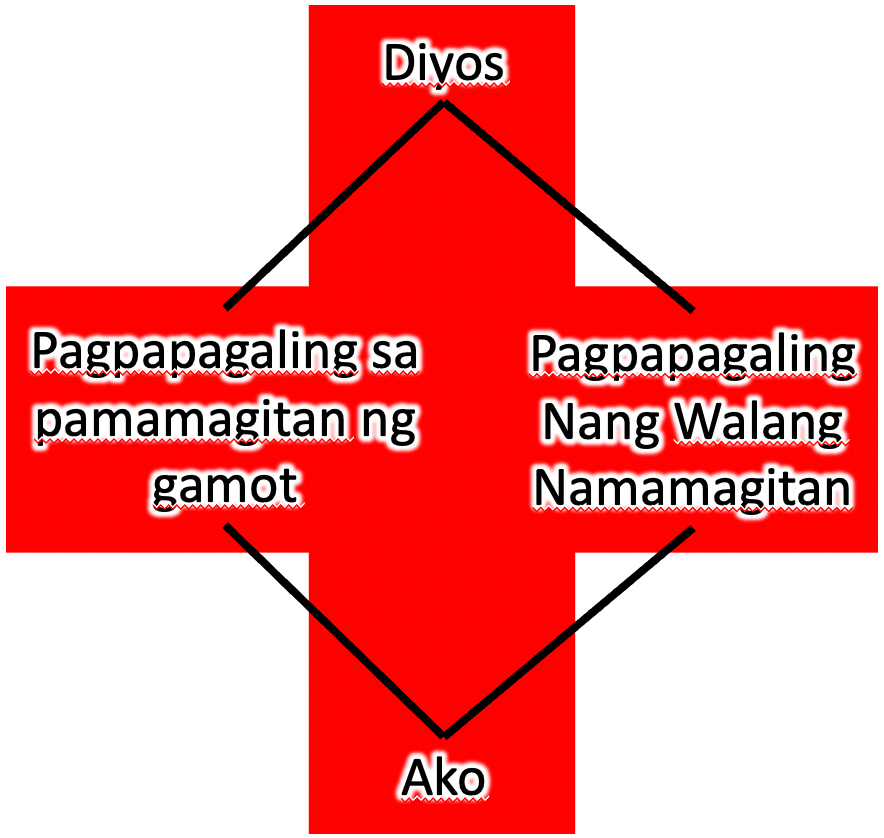
Ayon kay Stone, may dalawang maari paraan na ginagamit ang Diyos para sa ating kalusugan. Paminsan-minsan, nagpapagaling ng Panginoon ang mga tao sa pamamagitan ng gamot. Paminsan-minsan hindi siya gumamamit ng namamagitan — diretso galing sa kanya ang pagpapagaling (tingnan ang larawan sa ibaba). Dapat nating tanggapin ang tulong sa anumang paraan na pinili ng Diyos.
Ang isang magandang halimbawa dito ay ang kuwento ng pagpapagaling ni Naaman sa 2 Kings 5:1-14. Kung naalala nyo, si Naaman ay Heneral ng mga Kalaban ng Israel noong panahon ni Elisha. May malubhang sakit sa balat si Naaman. Meron siyang aliping dalaga mula sa Israel na nag payo sa kanyang amo na meron propeta sa Israel (si Elisha nga) na pwedeng magpagaling sa kanya. Para gawing maiksa ang kuwento, pumunta si Naaman kay Elisha at ang utos ni Elisha ay kinakailangan maligo si Naaman sa Ilog Jordan ng pitong beses para gumaling. Nakita natin na kahit may propeta ang Panginoon sa Israel, ginamit nya ang paligo sa ilog bilang proceso ng pagpapagaling sa sakit.
MGA IDINAGDAG 10 SET 2021:
Baka meron nagbabasa nito na nagsasabi ng ganito, “Dahil lahat ng gamot na binaggit sa Bibliya ay galing sa kalikasan, natural medicines lang ang dapat natin gamitin bilang Kristiyano. Iwasan natin ang pwedeng bilhin sa botika.” Alalahanin natin na ang mga gamot na nakalista sa itaas ay ang mga gamot na meron sila noong panahon nila. Hindi naman nila pinili na puro natural cures lamang — sa totoo lang wala naman silang mga pinagpilian. Ginamit nila kung anong meron sila. Wala naman sila botika noong panahon nila kaya wala silang option na gamitin yun.






 Michael J. Fast