We waited several hours for the ferry to arrive. Soon upon its docking, it disgorged its contents: A bus, several 10-wheeler trucks, a few cars, some motorcycles, and then 250 people carrying luggage, bags, pushing carts, holding babies, returning home for some much needed vacation — their journey towards rest and relaxation nearing it’s end.
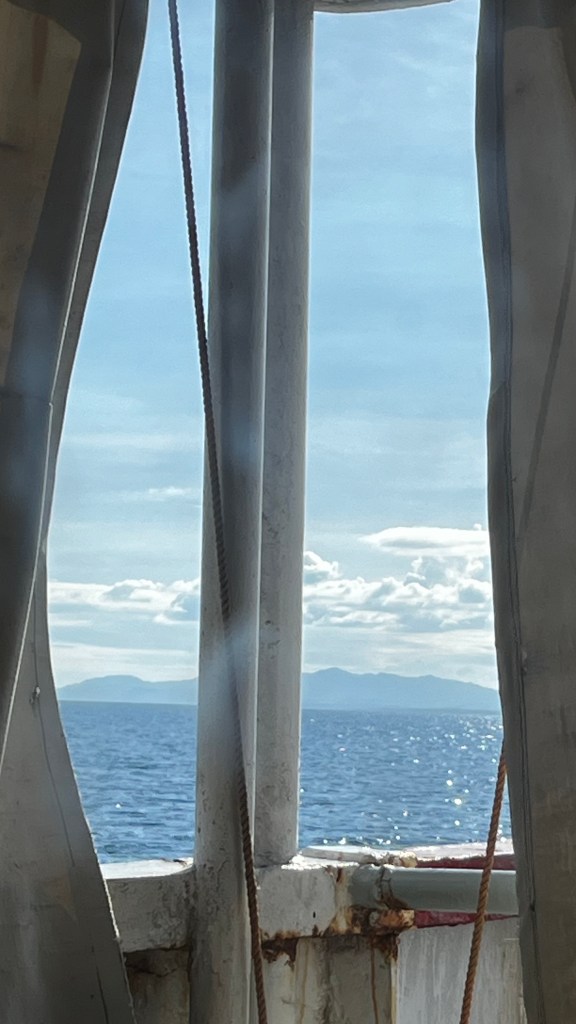
Soon it was our time to embark for our return. We found our spot — comfy, cushy seats that seemed to be stuck on ‘Recline.’ An opportunity to sit back and enjoy the ride. Looking out through the windows, a wondrous revelation of God’s creation. A small gap between two rope-tied tarpaulins, just above a rusty railing. An imperfect vehicle used as a lens into a wondrous world. Waiting and wondering: Who else will join our journey home?
Turns out it’s kids. A young family. Mother and father lovingly spending this journey with their kids. Their kids that are noisy. Their kids that run around. Their kids that play. Joining me on my seat. Looking straight into my eyes with no shame. Exploring the outside. Having snacks. Enjoying their toys. A reminder of a lost innocence right here in our midst.
The leisurely advance of the ferry over the waves allows me to immerse myself in the world around, and to reflect on what God is saying to me today through his creation that groans and speaks and reveals.
There has to be brightness doesn’t there? I mean a brightness brighter than the sun?Sparkling, listening, shining reflecting, colorful, kaleidoscope divided into planes. Shades of blue. Azure. Shiny. Faded. Solid. Liquid. Light.
There has to be darkness doesn’t there? I mean a darkness darker than the blackest night? Inhibiting my senses. Developing. Overwhelming. Deadening.
But then there has to be both doesn’t there — a blending of darkness and light? Which tells me that neither is right or wrong. But they are complements. Partners. Joined together. After all if we only have one or the other, we can perceive or define nothing can we? They work together …
… Sometimes forming a line as straight as straight can be with no variation. Sometimes forming a different line giving shape to the imagination as I try to compare what I see to what I know. Other times forming fuzzy fluffy, faded, blurry lines, and then no lines at all and finally distinction connects to imagination.
It’s a very big big big big picture — bigger than my own understanding. But it’s also the smallest picture you can imagine — detail with no end. The big picture made up of so many small tiny details, each one of them just as interesting and fascinating as the next. I could spend a lifetime exploring everything I can see just in the glimpse between the ship’s tarpaulin awnings, looking off into the distance … could spend time studying oceans and waves, and how the light shines on them and how they break in the gentle breeze. I could look at the islands beyond, exploring the beaches around them, working the way up through the lowlands into the highlands to the peaks of the mountains.
I could then look at the clouds and wonder where they come from, where they go, how they’re formed, what their purpose is. Ethereal turning to concrete. Is rain coming or not? Is it a storm or not? The sun not only perceives them, but adds to their wonder, picking them out — giving shapes through lights and darknesses and colours at sunfall.
And then, beyond that I can look to the sky that goes on seemingly … infinitely …. Taking me farther than I can even imagine. And realising, finally, indefinitely, that all of this is just a small part of all that exists and a small part in relation to who God is.
If I wanted to create — create! Haha! As if that word can apply to me! Perhaps ‘jury rig’ is more apropos — something as wonderful, I’d need to use what has already been made. I can’t do it on my own. I must explore and scrounge and scrape and gather and collect. I must experiment and question and discover. And finally fabricate. And then the glory of whatever it is that I make it’s only there because of the glory that reflects God through his creation.
Even if I were to take a part of myself — that I could argue I’ve had some role in making — I still couldn’t do anything with it. Everything I do merely an imitation of what I perceive and a poor one at that.
The railing, serving the valuable purpose of keeping me safely on board, is also a reminder that all I see around me is marked by sin. Not because it’s a barrier, but because it is pitted and gouged by rust — rust that helps prevent even the barrier from doing its job of being a barrier. It’s the rust that’s a reminder that all that I see is enslaved. Trapped. Just a shadow of its former self.
What would it have been like in its pristine, pure, unsullied, rust-free, unsinful state? I can’t even imagine.
I have rust in my life too. Sometimes it gets chipped away. Other times it gets painted over. But its constant presence is a reminder of not only the realities of the world, but also how the processes of nature can be strong-armed towards being evil.
‘It’s OK to take care of myself isn’t it?’ Perhaps not if someone else needs taking care of, too.
‘It’s OK to build a wall around myself isn’t it?’ But not if people around me are feeling unloved, too.
‘It’s OK to walk the easy path isn’t it?’ But not if the difficult path bears more fruit.
‘It’s OK to just do just enough to get by isn’t it?’ But not if there’s an opportunity to have something deeper and more fulfilling — a genuine relationship rather than dimensionless status quo.
Paint covers and looks nice for a while, but eventually the rust emerges again. Much better to get a chipping gun and let it do its work at excising the rust from my life. Rat-tat-tat-tat-tat. And the chipping gun has many settings. The tried and tested word of God. The seemingly timeless doctrines of my faith. The instruction and advice of significant people in my life. My family’s loving guidance. And my own reflections that identify those rusty parts that need to be chipped away.
In spite of it all, I remain safe here floating on top of the waves, safe in a rusty ship, outfitted with lifejackets, lifesavers, and lifeboats ensuring that any perceived danger is kept at a distance as I live my life and try to do the tasks that God has in store for me today. Even this marred world inhabited by marred people can still do things that bring glory to the pure and perfect God above. And perhaps even more amazing than that, he permits us to do this and even guides our steps as we journey along, allowing the wonder of the creation around us to draw us back to himself. And when we arrive back with him, we experience the ultimate rest and relaxation.
What glimpses of God’s grace have you discovered through life’s ‘rusty’ moments? Share your story below and let’s encourage one another on this journey toward renewal.
Between Rust and Radiance: Catching God’s Voice on the Waves first appeared on michaeljfast.com
I recently had a chance to speak at the British Columbia Baptist Conference’s annual equipping session entitled Improving Your Serve. The theme this year was Abide to Thrive. In the seminar and subsequent reflection and discussion sessions, we reflected on how understanding our church identity informs community actions. We also considered how the good news, kingdom values, serving others, and truthtelling shape our identity. Then we explored where churches may need to realign their focus to be more present in today’s cultural conversations. All in all, we examined how abiding in Christ can lead to a more fruitful and impactful presence in the world.
If you missed the seminar, a video version of my talk can be found here, and a livestream here, but for those who are interested in getting the text of what I said here it is in its complete form.
Personal Story
When I was a kid, joining the church wasn’t just a formality – it was a process with theological requirements. Part of that process involved sharing my testimony. First, I had to present it to the church board. Once they approved, I had to stand before the entire congregation. Both groups had to vote before I could officially become a member.
I remember envying those who had dramatic testimonies – stories – of being saved from lives of obvious, even salacious sin. My story wasn’t like that. It felt ordinary. I hadn’t strayed far or hit rock bottom. I didn’t have a before-and-after moment that felt remarkable.
For a long time, I wrestled with the idea that my testimony wasn’t enough – that it didn’t measure up. But more recently, I’ve been struck by Connie Duarte’s words: ‘We are not called to be believers but disciples.’
That statement has challenged and reshaped how I see my journey of faith. It’s not merely about believing the right things or about meeting theological checklists. Nor is it about the level of initial transformation from darkness to light. Rather, it’s about abiding in Christ every day – submitting to Him, walking with Him, and letting His life flow through mine – journeying with him on a lifetime of being transformed. Being a disciple isn’t about how dramatic my testimony is; it’s about how deeply I abide.
This shift in understanding has led me to see the gospel – and my place in it – in a whole new way. The gospel isn’t just something to believe; it’s something to live out daily. And abiding in Christ, particularly in His proclamation is at the heart of that.
The Vine Metaphor: A Living Metaphor
The title of our seminar is Improving Your Serve: Abiding to Thrive. When discussing the concept of abiding, there’s no better passage for us to examine than John 15. Here Jesus talks about us being the branches and he’s the vine. There’s lots and lots of rich imagery in this metaphor that we will spend some time looking at today. But if we want to get down to brass tacks, the basic message of this story is that whether we like it or not our lives are organically bound up in God’s and in each other’s – I like the fact that Jesus’ use of an organic example here shows that abiding is dynamic, not static. Adding to that, a vine is communal rather than singular: Fruit comes in clusters, and not in isolation; Pruning is necessary for the entire plant to both grow and produce fruit.
It’s this organic story of connection, care, growth, and production that’s a fabulous story of our identity. But we often stop here and say, “Okay, I can live my life now in satisfaction because I’m connected, and I’m identified with who I am.” Once we identify ourselves, we remain satisfied with that identity.
Identity is important. Let’s look at the church, for example – especially since that’s why we have gathered today. In the church we have a series of things that identify us for who we are.
Debie Thomas, in her Into the Mess and Other Jesus Stories: Reflections on the Life of Christ, says, “If God is the vine grower, Jesus is the vine, and we are the branches, what should we do? We have only one task: to abide. To tarry, to stay, to cling, to remain, to depend, to rely, to persevere, to commit. To hang in there for the long haul. To make ourselves at home.”
Our seminar is entitled Improving Your Serve. And each of these three words in the title are significant for today’s conversation. That’s why, when speaking of identity, we will begin with the centre word: “Your.” So, let’s get into the nitty gritty of John 15!
ABIDING AS IDENTITY
The story starts with Jesus declaring “I AM.” This is God’s identity word – the name he uses when he introduces himself. Jesus’ ultimate identity, and we see this throughout the book of John, is his constant referral back to who he really is. He uses the technical term “I AM” to indicate that he is declaring that he is the same as the God who saved Israel from Egypt.
What’s interesting to note in John 15 is that Jesus does not simply say, “I AM.” Much like God’s declaration of who he was to Moses at the burning bush was not simply saying, “This is who I AM, period.” Jesus identifies himself as “I AM the vine.” I AM is connected to his creation – which is really how God initially identified himself in Exodus isn’t it? God made himself known to Moses at the burning bush, in response to hearing cries for help from his people!
YHWH exists for more to happen than mere existence – he exists also to save humans! We, too, are called to make this same movement from one thing to the next. And this progression starts with identity – Who are we? Who is God? – but then moves into ideas of purpose. It moves from merely being a vine and branches towards bearing fruit.
1. Worship as Identity
For example, we all engage in worship of some kind or another. Every now and then we decide, “Hey, let’s worship without singing,” Matt Redman-style, but in all reality, singing forms the core of how we see worship. There’s all of this kind of stuff that we do that helps us identify who we are and the kind of church we are – and all of those things are music-related: Are we going to sing praise and worship songs? Are we going to sing from the hymn book? Are we going to use instruments? Are we not going to use instruments? Is there going to be a worship team in a band on the front or is it just going to be a guy in a toque playing a guitar with a candle burning? Years ago, at Missions Fest one church advertised “a massive wall of sound.”
All of that to say that sometimes rather than identifying ourselves as those who worship, we instead identify ourselves as those who worship this way.
2. Word as Identity
We also identify ourselves through how we approach the Word of God. The Word of God – is it a significant part of our time when we gather, isn’t it?
Sermons, children’s songs such as “read your bible pray every day, and you’ll grow, grow, grow,” bible verses hanging on the church wall, arguments over bible translations, etc.
One of the churches I serve in the Philippines thought long and hard and eventually came up with the name, Metro Manila Bible Community – because for us as Bible believing Christians, the Bible is our sole source for faith and conduct. So much so that it becomes our identity.
But word is more than these things.
But then again, we often attach identity to the length of sermon – or bible translation used, or the place where the sermon is preached from, or whether or not we read through the bible in a year or not – rather than the fact there is a bible.
3. Sacrament as Identity
We have a third identifying mark. I have used the word “sacrament” here but some of you may be squirming in your seats because we generally avoid using that word. We say, “No, no, no, we’re Baptists. We don’t have sacraments; we have ordinances!”
In the long run, it doesn’t really matter what word we use. Rather what’s important is that we do have these things that are a significant part of how we identify ourselves. It’s right in there in our name: We are the BC Baptist Conference. Other groups don’t centralize baptism as much as we do, but rather they centralize the Lord supper. As members of BCBC, both of these are fairly intense processes for us.
I already told you my baptism story. There was a similar process when I wanted to participate in the Lord’s Supper. Mind you I didn’t have to convince the board. Rather, before I could take Lord’s Supper, I had to convince my dad that I understood what was happening so that I wouldn’t “partake in an unworthy manner.”
It’s different in the Philippines. Here children go through First Communion where they’re formally introduced into the rite. Why all the process? Because we have these things that we identify as being important, so much so they identify us with who we are.
4. System as Identity
A fourth identifying feature is system. I actually struggled with what word to use here. We could use governance. We could use discipline. We could use polity. But regardless, it’s the way we make sure that everything is orderly in our worship and our organization. How do we organize ourselves? We all have some kind of organizing system – whether we’re organized to attend church at a specific time, whether we’re organized into having a corporate worship and then a small discipleship or small group or Bible study, whether we have a Sunday school, whether we have a board of trustees or board of elders or board of directors, whether we have a pastoral team or not whether we agree that pastors are only male or can they also be female – all of this stuff is part of our discipline. It’s our way of addressing what’s in 1 Corinthians 12 to having an orderly experience and that’s also how we identify ourselves.
And of course we joke about this, right? Whenever you have two Baptists, you have three opinions! Maybe we have an organizing system but maybe it’s not always that great.
ABIDING AS THRIVING
Now that we’ve looked at identity, let’s come back to abiding. Sometimes when we think about abiding, we think about abiding as identity – I’m connected to the Father, I’m connected to the vine – who is Jesus – because I’m one of the branches connected to this vine and I’m happy with that. But if we take the vine motif to its very end as Jesus does in his passage, we realize that this vine motif is more than merely identity and there’s this transition that happens as we transition from “being” to “doing.”
If we return to our title – Improving Your Serve – we’ve moved beyond Your to the Serve portion of the conversation.
When I was younger, we tried to avoid talking about doing largely because of Bible verses that say things like “We are saved by faith not by works.” We internalised this so much that when we came to other verses that seemed to value good works – such as James’ “faith without works is dead” – we struggled.
Another struggle with is avoidance of doing checklists as followers of Jesus Christ. And we have lots of checklists don’t we. When I was a kid, it was “Don’t drink, don’t smoke, don’t chew, or go with them that do.” Another checklist might be
go to church every Sunday – & invite your friends,
read your Bible and pray every day,
share the gospel with whoever comes across your path,
be involved in the church through other things, such as teaching a Sunday school class or singing in the choir.
We even found biblical support for this. We looked at the story of Mary and Martha, and we interpreted Jesus words to imply that we should simply be sitting at the feet of Jesus and not be so busy doing the things that need to be done.
There’s a pushback against checklists in part because we don’t want to turn our relationship with Jesus into some kind of a cosmic game of Good Manners and Right Conduct. We’re looking for something more authentic than that. We’re looking for something more organic than that.
What we realize is that these checklists are in fact ways for us to engage in discipleship. We are confronted by two questions: How can we be disciples of Jesus Christ? Is it possible to be disciples of Jesus Christ without doing the things Jesus Christ wanted us to do?
This adds a different nuance to the checklist. Instead of checking off things on the list we evaluate each situation we came to in life. You may have heard of this phrase that has actually appeared over the past hundred years of the church at least – It was illustrated by an acronym WWJD? meaning What would Jesus do? It was a question we asked ourselves when confronted with a situation we needed to evaluate. An area perhaps that wasn’t directly spoken about in scripture but was an area where we needed a make a decision. With no to pull out of scripture to serve as our guideline, we rather tried to understand the mind of Christ and applied that our situations.
The story of the vine and the branches has some troubling features to It. It talks about a gardener. It talks of being proved. And it talks about bearing fruit. These things are troubling to us because it seems to imply there are actions associated with our abiding. There’s an expectation of care, discipline, & fruitfulness.
Which is why Jesus spoke about this as a gardener-vine-branches-fruit process. It helps us understand this as something that’s natural and organic rather than something that’s forced and required.
Debie Thomas again:
“But ‘abide’ is a tricky word. Passive on the one hand, and active on the other. To abide is to stay rooted in place. But it is also to grow and change. It’s a vulnerable-making verb: if we abide, we’ll get pruned. It’s a risky verb: if we abide, we’ll bear fruit that others will see and taste. It’s a humbling verb: if we abide, we’ll have to accept nourishment that is not of our own making. It’s a communal verb; if we abide, we will have to coexist with our fellow branches.”
Gardening is all about growing a garden that produces delicious fruits. There are so many different kinds of fruits, and they come from all sorts of plants. Right now, I can see a bunch of fruits hanging from the trees outside my window. Some of them are picked for their leaves and used in soups, while others are eaten right off the tree, like coconuts, mangoes, avocados, and papayas. And let’s not forget the beautiful gardens themselves! We love looking at them, which is why there’s a magazine called Better Homes and Gardens. It shows off all these amazing gardens and tells us what makes them so special.
The parable of the talents tells of one of the servants who hid his money in the ground because he fundamentally misunderstood his master’s desires. The purpose of investment is the same as the purpose for a garden – to bear fruit. Do you know you do if you have money? Invest it. Do you know what you do if you have a garden? You prune and cultivate it, so it bears fruit. Do you know what you do if you have a family? You want the outcome of your kids’ lives to be better than your own.
So, what about the church? Do we know what we do if we have a church? We have seen what the church is. Now let’s look at what the church is all about. This means moving beyond checklists and identity and transitioning into thriving and fruitfulness. What does thriving and fruitfulness look like as the church abides in the vine? This is an important question because without asking this, we tend to focus on checklists and end up making statements such as, “Oh you’re not a part of us because you don’t keep the right lists you haven’t done everything haven’t checked everything off enough.” It leads to us creating lists that we argue about – lists to determine whether someone is in or out or not. But what Jesus really wants us to do in the church is to bear fruit. This is because fruit bearing is a natural outpouring, the organic result of what we do. As Jesus followers we bear fruit.
How do we get to that thriving point because mere identity is not thriving unless there’s fruit that is borne. It means while we keep our identifying features – while worship God in spirit and in truth, while we focus on the word as the sole standard of faith and conduct, while we continue to see the significance of the sacraments in our lives, and while we continue to maintain orderly worship – we also go beyond that and ask ourselves, “How does all of this help me bear fruit?”
A. From Worship towards Promulgating Kingdom Values to Those Outside the Church’s Four Walls.
The first level of this interconnectedness is with the vine himself. Verse 1 says, “I am the vine, my Father is the vinedresser,” and a few verses later, “remain in me, as I remain in you.” There’s a mutuality to our connection with God and with the other parts of the vine. None of these branches grow in isolation from either the vine or the other branches; together they bear fruit.
The values of the kingdom are so important that we should share them with others. We want to worship God and live according to these values, but we also realize that they’re not just personal; they’re values we incorporate into our lives and should share with the world. We enjoy being one with God, imitating Christ, and being Jesus-followers. But how do we connect with others? Understanding kingdom values, bearing fruit, and being part of the vine requires a shift from individual to communal understanding. True worship creates genuine community through mutual transformation in Christ’s presence. Christ’s work in us produces fruit, which isn’t just food but a seed that sprouts and bears new vines and plants, spreading around the world.
The most explicit description of these values is found in the fruit of the Spirit and includes love, joy, peace, patience, kindness, goodness, faithfulness, gentleness, and self-control. The fact that they are fruit means they are obvious in the lives of Jesus’ followers.
We can work at revealing the joys of the kingdom of God to people outside of our faith community through active participation with like-minded faith communities, active cooperation with like-minded groups, and active accountability in both the religious and secular world. All this is typified with the Christian attitude of unity in matters essential, liberty in matters non-essential, and charity in all other matters.
B. From Word towards Proclaiming Jesus Christ’s Role as Shepherd-Lord to Those Outside the Church’s Four Walls.
One could be forgiven for assuming when reading v7 – “If you remain in me and my words remain in you” – that this means that all we need to do is remain connected to Christ. He’s with us and we are with him. But the story doesn’t stop there because in the very next verse, we read “you will bear much fruit.”
There is good news – we are connected to Christ – but that good news extends beyond the salvation moment, and into our lives as followers of Jesus Christ.
The Good News of Jesus Christ is that Jesus Christ is not only our Savior. He is also the Lord Jesus Christ. Jesus connects him with humanity, Christ connects him with being God’s plan for the salvation of all peoples, and Lord connects him with being the one in charge of the universe – the One ultimately responsible for ensuring we have peace and order, economic sufficiency, public justice, and national righteousness. We know he was responsible for this because of the way he introduced himself to the world laid out his terms of engagement with humanity. And what are these terms of engagement? We see them in Luke 4:18-19:
“The Spirit of the Lord is with me. He has anointed me to tell the Good News to the poor. He has sent meto announce forgiveness to the prisoners of sin and the restoring of sight to the blind, to forgive those who have been shattered by sin, to announce the year of the Lord’s favor.”
To see the gospel being limited to merely the salvation moment is to do it a disservice. While the salvation moment holds significance, it is not confined to that single event. Traditionally, the gospel has been understood as a one-way transaction, flowing from those who possess knowledge to those who lack it. However, the gospel transcends this notion and becomes a shared journey among all who seek the fulfillment of this message. Our journey through salvation extends beyond that, encompassing discipleship and a deeper commitment to following Jesus. We are not merely labeled as “Jesus people,” but as “Jesus followers,” embodying the essence of our faith.
If Jesus terms of engagement includes these things – if his presentation of what the good news is is described in this way – then we too must engage in more than merely the salvation moment but rather join into the salvation journey with our neighbors.
We see that in the book of Acts. In the city of Antioch the followers of Jesus were first called Christians. Now I don’t want to talk about Greek, but I’m going to talk about Greek. The word Christian is a grammatical construction in Greek; it’s a diminutive form of the word Christ. That means when people saw those who proclaimed Jesus walking around them, they identified them as being “little Christs.” There was something about these people that move beyond merely Jesus people, but people who followed Jesus and imitated him so much so that they became little Christs themselves.
I am reminded of Oscar Romero’s 1978 sermon where he says,
A community is a family that believes; it is a group where each member accepts God and feels strengthened by the others. In their moments of weakness, they help one another and love one another; they shed the light of their faith as an example for others. When that happens, the preachers no longer need to preach because there are Christians whose very lives have become a form of preaching.
Even though we have this authentic identity as Bible followers, this authentic identity leads us to proclaim the truths that we find in the bible. This is because, to abide is to remain connected for the purpose of bearing fruit. The thriving is bearing fruit through being connected to the vine.
Practically, this could look like declaring the Good News of Jesus Christ to all people. We declare Jesus as Lord and Saviour of our community and we recognise His central role in transforming the world through intentional evangelism, communicated effectively in a culturally relevant way by people who have themselves experienced the transforming power of God.
C. From Sacrament towards Serving God and Serving Those Outside the Church’s Four Walls.
If the sacrament is a way to be reminded of grace in our lives, how can we be grace to our community through this natural outflowing from sacrament to serving God, neighbor, and others?
In verses 4 and 5, the importance of connection is highlighted, saying that “no branch can bear fruit by itself” and “bears much fruit.” This shows how our relationship with the vine and the natural flow of that union into producing fruit are connected.
This connection starts fruit bearing, but it also means we can’t stop bearing fruit when we’re with the vine. This is because being with the vine naturally leads to the showing of fruit.
If we follow the vine and bear fruit, it changes us. Other people who follow the same path and bear fruit also have rituals that set them apart. Our rituals help us reflect, mourn, confess, and be restored. This reality, shown in our organization and how we’re run, can sometimes make us feel like we’re not in the world. But we need to move beyond these rituals and live a real life where we actively serve, love God, and love our neighbors as we love ourselves.
Sometimes, this emphasis on the daily details can be reduced to a checklist, focusing only on feeding, distributing, and doing enough. But the real meaning is being a real presence in our world.
Our connection to Christ is the foundation of this journey. By copying His example, we don’t necessarily mean sacrificing ourselves like Jesus did on the cross. Instead, we try to keep His life and teachings. Jesus was really interested in the everyday things of life, which is why He used parables, healed the sick, fed the hungry, clothed the naked, and comforted the grieving.
Practically, this could look like showing the love of God to people both inside and outside of our faith community though acts of mercy, relief rehab and development. We will be engaging in educational ministry services such as establishing schools of all levels. We will be delivering free medical-dental clinics. We will be conducting livelihood programs for the poor of our communities.
D. From Systems towards Testifying to Our Experience with the Truth to Those Outside the Church’s Four Walls.
The story starts with the Father’s role as a gardener, but it goes beyond that. We see that the whole purpose of the gardener is for us to show ourselves to be his disciples. This is evident from the beginning, where we read, “He cuts off… he prunes” all the way to the end, where we read, “showing yourselves to be my disciples.”
We’ve been so caught up in defining ourselves and setting rules that we’ve forgotten why we’re doing it. We need to go beyond just having clear terms and start living out our faith. Our goal is to become disciples of Jesus Christ, not just to have a well-defined identity.
The church has a problem: we’ve pulled away from engaging with the world. And guess what? That’s actually changed the world and made it more secular. We’ve been so caught up in the rules and systems of our churches that we’ve forgotten about the world around us. But Jesus’ story of the vine and branches is a wake-up call for us. It’s a reminder that we’re meant to be part of the world, not separate from it. We’re Christ’s body, and the gardener is taking care of us. We’re connected to the vine, so we can re-engage with the world from a place of authenticity. And when we do, our witness and our call to truth come from a genuine connection to Christ. That means we can connect with others on a deeper level and share our faith in a meaningful way.
Practically, this could look like being prophetic voice by engaging society with biblical truth through participation in public advocacy, social justice, value transformation, promotion of freedom, engagement in the public square, involvement in marketplaces, and the transformation of public perception through education, evangelism, church planting, intercessory prayer, and discipleship.
Momentary Conclusions.
The brilliance of the vine metaphor lies in its ability to portray fruit bearing as organic and natural, rather than programmatic. Identity isn’t merely a state of being; it’s not just about being connected to the vine, which would imply that our identity is solely determined by that connection. The very purpose of a vine, as well as all plants, animals, and organic processes in the world, is to bear fruit – and their identities are tied in with the fruit they bear. Therefore, our identity cannot be reduced to a mere connection with “being” – there must also be a “doing.”
However, it’s crucial to emphasize that this “doing” is not merely a means to an end; it’s organic and natural. It’s an inherent expression of our connection to the vine. Bearing fruit is an essential aspect of the nature of a vine. Without this bearing of fruit, there’s a sense of incompleteness, as our being is intrinsically linked to our actions. This is the essence of the Thrive aspect of our topic for today.
Where are we headed with all this? What does it mean for us in the BCBC as we strive to Improve our Serve, and Abide and Thrive? We must not only assert our identity but also become present wherever we are. We are integral to what we engage with, as Jesus became one with the world when he descended from heaven in Philippians 2. By this, he declared his intertwined future with the world’s. Similarly, our future is connected to the world’s. How can we unite our futures to connect with God? It’s a call to re-enter cultural spaces and engage authentically with the world as we strive to abide but thrive.
Debie Thomas, again:
“If only we would consent to see reality as it truly is. ‘I am the vine,’ Jesus tells his disciples. ‘You are the branches.’ It’s a done deal. Whether we like it or not, our lives are bound up in God’s and in each other’s. The only true life we will live in this world is the life we consent to live in relationship, messy and entangled though it might be. The only fruit worth sharing with the world is the fruit we’ll produce together.”
So, we’ve covered two of the three words in the name of our seminar improving your serve. We talked about Your which is our identity, we’ve talk about Serve, which means the responsibility we have to wear fruit, and now we get to the Improving part.
We’ve prepared a series of questions that you can discuss and there’s a panel discussion as well after this to help us as we think about how we can move onto the next step and Improve our serve.
So, from Quezon City, Philippines, this is Michael Fast greeting you a Magandang Araw! God bless you.
I got tongue tied when giving directions to the tricycle on which barber shop I wanted to go to but I arrive nonetheless. Fortunately I have been there before so I am able to guide the driver. Unfortunately there is a lineup today. I guess that’s what I get from getting a haircut on Saturday afternoon.
I climb out if the tricycle (not made for people as big as I am) and hand over the fare. Then I pop my head in to ask, “Is there any hope?” I am number 2 so that’s not too bad. It looks like today Noel has another guy cutting, too, so that makes the line go down quickly. Noel, the owner of Marvin’s Barber shop, has been cutting my hair ever since I moved to Pingkian 12 years ago. Once I find a good barber I tend to stick with them. It’s gotten to the point where I just sit down and Noel knows what cut I want. Nice!
I sit outside along the front of the shop on a stack of two monoblock chairs. A bench of similar design is already occupied by three other people. The shop features the typical striped colours symbolic if barbershops the world over. It’s glass front featuring a painted lettered sign “Marvin’s BARBER SHOP.” A black plastic bucket on the ground beside the door catches water the drips constantly from the air conditioner. Faded photos of haircuts are featured prominently in the windows.
Life passes us by. Tandang Sora avenue is always busy. Only two lanes but it leads people past several schools, a mall or two, and a wet market. The road has improved over the years. Now it boasts a smooth asphalt surface that makes driving easy. The steep edges, however, make walkers a little more cautious.
Small delivery trucks, jeepneys, vans, motorcycles, tricycles, and cars pass by going here, there, and everywhere. Pedestrians also frequent the way carrying bags, purses, or books.
Directly across from the shop is a brand new stripmall, still unoccupied. Looks like there is room for fourteen shops on two floors, each with it own rollup door. A roofdeck is on the third floor. It’s one of the new places that are constantly being built in anticipation of the road being widened to 4 lanes.
The urban sprawl tends to hide the physical geography, but signs peek out from time to time. The south side of the road, where I am sitting, appears to be higher and the ground slopes away across the road towards the creek that I know is there.
The bench just emptied itself of people — I guess the lineup wasn’t as long as I thought. Soon it will be my turn. All of a sudden I see the nod and head on in. He seats me in his barber’s chair and starts the preparations. As I look into the full-width mirror I see Noel’s tools of the traded arrayed before me. There are seven electric clippers. A box holds 8 different types of brush with a couple more in various places on the shelves. An assortment of bottles sits on the left, ready to be applied during various stages of the haircut. Scissors and combs abound! A TV hangs on the wall behind me, playing the latest telenovela. I can see a reverse image in the mirror in front of me. This mirror is actually an infinity mirror since it works in conjunction with the mirror on the back wall.
A strip of toilet paper is wrapped around my neck to be held in place by the striped cape that will protect my clothes from falling hair. The clippers are chosen, and will be exchanged with other clippers at various times — why? I don’t know. From time to time the scissors come out, being used rapidly, sometimes held vertically as Noel swiftly operates them and spins them around the back of my head. Then the razor comes out to make sure the edges are neatly trimmed. At one point, the cape is removed, shaken out, then replaced as the final push begins. A razor makes sure the edges are neat.
Then comes perhaps the most interesting part. After putting rubbing alcohol on my hair, he begins to massage my neck and shoulders, making sure all the “lamig” is removed from my muscles. Then, with a sudden move, there is the head twist and neck jerk move that frees up all the bones there. This is always accompanied by a a laughing “Ayus!” on his part. The secret is to just relax and let it happen. But it is always a little freaky. Then a quick brush off of any fallen hairs and the process is done!
Guwapo na!
What is your favourite haircut story? Why not record it for posterity in the comments below?
Christmas is more fun in the Philippines! Christmas begins September 1 and ends in December. The joke is that this is because these are -ber months (all ending in -ber), which is reminiscent of brrrr and admittedly is the coldest things get in the Philippines (where daily temperatures begin at 25C and go up). I thought that a look at Filipino Christmas and a comparison with the Christmases practiced in other parts of the world, might help us further understand the process of appropriation.
The Christmas I remember included a variety of images, from Jesus in the manger, to Santa Claus’ red suit. There were shepherds, angels, wise men, reindeer, carols, Christmas songs, presents, and turkey dinner. We put up decorations, stood up Christmas trees, sat on Santa’s knee, and participated in and attended Christmas pageants. We debated: Should it be Christmas or X-mas? Is it proper to celebrate Christmas before Remembrance Day? When is the best time to tell our kids that Santa isn’t real. If Christmas falls on a Saturday, do we need to have a church service on both Saturday and Sunday or can we just have one? The longest kind of celebration for Christmas was the 12 days immortalised in the song. Canadians even had Bob and Doug MacKenzie’s version to enjoy!
What perhaps I didn’t realise back then was that Christmas is an intensely cultural experience and different cultures express and experience Christmas in different ways. Just go back over the lyrics to Band Aid’s Do They Know It’s Christmas? to see the absurdity of some of our ideas!
Christmas is an important time of the year for Filipinos. Preparation begins September 1 when malls begin playing Christmas carols. Soon decorations appear that depict various “Christmas” scenes. In mid-November, people began planning Christmas parties at a variety of locations: A person can expect to attend multiple Christmas parties each Christmas season. The start of Simbang Gabi on 16 December is significant in more ways than one: Not only does it signal the final nine days leading up to Christmas, it also signals the start of Christmas Carol season.
While it may be called Christmas there are some features of a Philippine Christmas that differ from the Christmases I experienced as a kid in Canada and maybe from the Christmas that you are used to.
World’s Longest Christmas. I guess we can begin at the four months of Christmas. Filipinos often brag that they have the longest Christmas celebrations of any place in the world. They also sometimes apologetically say that they start too early. I guess maybe I could point out that perhaps everyone else starts late?
Parol. The picture at the top of this post is of a parol. The parol is the ultimate Filipino Christmas decoration. Children learn to make these in elementary school and every house has at least one. The simplest parol feature a bamboo frame with colourful plastic skin while the more complex ones feature lights and music. The centre of parol culture is the province of Pampanga, just an hour or two north of Metro Manila, where craftsmen have perfected the art of parol. They have even developed a home-grown system for making the lights dance that predates modern digital light controllers.
Simbang gabi. Simbang gabi is nine days of early morning worship at the local church. It begins on December 16 and goes until Christmas Eve. Some treat the experience as panata, or vow, believing that God will grant their request if they attend each of the nine days.
Christmas caroling. Christmas carolling in the Philippines is a type of wassailing, similar in some ways to Canadian Halloween practices. What is interesting is that one of the more popular Filipino Christmas carols is actually about wassailing. Perhaps the best-known example of Christmas wassailing is in the popular Christmas carol We Wish You aMerry Christmas. As one looks at the lyrics one sees the wassailing process, described from demands for treats (“give us some figgy pudding”) to threats (“we won’t go until we’ve got some”). (Actually the Christmas carol “I love to go a-sailing” is actually “I love to go wassailing.”)
One year I did a study on Christmas carolling in our community. The choice of songs was limited. More than half of the groups sang the typical Christmas medley of Sa May Bahay Ang Aming Bati [We Greet the Owner of the House], We Wish You a Merry Christmas, and Thank You Very Much with two more groups merely omitting Thank You Very Much. By far the most popular song of the evening was Sa May Bahay Ang Aming Bati at 11 hits followed by We Wish You a Merry Christmas at 10 hits, and Thank You, Thank You, Thank You Very Much! at 9 hits. I was surprised that Ang Pasko Ay Sumapit [Christmas is Drawing Near] was only sung once that evening. Other songs included Jingle Bells, Noche Buena [Christmas Eve], Pasko Na Naman Muli [It’s Christmas Time Again], Last Christmas, and Maligayang Pasko [Merry Christmas]. While all of these songs are identified as Christmas carols, none of them makes more than a passing reference to the birth of Jesus.
In the province of Samar caroling is called Pananarit, a Waray-language retelling of the story of Mary and Joseph looking for a place to stay in Bethlehem. Carolers go from house to house asking, through song, “Can you see us here?” Those in the house answer “There is no room in the inn.” The complexity of the song required many singers. The song is quite lengthy, taking up four pages of paper, and a caroller was expected to know it perfectly if they expected to receive a prize. This is repeated every night until Christmas Eve when English songs such as We Wish You a Merry Christmas are permitted. This is because Jesus has now been born and so they don’t need to look for a place to stay.
Aguinaldo and the code words “Merry Christmas.” Since a major part of Christmas is gifts, there are a variety of hints that one can give in order to get a present. Aguinaldo is the term for the P20 that godparents give to their godchildren on Christmas. Some Godparents visit the bank to ensure that these P20 bills are new. In some settings the term “Merry Christmas” is code for “I am waiting for my gift,” which is why some offices ban its use. Having an Exchange Gift is a common feature at Christmas parties. The value is determined before hand to ensure an equitable distribution. 13th-month pay is enshrined in Philippine law that requires employers to give their employees an additional one-month’s pay each December.
What’s different? Christmas is a wonderful time for Filipinos. But you may have noticed a few differences with how you celebrate the same event. By and large Santa is missing. Maybe that’s because the only places with chimneys sell litson manok [roasted chicken] and anyone sliding down those chimneys would end up getting roasted. Other features of the Santa story are also far from the typical Philippine experience: Sleighs, snow, warm winter clothes, reindeer, and North Pole. Christmas carols are also different, as noted above. The Philippines has developed its own set of appropriate Christmas songs. In fact, the main indicator that Christmas has begun is that Jose Mari Chan sings his famous Christmas Song, Christmas in our Hearts.
All Christmas celebrations are in fact appropriations (like Halloween, Valentine’s Day, etc) in that they have been appropriated to bring different meanings to previously pagan festivals. Of course celebrations of Christ’s birth predate these appropriations but we don’t celebrate those anymore. Thus some of the main features of Christmas are really repurposed pagan items. This repurposing gives new meaning to old symbols. This is why I don’t agree with some who claim that to celebrate Christmas or Halloween is to embrace paganism because most paganism has been repurposed and given new meanings — examples of the conversion of culture that Andrew Walls speaks of.
I am hoping that this look at Christmas helps us understand the kinds of appropriations that are appropriate to use. Particularly those who are in the same line of work as I am, namely proclaiming the good news of Jesus Christ to people from another culture, can help find ways for this kind of appropriation to happen. Part of the secret I think it to let it happen organically.
What about your own Christmas celebrations? Have you experienced change in Christmas in your life? How have you made them your own? Feel free to leave a comment below.
If you have enjoyed reading this, please also consider Liking this post and Following this blog.
I am pretty excited today because my wife’s new blog, Beneath My Shell, went live just a few moments ago. Eva blogs her thoughts about her life as a missionary midwife living in the Philippines. Here is what she has to say about what you can expect:
My name is Eva Fast.
I am a Canadian missionary with the Baptist General Conference of Canada. I have lived with my family in Metro Manila, Philippines since 1999. My background is nursing and I fell in love with midwifery in 2007. Throughout the years I’ve been involved with over 700 natural births. Although I’m not practicing midwifery at this time, my passion for women and their stories remains. I believe women are stronger together with God as their foundation.
Please head on over a take a look at what Eva has to say. You will love her first story!
When you get there, don’t forget to subscribe so that you can get timely updates!
I am sitting at my daughter’s dining room table looking out the window. I am always struck by what I can see when I am high up on top of something. It gets me thinking about how space is arranged within cities and how at times diverging or even opposing parties find themselves adjacent to one another.
There is a house immediately behind the condo building that has two prominent, colourful, pictures of Jesus — one on the garage and the other beside the front door (you can see them in the photo above). I should point out that having a picture of Jesus on the front of your house is not at all unusual in Metro Manila but in this instance it seems like a different message is being portrayed. Then I noticed that on the next street over was a small Iglesia ni Cristo [Church of Christ] chapel and I realised that this particular area has an abundance of members from that church. The Iglesia ni Cristo is a Filipino new religious movement whose main location is just a few minutes down the road. Because of this reality I suspect the homeowner is sending a message to their neighbours: We are Roman Catholics in this house.
Thinking along these lines got me to take a closer look at the other spaces I could see. The largest part by far is indeed taken up by the properties of the Iglesia ni Cristo. Sticking up from the greenery of the surrounding mango trees is the new hospital, media center, member apartments, and university. A little further around we can see the main worship center with its grand spires.
Immediately behind the INC site is the beautifully-treed University of the Philippines Arboretum. The space, although transited by a 16-lane highway, is connected to the greater University of the Philippines, the premier university in the Philippines and the place where three members of my family went to school.
Immediately in front of the vast INC estates lies the Culiat Muslim Compound, an islamic community made up of people whose primary origins are in the far south of the country. The space contains a large community of people and is also home to at least five mosques.
Several Roman Catholic orders also occupy adjacent space including the Augustinians who have a variety of training centers and chapels, the Claretians who include the Claret Seminary, the Claretian Missionary Sisters, and the The Institute For Consecrated Life In Asia, and the Adorers of the Blood of Christ with their St. Maria de Mattias Center Inc.
There is also the smaller Our Lord’s Temple Ministry compound squeezed in between these different groups.
Interspersed in between these various institutions are houses and homes occupied by people from all walks of life. From the wealthy members of exclusive subdivisions to the poorer members of various informal communities squeezed in between other more formal establishments.
What is interesting is that while there are a variety of religious beliefs, practices, and traditions represented, at the core they are all interested in making the world a better place. I wonder how the different beliefs impact this desire?
Another question it raises is how such diverse groups manage to survive beside on another. Certainly the niceties of modern societies prohibit any overt forms of harassment from one to another. I wonder if there is any cooperation between these groups as they try to make the world a better place?
Which, of course, leads to a question that is relevant to whoever is reading this blog: How do we survive in close proximity to others with divergent beliefs, practices, and traditions? Any suggestions or examples from your own life? Please comment below.
If this topic was of interest to you, why not consider liking and subscribing to this blog?
It’s always a challenge to drive by a wet market. Because it’s a destination for so many people, that means (surprisingly enough) that there will be lots of people there! People also means traffic, the bane of most inhabitants of Metro Manila. The road from our house was pretty clear for the first while. In fact, I commented to Eva that there were only a few people on it. I guess leaving just after 8AM meant we missed the Monday morning rush. Normally when we get to the main corner, I avoid a left turn because not only does it lead to the market, it also goes past an elementary school, a mall, and a grocery store. During old normal times, driving past a school is always a bit touch and go because if you happen to hit a time when kids are either going to, or coming from school you can expect a rather long wait. It does help develop patience, however.
Today, however, we needed to visit a drug store right beside the market to pick up some medical supplies to help a friend. Our trip went fairly quickly and arrived at the drug store in good time. I did have trouble parking for two reasons. The first is because there were no more slots left in front of the store. The second was because there was a line of people standing on the street in front of the store. Lest you think that there was a sale on and people were lining up for that, I need to tell you that most people in Metro Manila do not drive their own vehicles. Rather they take public transportation. These people were lined up to take the next available ride to their destination.
Public transportation in the Philippines is both convenient and complex — at least to a certain extent — because it’s possible to take a ride from basically your front doorstep all the way to wherever you want to go in the Philippines. Here is what a typical journey looks like.
Before leaving home, I gather everything that I need for the journey — keys, coins, handkerchief, hat — and then head downstairs. Then head back upstairs for my face mask. Once I get my shoes on, I head out the gate, then go back inside to get my umbrella.
[If you are unaware of what an umbrella is, here is a simple explanation: An umbrella is a somewhat cumbersome device that if you take it with you it doesn’t rain but if you leave it at home — saying to yourself after looking at the sky, ‘It’s not going to rain today’ — then rain is guaranteed.]
As I walk down the lane from our house to the street, I see a green tricycle stop and signal to me if I want a ride. A raised finger eyebrow is all that’s needed to engage their services while a wave of the hand means, ‘No.’ (If I choose to not hire the roving tricycle, I can always walk a few steps to the corner where there is an official terminal for yellow tricycles). For the uninitiated, a tricycle is a motorcycle with a covered sidecar attached. Passengers can either sit in the sidecar, which is equipped with 3 seats, or sit sidesaddle behind the driver (2 more seats). In our area there are three main tricycle associations, each with their own colours.
The tricycle payment system is rather complex. If you hire a tricycle that is in the terminal lineup it costs P25 for a ride out to the main road. If the tricycle is not full, the driver is allowed to pick up other passengers on the way (who pay P10 each), with the proviso that the initial hire gets to sit in the best seat.
Once we get out to the main street, about 1.6km away, the tricycle pulls over to the side and we get out and pay the driver. There is a small market area here, too, in case we need to get something on the way home. But since we are going further we head around the corner to where the jeepney awaits. If the front seat is full, we need to board from the door in the rear, entering crouched over we make our way to the front and hope there is room on one of the two bench seats that run down each side. On the rare occasion that the jeep is full, it’s possible for men to hang from the back (sorry ladies, you will have to wait for space on the inside).
Payment for the jeepney is also interesting, if less complex than that of the tricycle. The base fare is P9 and increases are based on distance travelled. When unsure it’s possible to simply ask how much it will cost from one point to another. When it’s time to pay, you simply say something like, “Bayad ho” [“Here’s my payment”] and reach your hand toward the driver with your money in it. One of your fellow passengers will grab your money and keep passing it forward. When it gets to the front, the driver will ask, “Ilan?” [“For how many?”] and then pass back the appropriate change (if necessary).
Once at your destination, simply say something like, “Para ho sa tabi” [“Please stop at the side”] and the jeepney will stop for you. Exit is through the same door you entered. If you are going further, you can always take a bus, either to somewhere else within the city or to somewhere else in the country. The rule of thumb is, the smaller the vehicle the higher the fare. Thus tricycles are the most expensive and busses are the cheapest.
Apart from this there are also airconditioned options such as taxis, FXs, busses, and the LRT/MRT. But we need to save those journeys for another day.
How do you get around where you live? What unique features does your public transportation system have? Please let us know in the comments below.
Dark. Narrow. Uneven. Convoluted. Scary. Necessary. Full of life! The cries ring out revealing the fact that people want to connect with you: “Hello.” “Good morning.” “Makiraan po!” “Where are you going?” “Where do you live?” Eskinita are the lifeblood of Pingkian, the area in which I live. You may not notice them if you aren’t previously aware their presence because it doesn’t even seem like anyone can fit down them. But without them, life in Pingkian couldn’t go on, and understanding this can help make your life more fulfilling.
Eskinita is a word that always reminds me of the English word “skinny,” perhaps because that’s what they are. In reality, it comes from the Spanish word meaning “corner.” Since land is at a premium, in perhaps the most densely-populated area of the world, houses are built as close to the property line as possible. The spaces in between are the eskinita. Pingkian is by no means the only place where this happens. I have walked eskinita in Manila, Ho Chi Minh City, and Hanoi. Because houses are so small, life is lived on eskinita. Without eskinita no one could get to their house. No one could go to work or school in the morning. But eskinta is more than simply a means to and end.
Eskinita is stepping over the curb then three steps down. There is an initial sense of invading someone’s privacy when you first enter, realising that people’s homes front, not onto the street, but onto the eskinita. Scootch over to the side as someone passes by. People pass carrying large water jugs. The sound of an engine warns of an approaching motorcycle, making one wonder how it can even navigate! Stopping at the crossroads to sure we each know where the other one is going before moving on. Laundry tubs hang ready outside doorways. A cement bench outside a home waits for someone to pass the day sitting there. An open door swings out into the eskinita temporarily blocking my passage. Two young boys sit in the corner playing Mobile Legends on their cellphones. A lady in an alcove buys something from one of the many variety stores in the area. Many people set up a small store — or sell things like Avon or Tupperware — in order to help make ends meet. Strings of sachets containing every known liquid hang from the ceiling, drinks of all kinds, ice cream if you are lucky. A vendor walks by, his bucket filled with foods prepared earlier that day and suitable for snacking on. A friend used to sell banana-que, which is a deep-fried banana, coated with caramelized brown sugar on a BBQ stick. Delicious! Having walked each one everyday, my friend was a eskinita expert. A bicycle, loaded with wares, is stopped in the middle as a woman decides whether or not to buy a piece of chain – to use a leash perhaps? – a kargador waiting patiently to pass puts his load down; me, less patient, finding a way through.
Eskinita is bright blue PVC water pipes winding their ways along the ground, turning suddenly into the various houses — sometimes ending suddenly; cut off for who knows what reason? Rows of water meters silently recording consumption — when they are spinning fast it means a leak somewhere, when stopped it means they are turned off to save that same water from leaking. Dodging powerlines — more like interior wires strung up rather haphazardly, often just at head height — turns into an artform that you didn’t think you would ever need to master. Canals, or drainage ditches, sometimes along the edge, sometimes down the middle, sometimes non-existent carry water from various sources somewhere else. Videoke booms from somewhere near, accompanied by a voice — sometimes talented, often merely energetic.
Eskinita is sometimes cement, sometimes asphalt, and sometimes spongy ground beside a stream of black runoff that runs outside my friend Mang Pio’s house — evidence of the clogged drainage pipes hidden below. Mang Pio owns a fairly large chuck of land in the middle of a gaggle of houses. At 90 years old he is a fount of stories and jokes. I stop and chat with Edgar, who is doing laundry in a couple of 5-gallon pails in front of his place. Mang Pio, in his kindness, has allowed Edgar to stay on his property. He has a small place that the word “lean-to” wouldn’t adequately describe — more a hodge podge of various chunks of wood, plastic, and other light materials all precariously positioned to provide some semblance of shelter. Many homes along the eskinita are not like his, however. More and more I see multi-storey concrete structures, complete with all the comforts of home.
Eskinita is where animals abound. Dogs. Cats. Rats. Roosters. Chickens. Even the occasional rabbit. Sometimes caged but usually running free. The cats are perhaps the most resilient. Many times they may have seemingly fatal injuries but yet there they are, day after day, ekeing out a living. I guess that’s why they are said to have nine lives! The roosters (in reality fighting cocks) are the most cared for, receiving special feeds, daily grooming, and love from their owners.
Eskinita is where people are. Children playing hopscotch. Retirees passing the day outside their homes. Friends chatting. Men caring for their fighting cocks. People watering plants and/or the eskinita itself — one for growth the other to reduce dust. Small business owners selling fish of all varieties. Chicken. Pork. Rarely, beef. Vegetables. Barbershops. Internet cafes. Elderly women watching the world go by. And in the mornings mothers sunning their babies.
Eskinita is missing something, however. What is missing is space. Space that separates houses from one another. Space taken up by fences to ensure privacy. Space with garages, with doors that go up, then down, keeping occupants hidden from one another. There is no emptiness. No empty streets. No empty houses for most of the day while people are at work.
Eskinita is connection. A shared identity. A life living in proximity with others.
What do you notice about your community? Why not let the rest of us know in the comments below?
Life is certainly lived on the street here in Quezon City. I suppose it’s because the climate is so much more favourable to being outside. There isn’t as much variation as we experienced in Saskatchewan; every day starts at 25 and rises to at most 35. That means the occasional 21 degree mornings are surprisingly cold. In Saskatchewan we experienced a range of about 80 degrees over the nearly two years we lived there!
The small town of Herschel, Saskatchewan (yes the same Herschel immortalised by the backpack company) overcomes the weather when gathering by using a hockey rink. Monday evenings the buses don’t drop the kids at home. Instead everyone gathers at the rink, skates, talks, eats, and cooks. Sometimes a curling match breaks out. But nonetheless community happens. Inside.
Right now I am sitting at the carwash down the street from Emily’s new place and the videoke has just started up. For those unfamiliar, videoke is a singing system invented by a Filipino that features a TV showing various scenes accompanied by subtitle-like lyrics and thumping music. The quality of the voice isn’t as important as participating in community. But it sure is fun!
The carwash waiting area consists of three picnic tables places end to end. A variety of people are seated around these tables but their connection to the carwash has yet be determined. Neighbours? Friends? Passersby? At any rate, community is happening mist obviously through the friendly teasing of the carwash boy. Conversations in Tagalog about having to talk to me in English, which will give him a nosebleed because his brains will explode. Laughter later when they find out I understand them.
What is interesting is that there is never an option given of not speaking with me — because they want me to join them in their community making. Because in Filipino culture it’s not really us vs them but people who share community and identity together. The word here is kapwa and describes a complex relationship achieved after progressing from mere acquaintances to bosom buddies. Everything is about this shared identity: Classmates, barkada (originally those who travelled with you on the ship to prison but now simply meaning your closest friends), wearing a common t-shirt, dressing in the role you are currently in (road cyclists attire, school uniform, clothes for just popping out of the house, security guard uniform).
Everyone’s identity is shared with everyone else’s identity. Everyone knows where they fit.
Community. A life lived together. On the street.
What is your community like? Please comment below.
One of the tenets of postmodernism (if indeed it can be said to have tenets) is the denial of the metanarrative. A metanarrative is “an overarching account or interpretation of events and circumstances that provides a pattern or structure for people’s beliefs and gives meaning to their experiences.” For many, these metanarratives provide a framework for understanding the world. What’s sad is that sometimes these same metanarratives also provide a framework for oppression and hardship, if you happen to be on the wrong side of the narrative.
Postmodernism has it detractors, mostly people who adhere to a different philosophical system (cough ‘Modernism’ cough). One of their complaints is that denying a metanarrative is a metanarrative in and of itself. Apart from being a bit of a copout because it doesn’t seek understanding, this argument misses the point because it presumes that denial is single-stage process.
For example, in the 1970s, a number of Filipinos devoted their lives to overturning the metanarrative that basically denied their place in the world. Zeus Salazar started telling a new history with his Pantayang Pananaw. Virgilio Enriquez started telling a psychology story with his Sikolohiyang Pilipino. Pospero Covar started telling a new anthropology story with his Pilipinolohiya. Jose de Mesa started telling a new theology story with his work on contexualisation. These four men began telling stories that overturned the metanarrative that prioritised the West and saw places like the Philippines as “deviant.” In retelling the story with indigenous languages, using indigenous concepts, and respecting indigenous knowledge, they were able to open up a new chapter to a previously incomplete metanarrative. We have a lot to thank these pioneers for. And people are continuing the process today in ways that include anti-colonialism and post-structuralism.
But the process must necessarily continue past that point because, even though these guys fulfilled an essential service way back when, that service has now led to claims of essentialism among them. Essentialism meaning a specific definition of what ‘Filipino’ is. In their efforts to make the Filipino voice heard, they by necessity saw that voice as one voice. It was the Filipino voice.
What we realise today is that the Filipino voice is perhaps best characterised as “voices.” The Philippines is an archipelago of just over 7,400 islands of varying sizes, shapes, and populations. There are just over 180 languages in use on a daily basis. Filipinos are also present in all the countries of the world and live in both the most populated and least populated areas of the world. Filipinos are both fiercely nationalistic and regionally loyal. The family is the basic building block of society. All of this creates a rich diversity of identities. I like how Dr. Exiomo puts it: “Being can be expressed in many different ways.”
In other words, the metanarrative still needs to be denied because it doesn’t accurately tell everyone’s story in the proper way. It’s a continuous process of editing and revising that will ultimately lead to a fulfilled humanity.
Where do you fit into the metanarrative? Where does the metanarrative fail you? Feel free to let us know in the comments below!







 Michael J. Fast
