The Stories That Make Us Weep

The events that happened are the past, but ‘history’ is the record of those events. The two are rarely identical. Our connection with history is mediated through the stories we hear and remember. These stories can be skewed, and there is nothing wrong with trying to bring them more in line with reality.

I experienced this tension recently when I finished John Grisham’s Camino Ghosts. I had started it last year but put it down, finding the story initially uncompelling. Last week, while browsing my Kindle, I realized I had never finished it. I gave it another chance because Grisham is a favorite author of mine; I love how he connects his stories with real-world situations, helping me see things in a different light.

I finished the book earlier today and found myself weeping at the end. Briefly, the story follows a writer documenting an island off the north Florida coast inhabited solely by descendants of former slaves. The last inhabitant, an 80-year-old woman, is fighting a ruthless casino developer who wants to take over the island. The story has a good ending, but I found myself reflecting on why it moved me so deeply.

This reflection connected with another activity I’d been doing: genealogy. I decided this weekend to set aside time to look at my family tree, exploring the history of my great-great-great-grandfather, Rev. James Settee. I was researching his progenitors and came across an article written by Raymond Shirritt-Beaumont for a public school curriculum in Northern Manitoba. It discussed Rev. James Settee and his cousin — and later colleague — William Garrioch.

The author made a cryptic remark that a Joseph Smith was Settee’s great-grandfather. The article explored various possibilities before focusing on one person: a Joseph Smith who arrived in the Hudson Bay in the late 1700s. He made five journeys inland into what is now southern Manitoba and Saskatchewan, primarily to connect First Nations people with the Hudson’s Bay Company for trade. Smith eventually died on one of these trips. Remarks in his boss’s journal seemed to imply he had a “local family.”

For those unfamiliar with this history, that was very common. European men often formed families with First Nations women. Their children are known today as the Métis or Country Born. The article speculates that this child was Rev. James Settee’s grandfather. There’s no concrete proof; it’s a historical speculation based on Settee’s own claim of a Smith ancestor. This is where the past and the record of it — history — diverge.

“Certainly the glimpse Settee gave us of life among the Swampy Cree in the early years of the nineteenth century reveals a culture in transition, a unique blend of aboriginal and European that defies easy definition. For the Garriochs and Settees, that cross-cultural exchange had been going on for four generations, and perhaps longer, when James Settee and William Garrioch set out in 1824 for the mission school at Red River. It continues today among their descendants; indeed, one might say that the family represents Canada in microcosm. From its multicultural beginnings, the Garrioch family has become a new people, one that is firmly planted on this continent, but with roots stretching out across the seas. When all is said and done, what could be more Canadian than that?”

[Raymond Shirritt-Beaumont, Wabowden: Mile 137 on the Hudson Bay Railway, (Frontier School Division, 2004), 129.]

It was with this understanding of my own ancestors’ blended history that I returned to the story of the island in Camino Ghosts. Reading the story of a woman whose ancestors were slaves, who grew up on the fringes, and who finally saw justice done connected me directly to the story of the First Nations and Métis people of Canada — my ancestors. Reading how they worked not only in the fur trade but also in spreading the gospel of Jesus Christ throughout Manitoba and Saskatchewan connected me personally.

I am a long time removed from that period. Yet, thinking about their journeys through the wilderness of Northern Canada brought me back to my own experiences in that same wild. As I read, pictures of the lakes, trees, animals, and fish came directly to my mind.

The story became profoundly meaningful because I could feel a direct connection. Through my ancestors, their stories — the injustices they experienced through displacement and cultural pressure and the hardships they endured — became real. The theme of justice in Grisham’s book resonated with that personal history.

This reminds me again of the importance of relationship. It is impossible for me to care about the world or to desire to make it a better place without a relationship with it. That’s why perspectives are important. I must expose myself to other people’s perspectives — to understand their point of view, to hear their stories of joy, hardship, and justice. It is only through hearing these stories that we can connect our stories together.

I’ll close with a moment from the show Alone. In Season 10, set at Reindeer Lake, the producers invited Cree elders from the Peter Ballantyne Cree Nation to give a blessing. An elder stood and prayed over them in nîhithawîwin — the subtitle translation was the words of the Lord’s Prayer. This prayer had become so integral to this First Nations community’s way of life that their blessing invoked a connection with the God of Jesus.

I connect directly back to that because it was my great-great-great-grandfather, Rev. James Settee, a missionary with the Church Missionary Society in Northern Saskatchewan, who worked at making that prayer meaningful for First Nations peoples as he planted churches and communities of Jesus-followers in that part of the world. It felt like a full circle moment — a story connecting past to present, and history to the heart. This reveals what Shirritt-Beaumont so ably stated above, “a unique blend of aboriginal and European that defies easy definition.”

These are the connections have I found, but every story depends upon its listener. What’s your perspective? How do you connect with the world around you in a deeper way? How does your family story impact your experience so that you too can weep — like me — when you see beauty? If that is a new idea for you, what’s the first step towards discovery?

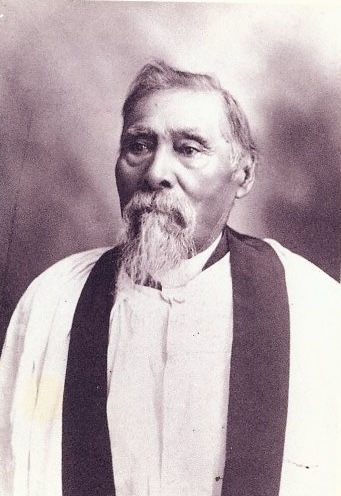
Photo of Rev. James Settee from the The Cathedral Church of St. John Archives.

Bears, Babylon, and Grace: Where God Meets Us in both the Wild and the Civilised

I’m sitting here in one of the fanciest, most high-tech, and newest recreation centres I’ve ever been in. It has a gym, physiotherapy, library, fitness rooms, pool tables, Foosball tables, hockey rink, swimming pool. Outside is a carefully manicured garden. I can look across the street and see a 7-Eleven, some condominiums, and other businesses. But just beyond that I can see the bush. A mountain rises directly in front of me — full of trees; evergreen trees by the look of it. It’s steep-sided, with no sign of any human settlement. And I know that if you go further beyond that mountain there are thousands of kilometres of other mountains just like it. Periodically roads cross it; perhaps a house or a small town; but there is no civilisation of any significance until you get to the north pole (where Santa has his workshop).

How is it possible for civilisation and wilderness be together like this? Inside this fabulously modern recreation centre there’s a sign that reminds us how to live with bears. Because you see, periodically creatures pass back-and-forth across the boundaries from civilisations to wildernesses. Bears come down from the mountain to feed on the salmon that are spawning in the river today — and upon garbage when there are no salmon! And humans brave the wilderness and climb up into the bush to see the wonderful views overlooking this valley.

This reminds me of the church.

This tension between boundaries and coexistence isn’t new—it echoes through history, even in how we’ve built our sacred spaces.

Throughout certain times in church history, churches were built like forts. That’s because there was a perception of the need of protection. From what, I don’t know. Hostile natives?? Enemies?? Natural disasters?? I wasn’t alive back then. I don’t know what the situation was, but I suspect that these threats were more imagined than real. I do know that my Métis forbears who were alive back then served as intermediaries between the Europeans who came to North America and the native peoples who lived here. Many of them served significant roles in the church. But their story — of bridging worlds without erasing them — is one we desperately need today.

But is there a way for such opposites to coexist? I think the perception back way back then was that the world was divided in two. There was the Christian world. There was also the Pagan world. A fairly clear dividing line existed between the two. One of the key marks of that division was civilisation, or rather if people conform to whatever civilisation means. Often it meant wearing clothes of a certain style and design, using technology of a certain kind, living in houses of a certain kind, thinking a certain way, having a “Christian” name, or receiving an education to remove all traces of Indigeneity.

But do we still need forts today? Apart from forts falling out of favour as a military option, perhaps they aren’t valid as a church option either. I am reminded of Theodore Wedel’s The Lifesaving Station, that tells the story of how a crude lifesaving station eventually transitioned into a clubhouse for members and forgot its original purpose — to save the lives of shipwrecked people. I wonder if as churches we need to break down the walls that make us look like forts and build bridges and windows to connect with our communities? Perhaps we need to embody the bridges rather than the walls of our past.

How does the Bible inform us on this?

The Bible speaks of all heavens proclaiming the Lord’s glory and stars communicating the wonders of God. Occasionally, my Facebook feed is filled with posts about the northern lights, and I’ve even taken my own pictures of them. What’s striking about these pictures is the frequent statements of awe and wonder, like “Look at the glory of God’s creation.” Even though from my perspective, I see a mountain covered in wilderness, from God’s perspective, I’m already in this wilderness.

This concept is called prevenient grace. It suggests that God precedes us in our global missions. That’s why it’s crucial to remember that wherever we go, God is already there engaged in his mission. We join him on this mission, not the other way around! We don’t bring God to them; our task as people entering the world is to share our experiences with the God they already know. Since he has already begun revealing himself, we can journey together. One recent example of this prevenient grace I’ve discussed is the redemptive analogies found throughout different cultures.

Bush vs Babylon (Wilderness vs. Empire).

It needs to be said that just because some places are civilized does not mean that God is automatically there. Babylon is the name often given to civilisation — based on Babel, the first place where the gathered peoples of the earth wanted to usurp God’s place. But even Babylon is not without hope. Israel’s captivity into Babylon was also an opportunity. Babylon received a group of people dedicated to its restoration. God says, “You know what? I will take you to the city — the city that is the ultimate example of evil in the world, the city of Babylon — and you will live in that city. You will build houses, plant crops, get married, have children, and your children will get married. You will pray for the blessing of the city and work toward its success, through the context of me as God — not only your God but the God of that city as well.” Thus God even appears among the civilised and his call to his people wasn’t to look back to their glorious past in the Promised Land but to look ahead to where Babylon also became a part of that land!

There are also countless examples from scripture and from history where, because of people’s sin and rebellion, God has said, “I’m here but I’ll let you guys figure things out a little bit and then I’ll come back.” This is the idea behind 2 Chronicles 7:14 — “if my people, who are called by my name, will humble themselves, pray, search for me, and turn from their evil ways, then I will hear ⌞their prayer⌟ from heaven, forgive their sins, and heal their land,” a passage that was not only relevant back in the day but also serves as a blueprint for those wanting to return to God today.

So what does this mean for us?

The bear foraging in a 7-Eleven parking lot, the northern lights over a prairie town, the Métis bridging two worlds — these are glimpses of a God who refuses to be confined by our categories. Civilization and wilderness aren’t opposites to reconcile but layers of a world God permeates. Our task isn’t to build walls or conquer, but to notice where grace has already gone ahead… and join in.

Babylon, like our recreation centers, isn’t inherently godless — it’s where God plants exiles to cultivate hope. Even in steel-and-concrete jungles, the wilderness of human longing for meaning persists, and grace meets us there.

Do you remember back to the time when you were first figuring God out? Did you experience prevenient Grace yourself?

Where do you see God already at work in the ‘wilderness’ of your life — the chaos, the unfamiliar, the seemingly secular? Share your story. Because if a bear can wander into a 7-Eleven and spark awe, imagine what our stories could do.